/
/
Ashneer Grover criticised the UPI charges debate, saying consumers could ultimately bear the cost. Here’s what he said and what the government has clarified.
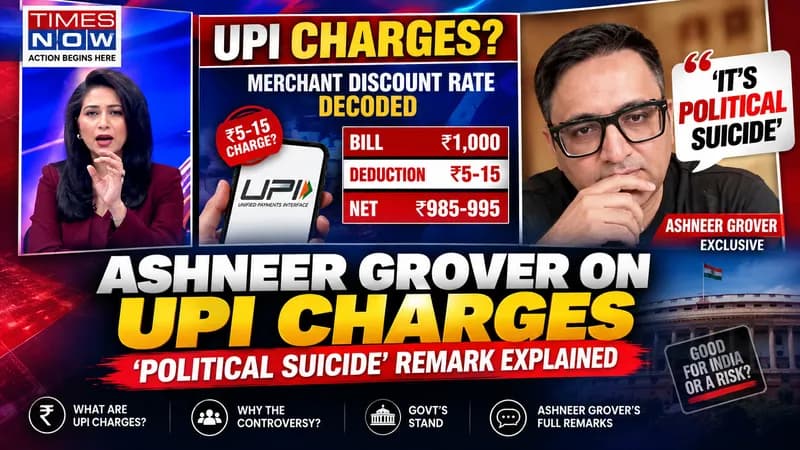
The UPI charge debate has moved beyond speculation, with the latest framework specifying how Merchant Discount Rate (MDR) will apply to certain merchant payments above ₹2,000.
Under the new framework, person-to-person (P2P) UPI transactions will remain completely free, irrespective of the amount transferred. Merchant payments up to ₹2,000 will also remain free, while a 0.4% MDR will apply to specified person-to-merchant (P2M) transactions above ₹2,000.
The government has clarified that MDR is a merchant-side payment ecosystem charge and not a fee that customers will directly pay for using UPI. It has also said banks should ensure that merchants do not pass the MDR cost on to customers.
In an interview with Times Now, Grover challenged the argument that consumers would remain unaffected if merchants were asked to pay a nominal fee on some UPI transactions.
His comments came as the government moved to clarify the rules surrounding UPI charges. A September 14 notification specifically bars banks and system providers from imposing direct or indirect charges on UPI transactions up to ₹2,000, while the government has said any future MDR would apply only to a limited category of merchant transactions.
During the interview, Grover questioned the distinction between a tax and a transaction charge.
Responding to the suggestion that a nominal fee could be imposed on people or businesses that can afford it, he argued that if the government wants to collect money, it should describe the mechanism clearly rather than suggest that consumers will never feel an impact. Grover compared the situation with fuel taxation, arguing that even when a tax or charge is collected from a company or intermediary, the eventual cost can be reflected in the price paid by the consumer. His broader argument was that who formally pays a charge and who ultimately bears its economic cost can be two different questions.
The government's current position is that consumers will not be charged for using UPI. The Finance Ministry has explicitly said that UPI will remain free for citizens and that person-to-person transactions will continue to carry no charges. It has also said that any future MDR would be limited to certain merchant transactions above a threshold and would be nominal.
A September 14 government notification further specified that no bank or system provider can directly or indirectly charge a person making or receiving a payment through UPI transactions of up to ₹2,000. That means Grover's warning about consumers eventually bearing costs is an argument about the potential economic impact, not evidence that consumers are currently being charged forUPI.
MDR, or Merchant Discount Rate, is a fee associated with processing certain digital payments. For years, UPI's zero-MDR model has been an important part of its mass adoption in India. The government has historically supported the ecosystem through incentive mechanisms designed to compensate participating banks and payment companies. The recent legislative changes created an enabling framework for a possible MDR structure, triggering concerns about whether UPI could eventually become less attractive for merchants or consumers.
The government has repeatedly stressed that the amendment itself does not impose a blanket charge on UPI users.
मोदी सरकार को RBI से ₹3 लाख करोड़ डिविडेंड,
— Adv. Vijay Singh (@VijaySingh_law) September 15, 2026
बैंकों का ₹4.11 लाख करोड़ मुनाफा,
NPCI का ₹1,888 करोड़ सरप्लस...
फिर भी जनता से UPI पर चार्ज क्यों?
डिजिटल इंडिया नहीं,
PM का डिजिटल वसूली मॉडल! pic.twitter.com/8jk8rWkYIE
The current rules make an important distinction between transactions up to ₹2,000 and possible charges on certain transactions above that level.
The September 14 notification protects UPI payments up to ₹2,000 from direct or indirect charges. It does not, by itself, establish a universal fee on every transaction above ₹2,000. The government has said that any future MDR would be restricted to a limited set of merchant transactions and that most UPI transactions would remain free. According to reporting based on government data, only about 4% of person-to-merchant UPI transactions in 2025-26 exceeded ₹2,000, although those transactions represented roughly two-thirds of the value of P2M payments.
The new framework specifies a 0.4% Merchant Discount Rate for specified person-to-merchant UPI transactions above ₹2,000. The MDR is shared among participants in the payment ecosystem, including banks, payment service providers and UPI application providers.
For transactions of ₹75,000 and above, the MDR is capped at ₹300 per transaction.
Importantly, the 0.4% rate does not mean that a customer making a UPI payment will automatically see an additional 0.4% deducted from their bank account. The government has specifically stated that MDR is a merchant-side charge and that customers will not pay MDR.
Small merchants have been given protection under the new UPI framework. The government has said that eligible small merchants receiving up to ₹1 lakh per month through UPI QR codes under the specified P2PM category will continue to receive zero-MDR treatment.
This means neighbourhood shops, street vendors and other eligible small businesses will not automatically face MDR simply because they accept UPI payments.
The government has also said that approximately 96% of merchant UPI transactions will remain unaffected because they either fall below the ₹2,000 threshold or come under the zero-MDR framework for small merchants.
The new framework also provides a separate MDR structure for certain essential and thin-margin sectors.
For transactions above ₹2,000 in sectors including railways, telecommunications, insurance, fuel and agricultural inputs, a flat MDR of ₹5 per transaction has been specified.
This is different from the standard 0.4% MDR structure for specified merchant transactions. The government has said the separate rate is intended to provide greater cost certainty for essential services and businesses operating on relatively narrow margins.
Ashneer Grover has continued to criticise the UPI MDR framework after the latest announcement on charges for certain merchant transactions above ₹2,000.
In his latest comments, Grover argued that even if the MDR is formally imposed on merchants rather than customers, businesses may factor the additional payment cost into their pricing. His argument is that the person officially paying a charge and the person ultimately bearing its economic impact can be different.
Grover has also described the levy as similar to tax collection and questioned whether charging for UPI could weaken one of India's biggest digital-payment success stories. These comments represent Grover's assessment of the policy and should be distinguished from the government's position that customers will not be charged MDR directly.
Grover's criticism went beyond the immediate question of transaction fees. He argued that UPI has become one of India's most visible technology success stories and warned against undermining the system through measures that could discourage adoption.
During the interview, he questioned why India would risk making a system that it promotes as a global digital-payment success story more expensive to operate. He also rejected the argument that the government should simply fund all the infrastructure required to maintain and expand UPI.
One of the key points raised during the interview was whether the government should continue funding the infrastructure required to operate, secure and expand UPI. The interviewer pointed to the substantial investment required to maintain digital-payment infrastructure, improve security and adopt new technology.
Grover rejected the suggestion that this justified the proposed approach. He argued that the financial system itself generates substantial economic value and questioned whether additional charges were the appropriate way to finance UPI's continued development.
The precise cost of maintaining India's entire UPI ecosystem depends on what is included in the calculation. The government has previously used incentive schemes to support banks and other participants in maintaining the UPI ecosystem. Official figures show that approximately ₹8,730 crore in incentive support was provided during financial years 2021-22 through 2024-25.
Recent reporting has also highlighted discussions around creating a more sustainable revenue model for payment companies and banks as UPI volumes continue to expand. Reuters reported on September 15 that the payments authority was consulting banks and payment firms about possible fees on larger merchant UPI payments, with discussions reportedly considering a rate around 0.4%. That reported figure should not be confused with a confirmed nationwide consumer fee. The government has not announced a blanket UPI charge for consumers.
The government's position is straightforward: UPI remains free for consumers. The Finance Ministry said in August that users would not face transaction charges and that all P2P transactions would remain free. It also said any future MDR would be applied only to a limited group of merchant transactions above a specified threshold.
The latest notification provides additional clarity by explicitly protecting UPI transactions up to ₹2,000 from direct or indirect charges. The government has also said most merchant transactions would remain free.
At its core, the dispute is not simply about whether consumers will suddenly be charged for sending money through UPI. It is about who should finance the infrastructure behind India's enormous digital-payment network and whether introducing MDR for selected merchant transactions could eventually affect pricing, merchant behaviour or consumer adoption.
Grover's position is that the economic burden can ultimately reach consumers even when a charge is technically imposed on a merchant or another participant. The government's position is that consumers will remain protected and that any future merchant MDR would be limited and nominal. Those are different arguments, and they should not be presented as if they describe the same policy outcome.
The new MDR framework does not mean that every UPI payment above ₹2,000 will result in an additional amount being deducted from the customer's bank account.
For example, if a customer makes a ₹2,500 UPI payment to an eligible merchant, the applicable MDR is a merchant-side charge under the framework. The customer is not supposed to be separately charged 0.4% by the UPI app.
Similarly, for a ₹5,000 or ₹10,000 merchant payment, the 0.4% MDR applies to specified eligible P2M transactions, while the customer-facing UPI payment itself remains free under the government's stated framework.
Person-to-person payments remain free even when the amount is above ₹2,000.
Grover's remarks have attracted attention because of his blunt criticism of the government's approach and his warning that charging for a technology India frequently presents as a global success could undermine its broader appeal. His “political suicide” remark is therefore best understood as his assessment of the policy, rather than an official description of the government's plans.
For now, the clearest confirmed position is that UPI users will not be charged for transactions up to ₹2,000, P2P UPI payments remain free, and any future MDR would be limited to specified merchant transactions rather than imposed universally.
The new UPI MDR framework has triggered a strong discussion on social media, with users focusing on whether merchant-side charges could eventually affect prices.
Some social-media reactions have questioned whether merchants may try to recover the additional payment-processing cost through higher prices or other charges. Others have used memes and humour to express concerns about the return of cash payments or the possible impact on everyday digital transactions.
At the same time, the government's clarification has emphasised that consumers will not be charged MDR directly and that P2P payments will remain free. The difference between these two perspectives — the possible economic impact of merchant costs and the government's consumer-protection position — is at the centre of the ongoing debate.
The government and Ashneer Grover are approaching the UPI MDR issue from different perspectives.
The government's position is that MDR is a merchant-side payment ecosystem charge, not a tax or a direct fee on consumers. It says P2P transactions will remain free, payments up to ₹2,000 to merchants will remain free, eligible small merchants will continue under zero-MDR provisions, and customers should not be asked to pay the MDR.
Grover, meanwhile, has focused on the possible economic impact of merchant charges. His argument is that even when a fee is formally imposed on a business, the cost can potentially be reflected in prices paid by consumers.
Therefore, the two positions address different parts of the issue: the government is describing who is legally charged under the framework, while Grover is questioning who could ultimately bear the economic cost.
The government has clarified that Merchant Discount Rate is not a tax collected by the government or NPCI.
According to the Finance Ministry, MDR is a charge within the payment ecosystem and is distributed among participating banks, payment service providers and UPI application providers. The stated purpose is to support the operation, technological development and expansion of the UPI ecosystem.
Ashneer Grover has used the term “tax collection” while criticising the policy, but that is his description of the economic effect of the levy, not the government's official classification of MDR.
The government says the new MDR framework is intended to create a more sustainable revenue model for the UPI ecosystem as transaction volumes continue to grow.
According to the Finance Ministry, revenue generated from larger merchant transactions will support banks, payment service providers and UPI application providers in maintaining and expanding payment infrastructure, including in rural and semi-urban areas.
The government has also said that 5% of total MDR collections will be contributed to a dedicated fund aimed at promoting UPI adoption among small merchants.