Bank of India Classifies ₹575.40 Crore Future Enterprises Loan As Fraud: What It Means For Investors
Bank of India has classified its ₹575.40 crore Future Enterprises loan as fraud and reported it to the RBI. The exposure is fully provisioned. Here is what it means for investors.


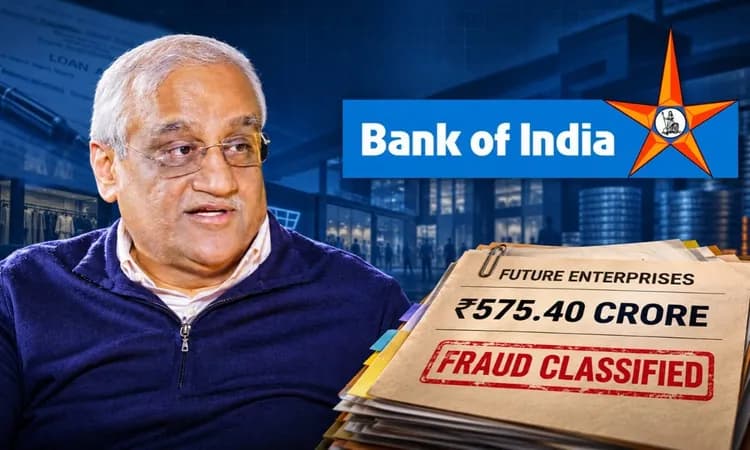
Bank of India (BoI) has classified its ₹575.40 crore loan account linked to Kishore Biyani-promoted Future Enterprises Ltd (FEL) as fraud. The key point for investors is that the public sector lender has already set aside provisions for the entire outstanding amount.
In an exchange filing dated October 12, the bank said the account was already a non-performing asset (NPA) and that the fraud classification was reported to the Reserve Bank of India (RBI) on the same day, in line with regulatory requirements.
What Did Bank of India Disclose In Its Filing?
The disclosure, made under SEBI’s listing regulations and the bank’s policy on material events, lists a single account. Future Enterprises Ltd shows an outstanding amount of ₹575.40 crore, with a provision of the same amount held against it.
BoI did not share details of the transactions behind the classification, the findings of any investigation, or the next steps for recovery. The filing tells readers how the bank now categorises the account, but not why.
Is This A Fresh ₹575 Crore Loss For Bank of India?
No. The outstanding figure should not be read as a new charge arising from this announcement. Because BoI has already provided for the full disclosed exposure, the fraud tag does not, on the face of the filing, add a further hit to its earnings.
Provisions are amounts a bank sets aside against possible loan losses. Full provisioning means the books already cover the disclosed outstanding amount. It does not mean the money has been recovered, and any future recovery would depend on the outcome of the insolvency process.
What Does Classified As Fraud Mean Under RBI Rules?
When a bank classifies a loan account as fraud, it must report it to the RBI. The tag is a regulatory classification by the lender. It is not a court verdict, and it does not by itself establish criminal liability for any individual. Under RBI’s framework, borrowers are expected to be given an opportunity to respond before such a classification is finalised, though the filing does not describe that process for this account.
Why Is Future Enterprises Under Insolvency?
Future Enterprises has been undergoing the Corporate Insolvency Resolution Process (CIRP) under the National Company Law Tribunal since FY23, according to reports on the filing. Unlike Future Retail, which ran the group’s stores, FEL was set up to hold physical assets, manufacturing infrastructure and investments.
Its total admitted financial claims are reported at more than ₹13,540 crore, including roughly ₹6,952 crore owed to 22 secured lenders. Reports also indicate that Central Bank of India acquired FEL’s remaining stakes in its insurance joint ventures for ₹508 crore, which forms part of the recovery pool for lenders. How much BoI ultimately receives has not been disclosed.
What Happened To Future Group?
Future Group built a large retail footprint through formats such as Big Bazaar, Central and Brand Factory. Rising debt, pandemic disruption and legal disputes hurt its finances. In August 2020, it announced a planned sale of retail, logistics and warehousing businesses to Reliance Retail for ₹24,713 crore, a deal that became entangled in a dispute with Amazon over contractual restrictions linked to its investment in Future Coupons.
The group’s troubles have since led to insolvency proceedings across entities, and the NCLT’s Mumbai bench has ordered the liquidation of Future Retail after resolution efforts failed.
How Did Bank of India Shares React?
At 10:50 am on October 14, BoI shares were trading at ₹133.75 on the BSE, down ₹0.75 or 0.56% from the previous close of ₹134.50. The stock opened at ₹134.25 and ranged between ₹133.20 and ₹134.75 in morning trade. Its 52-week high and low are ₹178.45 and ₹122.20.
The decline is small, and the price action alone is not evidence that the fraud disclosure caused it.
What Should Bank of India Investors Watch Next?
The immediate questions are whether further details emerge on the basis for the fraud classification and how much the bank can recover through the insolvency and asset-sale process. The filing confirms full provisioning but gives no timeline or estimate for recovering the dues.