/
/
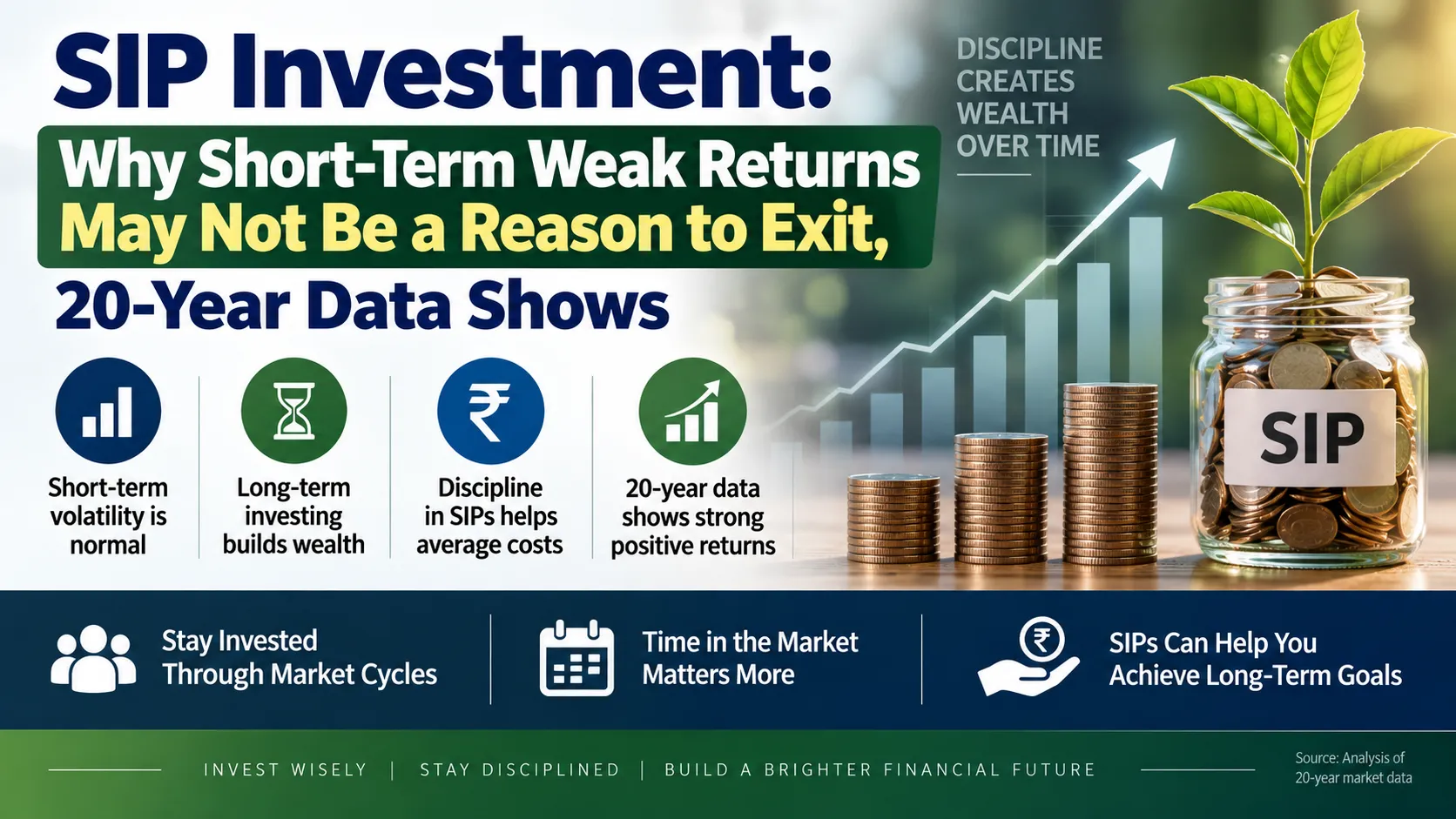
SIP Investment: Investors worried about weak returns from their mutual fund Systematic Investment Plans (SIPs) may have reason to stay invested rather than exit because of short-term underperformance.

SIP Investment: Investors worried about weak returns from their mutual fund Systematic Investment Plans (SIPs) may have reason to stay invested rather than exit because of short-term underperformance.
A report by Share.Market by PhonePe analysing two decades of SIP data suggests that poor performance during the initial years does not necessarily determine the eventual outcome of a long-term SIP investment.
According to the analysis, covering data through June 2026, around 7 out of 10 five-year SIP periods generated double-digit annualised returns, even when markets delivered weak or negative returns during the first two years.
The findings suggest that short-term volatility can look very different when viewed over a longer investment horizon.
The report analysed SIP performance over the 20 years ending June 2026.
According to the analysis, two-year annualised SIP returns in the Nifty 500 TRI fell below 5% in more than 25% of the observations.
However, when investors continued their SIPs for a full five years after experiencing weak performance during the first two years, the probability of ending with a capital loss fell sharply.
Among periods where the first two years delivered negative returns, approximately 69% eventually produced double-digit annualised returns over five years.
This highlights the potential benefit of remaining invested through market cycles rather than making decisions based solely on the early performance of an SIP.
One of the key advantages of SIP investing is rupee-cost averaging.
Under an SIP, investors put a predetermined amount into a mutual fund at regular intervals. When markets fall, the same investment amount buys more units. When markets rise, it buys fewer units.
This can help average the purchase cost over time.
The PhonePe analysis suggests that extending the investment period after a weak start allowed this mechanism to work across different market cycles.
In periods where the first two years began with negative returns, continuing the SIP for another three years significantly improved the eventual outcome.
The data also provides an interesting picture of periods that started particularly poorly.
Among the periods where the first two years began with negative returns, around 53% eventually delivered annualised returns between 15% and 20% over the five-year period, according to the report.
More importantly, the analysis found that when investors continued their SIP through the fifth year after an initially negative phase, the five-year annualised return did not remain negative in the historical periods examined.
This does not mean that every mutual fund or every future SIP will produce similar results. Historical market behaviour cannot guarantee future returns.
The report also examined SIP periods where investors initially received modest returns of between 0% and 5%.
According to the analysis, investors who continued their SIP for five years in such periods subsequently recorded annualised returns above 5% in all the historical observations examined.
Around 72% of those periods generated double-digit annualised returns.
The findings again point to the importance of investment duration when evaluating SIP performance.
The historical analysis indicates that the risk of ending with a capital loss fell substantially as the SIP investment horizon increased.
According to the report, investors who stayed invested for seven or 10 years did not experience a capital loss in the historical periods analysed.
The 10-year data was particularly notable. SIPs generated double-digit annualised returns in approximately 90% of the observations.
Around 65% of 10-year SIP periods produced annualised returns in the 10%–15% range. When the 15%–20% return range, which accounted for about 26% of observations, was added, roughly 90% of 10-year SIP periods had generated annualised returns of at least 10%.
The data offers an important lesson for investors: the first one or two years of an SIP may not provide a reliable indication of its eventual long-term outcome. Equity markets move through different cycles, and short-term returns can be affected by economic conditions, interest rates, corporate earnings, geopolitical developments and investor sentiment. An SIP is designed to spread investments over time rather than depend on a single entry point. That makes the investment horizon an important factor when assessing performance.
Nilesh D. Naik, Head of Mutual Funds at PhonePe, said that investors often become concerned about short-term SIP underperformance as market cycles change.
According to Naik, the company's two-decade study of SIP performance reinforces the idea that the initial years of an SIP do not necessarily determine its eventual outcome.
The findings therefore provide historical context for investors who may be tempted to stop their SIPs solely because of a period of weak market performance.
A weak initial return by itself may not be a sufficient reason to discontinue a long-term SIP.
However, investors should not interpret historical data as a guarantee that continuing an SIP will always result in positive or double-digit returns.
The suitability of an SIP depends on factors such as the investor's financial goals, risk tolerance, investment horizon, fund selection and overall asset allocation.
Investors should also periodically review whether the mutual fund remains appropriate for their objectives rather than reacting emotionally to short-term market movements.
The broader message from the 20-year analysis is that time in the market can matter significantly for SIP outcomes. Historically, extending the investment horizon after a weak beginning substantially improved the probability of positive and double-digit annualised returns.