UPI Payment Charges: Big Transactions May Face MDR as Government Reviews UPI Funding
UPI MDR charges may be introduced for certain large transactions or merchants as the government reviews ways to make UPI financially sustainable. Know what it means for users.


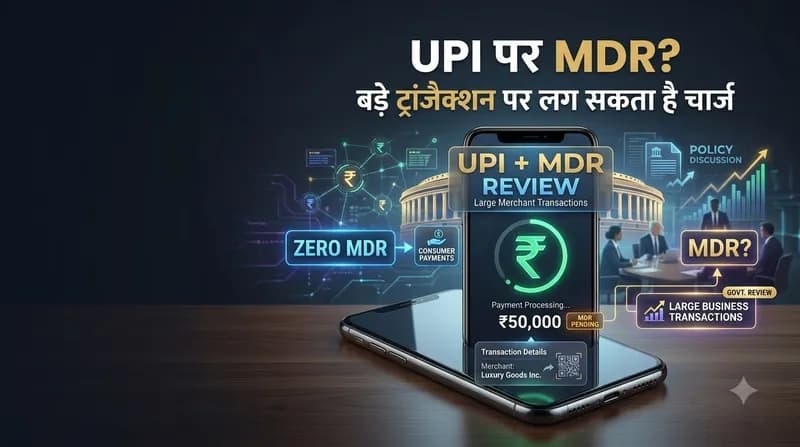
UPI Payment News: Unified Payments Interface (UPI) users and merchants could see changes to the current payment-cost structure as the government examines ways to make the country's digital payments ecosystem financially sustainable.
According to information shared by the Department of Financial Services (DFS) with the Parliamentary Standing Committee on Finance, the government is considering two broad approaches. One option is to introduce Merchant Discount Rate (MDR) on certain large UPI transactions or categories of merchants. The other is to move towards a tiered incentive system that would gradually reduce the government's financial support for UPI.
Importantly, the information does not indicate a proposal to charge ordinary consumers for routine UPI payments. The discussion is focused on the financial sustainability of the UPI ecosystem and the cost of processing transactions.
What Is UPI MDR?
MDR, or Merchant Discount Rate, is a fee associated with accepting digital payments. It is generally charged to merchants and is distributed among participants involved in processing the payment.
Under the proposal being considered, the government could potentially apply MDR to selected large-value UPI transactions or specific merchant categories, rather than introducing a blanket charge on every UPI payment.
No final decision or implementation date has been announced based on the information currently available.
Why Is the Government Considering UPI Charges?
The issue is linked to the cost of maintaining and expanding India's rapidly growing digital payments infrastructure.
The government has kept UPI transactions free for users and has supported the ecosystem through incentives intended to compensate participants for the absence of MDR on eligible transactions.
The Department of Financial Services has reportedly presented two possible ways to address the long-term funding challenge: selective MDR and a gradual, tier-based reduction in government incentives.
The aim is to make the UPI ecosystem more financially sustainable without undermining the widespread adoption of digital payments.
Will Normal UPI Payments Become Chargeable?
For regular consumers, there is no indication in the information provided that a general UPI payment fee is being introduced.
The discussion is specifically around whether certain large transactions or merchant categories should carry MDR.
Therefore, consumers should not interpret the proposal as an immediate decision to charge a fee on every UPI payment.
Any change would depend on the government's final policy decision and the scope of any new MDR framework.
Government Faces a Growing UPI Funding Challenge
The financial pressure behind the discussion is significant.
According to the parliamentary committee information cited in the report, the government has allocated around ₹2,000 crore to promote UPI transactions and compensate for the impact of zero MDR.
At the same time, the industry's estimated operational cost is around ₹20,700 crore.
That creates a substantial gap between the government's current support and the estimated cost of running the broader UPI ecosystem.
The committee has raised concerns that a persistent funding gap could eventually affect investment in areas such as payment infrastructure, security and the capacity required to support the country's growing digital transaction volumes.
UPI Was Not Always a Zero-MDR System
The current zero-MDR model was not always in place.
Merchant transactions through UPI previously had an MDR structure. The government subsequently moved to a zero-MDR framework from January 2020, with the objective of encouraging digital payments and reducing barriers for merchants and consumers.
The policy helped establish UPI as a low-cost payment method and supported India's transition towards digital transactions.
The government is now examining whether the same model can remain financially sustainable as transaction volumes and infrastructure requirements continue to grow.
What Could Change for Merchants?
If selective MDR is eventually introduced, the impact would primarily depend on which transactions and merchant categories are covered and what rate is set.
Large merchants or high-value transactions could potentially face a payment-processing cost where none currently exists.
However, the government has not announced a final MDR rate or a definitive list of transactions that would be subject to the proposed charge.
Merchants should therefore wait for an official policy notification before assuming that a particular UPI payment category will become chargeable.
What Is the Tiered Incentive Model?
The second option under consideration involves changing how government incentives are provided to the UPI ecosystem.
Instead of continuing the existing support structure indefinitely, the government could introduce different incentive levels based on transaction categories or other criteria, with support gradually declining over the coming years.
The objective would be to move UPI towards a model that relies less heavily on direct government financial support while keeping digital payments accessible.
Is UPI Becoming Paid?
Not at this stage.
The government is considering options, rather than announcing a blanket UPI fee.
The key distinction is between a possible MDR on selected transactions or merchants and a charge imposed on ordinary consumers every time they use UPI.
Based on the information available, the current discussion concerns the former, while there is no stated proposal for a universal consumer charge.
What Should UPI Users Know Now?
For everyday users, there is no need to change their payment habits based solely on this proposal.
UPI remains a widely used digital payment system, and any change to its pricing structure would require a formal policy decision and implementation framework.
The important development is that the government is examining how to balance free or low-cost digital payments with the rising cost of maintaining a secure and scalable payment infrastructure.
Key Takeaway
The government is considering selective MDR on certain large UPI transactions or merchants as one possible way to strengthen the financial sustainability of India's digital payments ecosystem.
A second option is a tiered incentive structure that would gradually reduce government support.
However, there is currently no announcement of a blanket charge on ordinary UPI payments, and no final MDR rate or implementation date has been specified.
Consumers and merchants should therefore distinguish between a policy proposal under consideration and an implemented UPI charge.
Will UPI payments become chargeable for ordinary users?
There is currently no indication of a blanket fee on ordinary consumer UPI payments. The proposal under consideration focuses on selected large transactions or merchant categories.
What is UPI MDR?
MDR stands for Merchant Discount Rate. It is a fee associated with accepting digital payments and is generally linked to the merchant side of a transaction.
Is the government bringing MDR back on all UPI transactions?
No such blanket decision has been announced. The government is considering whether MDR could apply to certain large transactions or merchant categories.
Why is the government considering UPI MDR?
The government is examining ways to address the gap between the cost of operating and maintaining the UPI ecosystem and the financial support currently provided to compensate for zero MDR.
How much does the government currently support UPI?
The information cited in the parliamentary committee discussion puts the government's budgetary support at around ₹2,000 crore, compared with estimated industry operational costs of approximately ₹20,700 crore.
When could UPI MDR charges start?
No specific implementation date has been announced in the information available. The government is still considering the possible models.
Will small UPI payments be affected?
The proposal described by the Department of Financial Services concerns certain large transactions or merchant categories. It does not state that all small consumer UPI payments would become chargeable.