

/
/
Meta signs a multi-billion dollar deal to rent Google AI chips for advanced AI models, intensifying the global race for computing power and infrastructure.
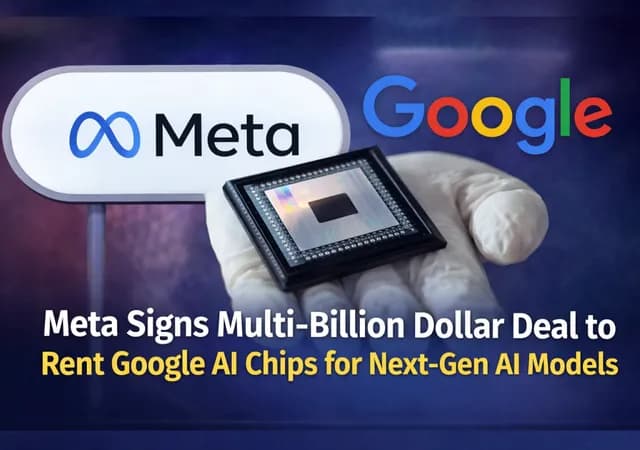
In a move that clearly signals how serious the AI race has become, Meta Google AI chips deal is now one of the biggest tech stories of the year. According to a report by Reuters on February 27, 2026, Meta Platforms has signed a multi-billion dollar agreement with Google to rent artificial intelligence chips for developing new AI models.
The report, originally cited by The Information, describes the agreement as a multi-year deal focused on boosting Meta’s AI infrastructure. While neither company officially confirmed the agreement to Reuters, the scale and timing of this partnership say a lot about where the tech industry is heading.
And honestly? This isn’t just another corporate transaction. This is a power move.
The Meta Google AI chips deal comes at a time when tech giants invest billions in AI hardware. AI models are no longer mini experiments but they are huge systems that require enormous amounts of computing power.
Google’s chips, also referred to as Tensor Processing Units (TPUs), were developed to handle machine learning workloads. They are Google’s in-house alternative to Nvidia’s dominant GPUs. Over the past year, Google has been actively marketing TPUs as a competitor in the AI hardware industry.
For Meta, renting these chips means faster AI model development without building everything from scratch. It also reduces reliance on just one supplier, something that has become strategically critical.
The Meta Google AI chips deal is not happening in isolation. In fact, Meta has been on a full-blown AI infrastructure shopping spree.
Here’s what we know:
This is not cautious investment. This is aggressive expansion.
Meta is clearly trying to ensure it never falls behind in the AI arms race again, especially after watching competitors move quickly in generative AI.
The Meta Google AI chips deal could also be a turning point for Google.
For years, Nvidia has dominated the AI chip market. But Google has quietly been building and improving its Tensor Processing Units. TPU sales have reportedly become a key growth engine for Google Cloud revenue, especially as investors demand proof that Google’s AI spending is generating real returns.
The report also mentions that Google has partnered with a large investment firm to fund a joint venture that would lease TPUs to other customers. That’s a big shift. Google isn’t just using its chips internally anymore, it’s monetizing them at scale.
If Meta becomes a long-term TPU customer, it could validate Google’s strategy in a powerful way.
The Meta Google AI chips deal highlights a larger truth: the AI battle is no longer just about smarter algorithms. It’s about infrastructure.
Innovation is now based on high performance chips. In their absence, even the most advanced AI ideas remain stuck in paper.
Meta and Google compete fiercely in advertising, social platforms and AI services, yet here they are, partnering on hardware. That tells you how serious the computing crunch has become.
This is Silicon Valley’s new reality. Rivals in one arena, partners in another.
The Meta Google AI chips deal is more than just another tech headline. It’s a clear signal that AI infrastructure has become the most valuable strategic asset in the industry.
Meta is diversifying aggressively. Google is commercializing its hardware muscle. AMD and Nvidia are cashing in. Everyone is racing.
And if this pace continues, 2026 could be remembered as the year the AI infrastructure war truly exploded.
For readers and investors alike, one thing is certain, the real AI competition is happening behind the scenes, inside data centers powered by billions of dollars’ worth of silicon.










