

/
/
Google AI Edge Gallery brings on-device function calling to iOS and Android, enabling fast, offline AI actions using the 270M FunctionGemma model.
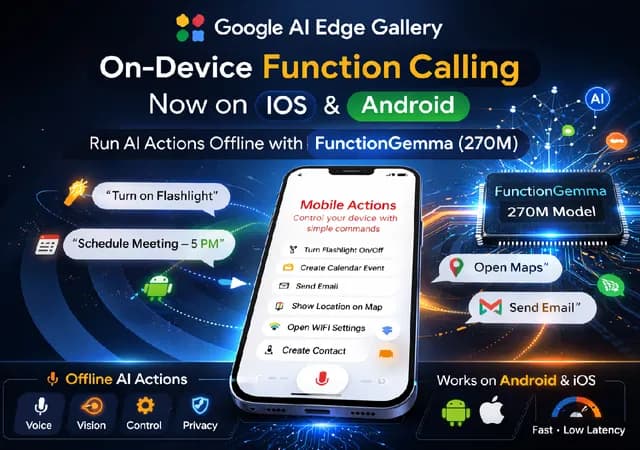
Google just made a move that could quietly change how mobile AI works forever. With the expansion of On-Device Function Calling inside the Google AI Edge Gallery app, developers can now build AI tools that don’t just “talk”, they act. And they do it offline.
This isn’t another cloud-based AI demo. This is AI that runs directly on your phone.
And honestly? That’s where the real future of AI belongs.
For years, AI assistants have mostly responded with text. Ask something, get an answer. That’s it.
But On-Device Function Calling flips that script. Instead of just describing an action, the model predicts and executes a function, like:
All without sending data to the cloud.
Google’s new FunctionGemma model powers this shift. At just 270 million parameters, it’s shockingly compact. Traditionally, function-calling models required massive memory and drained battery life. Compressing that capability into a mobile-friendly footprint is a serious engineering achievement.
Let’s be clear, this is not just optimization. This is miniaturization without compromise.
The Google AI Edge Gallery app, previously Android-focused, is now available on iOS. That means Apple hardware can now run the same high-performance demos powered by Google’s on-device stack.
Inside the app, developers can explore:
And yes, it’s all happening offline.
In my opinion, this is a smart strategic move. Cross-platform AI that respects device-level privacy? That’s how you win long-term developer trust.
The standout demo inside Google AI Edge Gallery is Mobile Actions, and this is where things get genuinely impressive.
Instead of acting like a chatbot that simply responds with text, this system understands a command and directly maps it to an actual device function.
For example, you can say:“Show me the nearest airport on the map.”
The model identifies the correct Maps intent and opens the location instantly.
Or try: “Schedule a meeting with Riya at 5 PM this Friday.”
Instead of drafting a message about how to do it, the system triggers the calendar app and prepares the event.
You say: “Turn on the flashlight.”
It turns on the flashlight.
You can even say: “Open Bluetooth settings.”
And it navigates straight to the appropriate system panel.
That’s the difference On-Device Function Calling makes. No latency spikes. No server pings. No dependency on internet strength.
For developers building voice assistants, in-car navigation tools, or productivity apps, this is huge. It proves that AI on mobile can move beyond conversation and become an action engine.
Then there’s Tiny Garden, an interactive mini-game demo.
Say: “Plant carrots in the first row and water them twice.”
Instead of generating a playful reply, the model breaks the instruction into specific internal functions, like selecting grid coordinates, triggering a plantCrop action, and then executing a waterCrop function multiple times.
Everything runs locally on the device.
No cloud request. No background server processing. Just a compact 270M FunctionGemma model understanding context and mapping natural language to actual app logic.
That’s what makes Tiny Garden more than just a demo. It proves that On-Device Function Calling can handle structured, rule-based environments with precision. If a lightweight mobile model can manage custom game mechanics offline, it can just as easily adapt to enterprise workflows, smart home controls, industrial dashboards, or advanced productivity tools.
This isn’t about gardening.
It’s about showing that true “agentic AI”, AI that understands, decides, and acts, can live directly inside your phone.
Google didn’t just ship demos, they added benchmarking inside the app.
On a Pixel 7 Pro, Mobile Actions reportedly runs at:
That’s fast. Really fast for on-device CPU execution.
Developers can now test models directly inside the Gallery app:
This kind of transparency matters. If you claim performance, let people test it. Google did.
Cloud AI isn’t going away. But dependency on it will.
Privacy regulations are tightening globally. Latency is a real-world issue. And users don’t want every command routed through a server.
On-Device Function Calling solves all three problems:
This isn’t flashy consumer news, but it’s foundational infrastructure news. And infrastructure changes reshape entire ecosystems.
Google AI Edge Gallery now positions itself as a serious developer playground for offline AI agents.
With FunctionGemma, LiteRT integration, and cross-platform availability, Google is signaling something clear:
The future assistant won’t just answer. It will act locally.
And if this model evolution continues, we may soon stop thinking about “AI chat” entirely.
We’ll just think of it as software that understands and executes.
That shift has officially begun.










