/
/
KPMG AI usage dashboard tracks employees’ AI activity with a 75% target, but concerns grow over accuracy, pressure, and real productivity impact
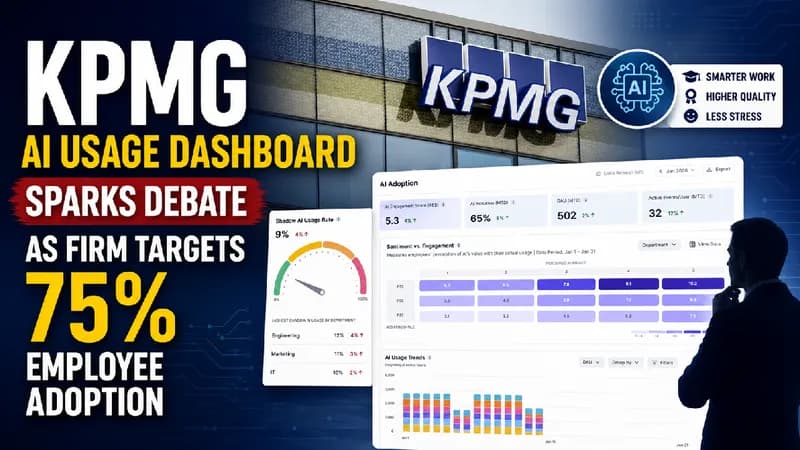
The KPMG AI usage dashboard is making headlines, and not just for innovation. The consulting giant has rolled out a system that tracks how often employees use artificial intelligence tools, setting a clear expectation: hit a 75% usage target.
On paper, it sounds like the future of work. In reality, it’s raising some uncomfortable questions.
According to reports from Business Insider, the dashboard is currently being used across KPMG’s US advisory division, covering around 10,000 employees. It allows workers to track their own AI usage, compare it with teammates, and measure progress against company-set goals.
And yes, this isn’t optional culture anymore, it’s performance.
KPMG’s system is designed to turn AI usage into something measurable and visible. It tracks how often employees use AI tools during their workday and compares it against targets and peer performance.
Here’s what we know so far:
KPMG says the goal is simple, encourage “frequent and sophisticated” use of AI.
And honestly, that part makes sense. AI isn’t going anywhere. Companies that ignore it will fall behind. But here’s where things get tricky.
KPMG isn’t just tracking usage for fun. The firm claims that employees who regularly use AI tend to produce higher-quality work, feel less stressed in their day-to-day tasks, and are able to focus more on strategic and meaningful work rather than routine activities.
A company spokesperson told Business Insider that these benefits can even help employees grow faster in their careers.
That’s a strong claim, and if true, it’s a big deal. But using AI more doesn’t automatically mean working smarter. It depends how you use it.
This is where the story takes a turn.
Some employees reportedly feel the dashboard doesn’t reflect real productivity. In fact, a few have pointed out that the system can be easily manipulated.
One employee said something that perfectly sums up the concern: “You can just run a prompt, and that counts as AI usage for the day.”
That’s the loophole.
If simply opening an AI tool counts as “usage,” then the metric starts losing meaning. Worse, it may push employees to focus on hitting numbers instead of actually improving their work.
There are also gaps in tracking. Certain developer tools and advanced AI platforms reportedly aren’t even included in the system. So ironically, more meaningful AI work might go unnoticed.
KPMG isn’t alone here. This is part of a bigger shift.
Companies like JPMorgan Chase, The Walt Disney Company and Amazon are also tracking how employees use AI.
Why? Because businesses are under pressure to prove that AI investments actually deliver results.
And tracking usage is the easiest way to show numbers, even if those numbers don’t tell the full story.
Let’s call it what it is, this feels like the gamification of work.
On one hand, KPMG is right to push AI adoption. The workplace is changing fast, and employees need to keep up. Ignoring AI is not an option anymore. But turning AI usage into a KPI? That’s risky.
Because when metrics become the goal, people stop focusing on meaningful outcomes. They start playing the system.
Instead of asking, “Did AI improve my work?” employees might start asking, “Did I hit my 75% today?”
And that’s not progress, that’s pressure. AI should be a tool that empowers people, not a number they’re forced to chase. KPMG’s idea is bold, but whether it actually improves work or just adds pressure… that’s a story still unfolding.
It’s a tool that tracks how often employees use AI in their daily work and compares it with targets and team performance.
From KPMG’s side, the idea is pretty clear, they want people to actually use AI more, and use it properly. The belief is that if employees get comfortable with AI, their work will improve and things will move faster.
It means employees are expected to use AI tools on about 75% of their working days.
Not really. Some feel it adds pressure and doesn’t truly show how useful their work is, since it can be easily gamed.
Not at all. Big names like JPMorgan Chase, The Walt Disney Company, and Amazon are also tracking how employees use AI. It’s becoming a wider trend across industries.