/
/
India will introduce caller name display from November 1, 2026, on 4G and 5G networks. Here is how CNAP works and what mobile users need to know.
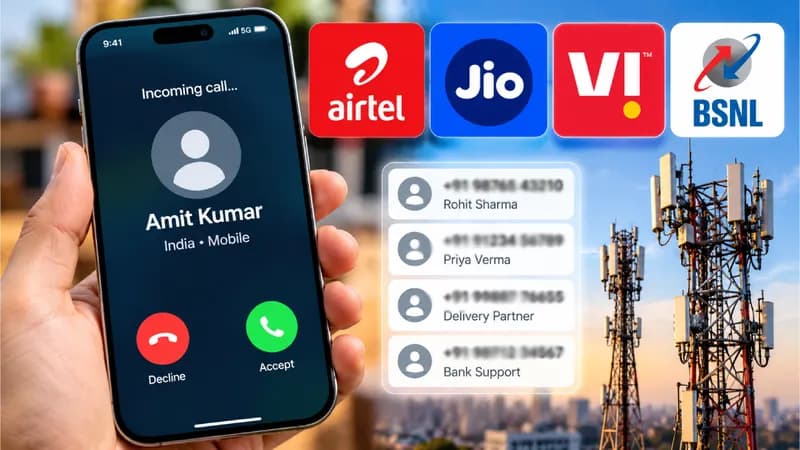
India's days of receiving calls from unfamiliar numbers without any caller name could soon become less common. Starting November 1, 2026, telecom operators will introduce a government-directed caller identification system designed to display callers' names alongside their phone numbers on supported mobile networks.
The Department of Telecommunications (DoT) has directed telecom service providers to implement Calling Name Presentation (CNAP) across their service areas. The instruction, issued through a circular dated October 13, aims to make caller identification more accessible and help people make better-informed decisions before answering incoming calls.
The service will be enabled by default on 4G and newer-generation mobile networks, including 5G. Users will not need to submit a separate request to activate it.
The change will affect subscribers using networks operated by Bharti Airtel, Reliance Jio, Vodafone Idea (Vi) and Bharat Sanchar Nigam Limited (BSNL), subject to the applicable network rollout.
But there is an important distinction: seeing a caller's registered name does not automatically mean that a call is genuine or safe. While the new system could make identifying unknown callers easier, it should not be treated as a complete solution to spam calls and financial fraud.
BIG BREAKING 🚨 Govt directs telecom operators to mandatorily display callers’ registered names on incoming calls from Nov 1.
— News Algebra (@NewsAlgebraIND) October 15, 2026
Under the new directive, incoming calls on supported networks will display the caller's phone number and a name, with the name shown according to the applicable identification rules.
Until now, people have generally relied on their saved contacts or third-party caller identification applications to identify unfamiliar numbers. CNAP introduces a telecom operator-based system that retrieves the caller's name from subscriber records.
Here is what mobile users can expect:
The system is intended to make caller identification a built-in telecom feature rather than something users must obtain through a separate application.
However, the initial rollout is focused on 4G and newer wireless networks. The government will examine the introduction of CNAP on 2G and 3G networks and public switched telephone networks, including landlines, separately.
The new system will rely on subscriber information maintained by telecom operators.
Every operator must establish and maintain a database linking subscribers' names to their telephone numbers. When a call arrives, the receiving operator will retrieve the relevant caller name from the originating operator's records and display it on the recipient's phone.
The process is designed to happen during the incoming call without requiring the recipient to search for the number manually.
For example, imagine receiving a call from an unfamiliar Indian mobile number.
If the number is not saved in your contacts, your phone can display the name recorded in the caller's telecom subscriber records. If the call originates internationally, the screen will show "International Call" instead.
This approach differs from caller identification services that may use community-generated information, user reports or independently collected databases.
CNAP relies on the name recorded by the originating telecom operator. That makes the accuracy of subscriber records particularly important.
If a person's registered details are outdated or incorrect, the name displayed may not accurately reflect how the recipient knows that person.
CNAP could offer an alternative to third-party caller identification apps such as Truecaller because it is designed to work through telecom operators' systems.
Users will not need to depend exclusively on an installed application to see a name associated with an unfamiliar domestic number.
However, this does not mean that CNAP will completely replace third-party caller identification services.
The two approaches can rely on different sources of information and offer different features. CNAP displays the name recorded in the telecom operator's subscriber database, whereas third-party applications may provide additional information, such as user-reported spam warnings or business identification.
The government-mandated service also has a defined initial network scope and specific privacy exceptions.
For users, the practical benefit is straightforward: supported phones should be able to display the registered name associated with an unsaved domestic number without requiring a separate caller identification app.
The important question will be how accurately the displayed names match callers and how effectively the system helps people recognise suspicious calls.
One of the biggest expectations surrounding CNAP is that it could help people identify unfamiliar callers more easily.
Spam calls and impersonation scams often depend on catching people off guard. A caller may pretend to represent a bank, financial institution, government department or delivery service to persuade someone to reveal sensitive information or transfer money.
Displaying a registered name could provide recipients with another piece of information to consider before answering or responding to a request.
It may also help users recognise certain legitimate callers whose numbers they have not saved.
However, CNAP cannot guarantee that a call is genuine simply because a name appears on the screen.
A displayed name identifies information associated with a subscriber record; it is not, by itself, proof that the caller represents the organisation or person they claim to represent.
The system should therefore be viewed as an additional identification measure, not a replacement for telecom anti-spam measures, fraud detection or basic precautions.
Users should continue to avoid sharing one-time passwords (OTPs), banking credentials, PINs and other sensitive information with unknown callers. They should also independently verify claims involving money, account restrictions or urgent payments.
Displaying subscriber names raises an important question: how will telecom operators handle this information?
The DoT directive requires operators to follow a security-by-design approach while implementing CNAP.
Under the prescribed mechanism, the caller's name retrieved through the query-and-response process must not be retained after the incoming call ends.
Operators must also ensure that their databases, networks and connectivity infrastructure can handle name lookups efficiently without compromising the quality of telecommunications services.
The directive includes an exception for subscribers who have activated Calling Line Identification Restriction (CLIR). Their caller names must not be displayed through CNAP.
These safeguards are intended to limit the retention of retrieved caller-name information and preserve the existing caller identification restriction facility.
Nevertheless, the system's effectiveness will depend on how operators implement the requirements, secure their databases and handle complaints.
Yes, eligible business and bulk mobile connections may be offered the option to display a verified preferred name instead of the name recorded in the operator's subscriber database.
However, businesses will not be free to choose any name they want.
Under the directive, the preferred name must meet specific verification requirements. It must be either:
Telecom operators must verify the proposed name and supporting documents before allowing it to be displayed.
For new connections, the approved preferred name must be recorded in the customer application form and subscriber data records, with the required supporting documentation.
Existing business subscribers who want to update their displayed names will need to apply through the process established by their telecom operator.
These requirements are intended to prevent businesses from displaying arbitrary or misleading names through the service.
The initial CNAP rollout does not automatically extend to every telephone connection in India.
The DoT directive focuses on wireless terrestrial networks using 4G and newer-generation technologies. The introduction of the service on 2G and 3G networks, as well as public switched telephone networks, will be considered separately.
This distinction matters because not every subscriber uses the same network technology.
While many smartphone users have access to 4G or 5G, the experience of customers on older networks or landline connections may differ during the initial implementation.
The government has not made the initial November 1 rollout a universal promise that every telephone in the country will display caller names from that date.
For most users on supported networks, no separate activation request will be necessary.
The service is intended to be enabled by default, meaning subscribers should not need to download an application or submit a form simply to use the basic CNAP feature.
Users can take a few practical steps:
If the service does not appear immediately on a particular device, users should check with their telecom operator rather than assume that their number is ineligible.
The DoT directive also requires operators to establish mechanisms for receiving, recording and resolving complaints related to CNAP within the applicable time frame.
The directive follows trials of caller-name presentation on 4G and newer wireless networks and builds on recommendations issued by the Telecom Regulatory Authority of India (TRAI) on February 23, 2024.
In October 2025, TRAI supported the DoT's proposal to make the service available by default. This differed from its earlier recommendation, which had proposed that users activate the feature only if they wanted it.
The latest directive moves the system towards default availability on supported networks.
The broader objective is to make caller identification more widely accessible through telecom infrastructure and subscriber records.
For mobile users, the change could mean less guesswork when an unfamiliar domestic number appears on the screen. For telecom operators, it means maintaining the databases, connectivity and safeguards necessary to deliver caller names reliably.
India's new caller name display rule could make everyday phone calls more transparent. From November 1, 2026, CNAP is scheduled to bring registered caller names to supported 4G and newer mobile networks without requiring users to activate the service manually.
The system also includes provisions for international calls, verified business names, privacy safeguards and subscribers who have chosen to restrict caller identification.
Still, its real-world value will depend on accurate subscriber records, reliable implementation and how effectively users understand the information displayed on their screens.
The key takeaway is simple: a caller's name can help you identify an unfamiliar number, but it cannot guarantee that the person on the other end is trustworthy.