/
/
Accenture rolls out Microsoft Copilot to 743,000 employees, marking the biggest enterprise AI deployment yet. Here’s why it matters for work
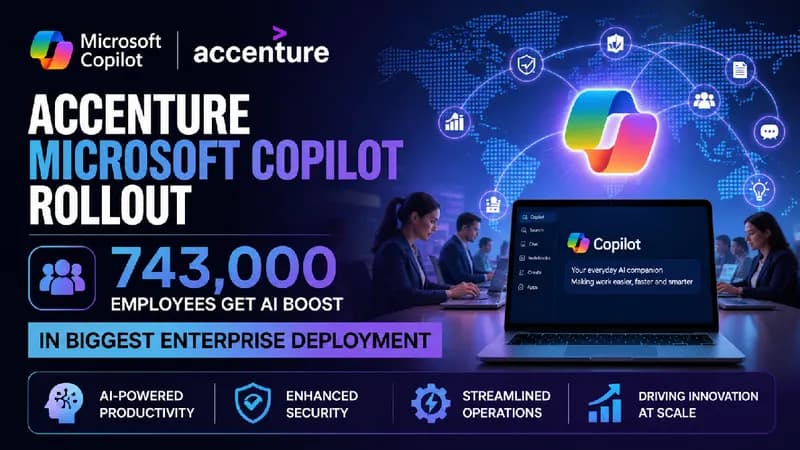
The Accenture Microsoft Copilot rollout isn't just another tech update; it's a clear sign that AI is now necessary in the corporate world. When a company puts AI tools into the hands of 743,000 employees, it’s not experimenting anymore, it’s committing to a completely new way of working.
And honestly, this move feels like a tipping point.
Global consulting giant Accenture has rolled out Microsoft 365 Copilot to around 743,000 employees across more than 120 countries. This is currently the largest enterprise deployment of any generative AI tool.
The rollout builds on earlier pilot programs that started small, with a few hundred employees, before expanding to tens of thousands and finally scaling across the entire workforce.
According to company data:
That’s not a small efficiency boost, that’s a workplace transformation.
Companies have been talking about AI for years. But most of it stayed in presentations and pilot projects. This is different.
By integrating Copilot directly into everyday tools like Word, Excel, Teams, and Outlook, Microsoft is embedding AI into daily workflows, not as an add-on, but as a core layer of work itself.
And here’s the bigger picture:
In simple terms: if this works for Accenture, expect others to follow quickly.
Copilot isn’t just some fancy chatbot sitting idle. It’s actively changing how work gets done:
Accenture’s CIO even described it as a “personal digital colleague”, and that’s probably the most accurate description so far.
What’s interesting (and slightly surprising) is how widely it’s being used, even by non-technical teams. Marketing, communications, and sales teams are reportedly using Copilot for creative work, strategy, and customer insights. That’s where things start getting serious.
Here’s where I’ll add a bit of perspective.
Yes, the numbers sound impressive, 15x faster tasks, massive efficiency gains. But these are self-reported results, and we’ve already seen mixed global research on whether AI truly boosts productivity long-term. Still, even if you cut those gains in half, it’s huge.
Because the real value isn’t just speed, it's a shift in work quality. Employees are spending less time on repetitive tasks and more time on higher-value work. That’s the part companies actually care about.
This isn’t just about tools, it’s about positioning.
Accenture is already working with major AI players like Google Cloud, SAP, and Anthropic. By using Copilot internally at this scale, it gains something competitors can’t easily replicate: Real, hands-on AI experience at enterprise scale
That’s a big advantage when competing with firms like IBM, Deloitte, and PwC.
There are even reports suggesting that AI usage is being tied to employee performance and promotions, which tells you how seriously this is being taken internally.
Microsoft CEO Satya Nadella has been quite clear: Copilot is becoming a “daily habit”, almost as common as email.
He also revealed that enterprise customers with more than 50,000 Copilot users have quadrupled year-over-year, with Accenture leading the pack. That’s not just growth, that’s momentum.
Let’s not overcomplicate it. This rollout tells us three simple things:
And yes, that last point might sound harsh, but it’s real.
The Accenture Microsoft Copilot rollout isn’t just a tech story, it’s a workplace revolution happening in real time. Whether the productivity hype fully holds up or not, one thing is clear: AI is no longer coming, it’s already here, quietly reshaping how work gets done every single day.
It is helpful for carrying out the day-to-day tasks such as drafting email,summarizing meetings, analyzing data, and reducing the time spent on repetitive work. It is just as if you have a smart assistant in your office apps.
At this scale, yes. Deploying AI tools to over 7 lakh employees makes it the largest enterprise rollout so far.
Most likely. Big companies usually wait for proof, and this rollout is exactly that. If results hold, expect rapid adoption across industries.
Not immediately. Right now, it’s more about changing how people work rather than replacing them. But roles will definitely evolve.
A bit of both. It's a great chance, but only if you're willing to adapt and learn how to work with AI.