/
/
Raksha Bandhan 2026 will be celebrated on Friday, August 28, 2026, and this year's festival falls during Panchak. The overlap has led to questions among families about whether tying rakhi during Panchak is considered auspicious.
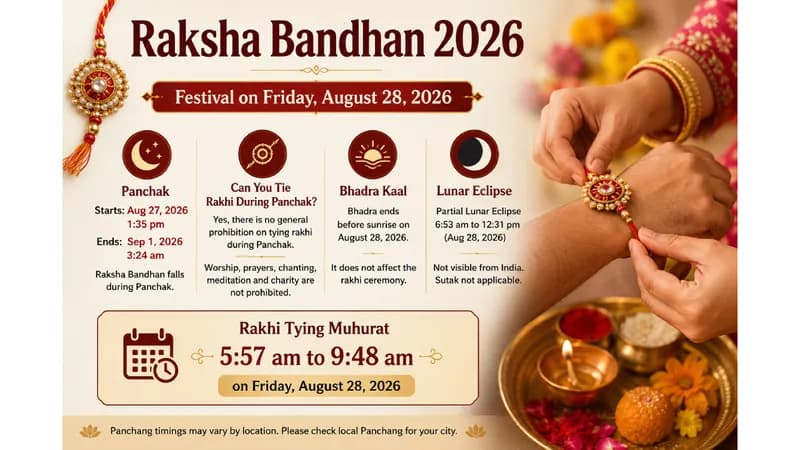
Raksha Bandhan will be celebrated on Friday, August 28, 2026, and this year's festival falls during Panchak. The overlap has led to questions among families about whether tying rakhi during Panchak is considered auspicious.
There has also been confusion about Bhadra Kaal and a lunar eclipse around the festival date. According to the Panchang details provided for this year, however, neither Bhadra nor the eclipse creates a restriction on the Raksha Bandhan ceremony in India.
The main consideration for families is therefore the timing of the rakhi ritual.
Yes. Panchak is set to begin at around 1:35 pm on August 27 and continue until approximately 3:24 am on September 1, 2026.
Since Raksha Bandhan falls on August 28, the festival will take place during Panchak.
Panchak is associated in Hindu astrology with the Moon's movement through five nakshatras. These include the final part of Dhanishta, followed by Shatabhisha, Purva Bhadrapada, Uttara Bhadrapada and Revati.
The period is traditionally identified when the Moon passes through these five nakshatras while moving through Kumbha and Meena signs.
According to the religious belief cited in the Panchang information for Raksha Bandhan 2026, there is no general prohibition on tying rakhi during Panchak.
Panchak is traditionally associated with certain activities that some families choose to avoid. However, religious practices such as worship, prayers, chanting, meditation and charity are not generally considered prohibited simply because Panchak is underway.
Raksha Bandhan is itself a religious and family festival centred on the bond between brothers and sisters. Therefore, the presence of Panchak does not automatically mean that the rakhi ceremony has to be cancelled or postponed.
Families that follow a particular regional tradition or family Panchang may, of course, choose to follow their customary practices.
According to the timings provided:
This means the entire Raksha Bandhan day falls within the Panchak period.
Despite that overlap, the available Panchang guidance does not treat Panchak as an obstacle to the basic rakhi ritual.
No. The Bhadra period associated with Raksha Bandhan 2026 is expected to end before sunrise on August 28.
This is significant because Bhadra is traditionally considered an unsuitable period for certain auspicious activities, and Raksha Bandhan rituals are often planned around it.
Since Bhadra is not continuing into the relevant daytime period on August 28, it does not prevent families from performing the rakhi ceremony during the recommended morning muhurat.
A partial lunar eclipse is also associated with August 28, with the eclipse period given as approximately 6:53 am to 12:31 pm.
However, the eclipse will not be visible from India according to the supplied Panchang information.
Because it is not visible in India, the associated Sutak period is not considered applicable for people observing the festival in the country under this tradition.
Therefore, the eclipse does not create an additional restriction on Raksha Bandhan rituals in India.
The main rakhi-tying window mentioned for August 28, 2026, is:
5:57 am to 9:48 am
This provides families with a morning window for completing the main ceremony.
The timing falls within the Purnima Tithi associated with Raksha Bandhan, making it the key period highlighted for the ritual.
Because Panchang calculations can vary slightly by location, families who follow a specific local Panchang may want to check the timings for their city before finalising the ceremony.