/
/
MP Census 2027 begins with digital house listing. Know the 33 questions, what details to share, and how your data will stay safe and private.
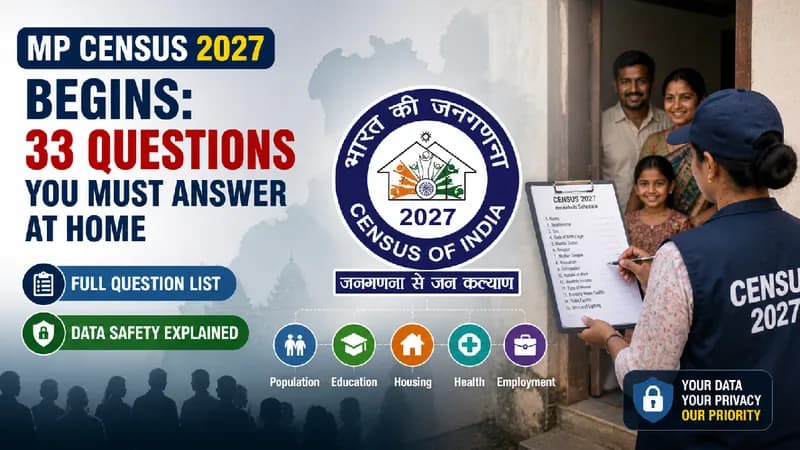
If someone from the government knocks on your door this month, don’t be surprised. MP Census 2027 has officially started from May 1, and yes, it’s going fully digital this time. That’s a big shift, and honestly, a much-needed one.
This first phase, called house listing, is already underway across Madhya Pradesh. Around 1.5 lakh enumerators, mostly school teachers, are going door-to-door collecting detailed information about homes, assets, and basic facilities. And here’s the part people are talking about: you’ll be asked 33 questions.
Let’s break it down in simple terms.
The government isn’t randomly collecting data. The goal is to understand how people live, so policies can actually match reality.
Here’s what officials will likely ask you:
Important: Caste-related questions will NOT be asked in this phase. That comes later in February 2027 during the population enumeration phase.
This is actually a smart move. Separating infrastructure data from personal identity data reduces confusion, and possibly resistance.
This is India’s first fully digital census, and that alone makes it historic.
Instead of paper forms getting lost or delayed, data is being collected through mobile apps. That means Faster processing, Fewer human errors and Real-time updates for policymakers.
But let’s be honest, people are also worried. Whenever “data” and “government” come together, privacy concerns naturally follow.
Officials have made one thing very clear: Your data is completely confidential
According to Census Director Kartikeya Goyal, the system uses end-to-end encryption, meaning:
In simple words, this data is for planning, not policing. Still, skepticism is natural. Trust isn’t built overnight. But if the system works as promised, this could set a new benchmark for data handling in India.
Here’s where you need to be smart. While official enumerators are genuine, fraudsters often take advantage of such large drives.
A real census worker will never ask for sensitive financial data. If something feels off, it probably is.
Many people treat census questions casually, but they shouldn’t.
Your answers directly impact road and infrastructure planning, electricity and water supply improvements, welfare schemes and subsidies, and overall urban and rural development.
In short, this isn’t just a form, it’s a blueprint of the country. And yes, inaccurate data leads to poor decisions. It’s that simple.
The MP Census 2027 is not just another government project; it Is a real effort to bring India up to date with how it sees itself.
Technology can make systems better, but trust from the public is what makes them work. If people feel safe, they’ll share accurate data. If they don’t, even the best system will fail.
For now, the government seems prepared. The real test? How smoothly this plays out on the ground. And when that knock comes on your door, at least now, you’ll know exactly what to expect.
1. Do I have to answer all 33 questions?
Yes, but only basic household-related questions. Nothing invasive or financial.
2. Will my personal data be shared anywhere?
No. Officials say it is fully encrypted and used only for government planning.
3. Can I refuse to share information?
You can, but it’s not advisable. Census data makes public services better.
4. How do I identify a real census worker?
They will have a government app and an official ID. Always check before you answer.
5. Will caste details be asked now?
No, caste data will be gathered in the second phase in 2027.