/
/
Around 30 robots protested in Warsaw, demanding stronger AI rules as Poland moves to regulate artificial intelligence and protect workers from automation.
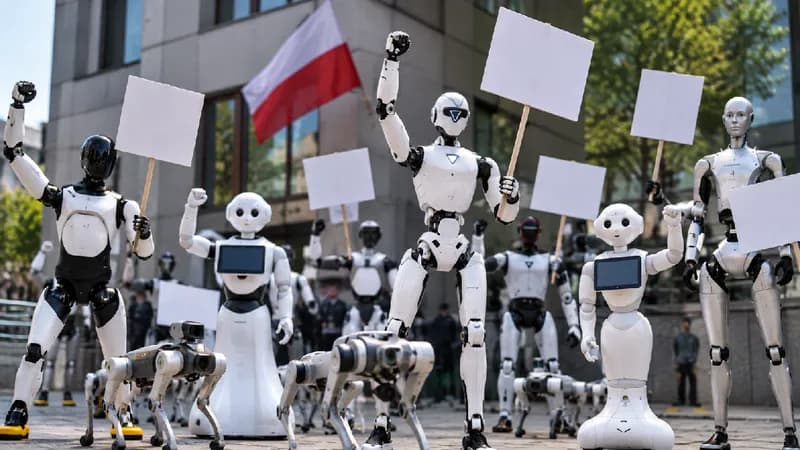
Something genuinely strange happened on the streets of Warsaw this week, and it wasn't a film shoot.
Around 30 robots marched outside Poland's Ministry of Digital Affairs, not to demand better conditions for themselves, but to make a point on behalf of human workers. The AI robots protest in Poland was organised by the Democratism initiative, and its message was pointed: artificial intelligence and automation are moving fast, and the rules governing them aren't keeping up.
The machines present included humanoid robots, robot dogs and the Agibot A3, an AI-powered humanoid. Together, they made for an image that was hard to ignore.
Footage from the event shows robots moving in slow circles, waving flags and broadcasting slogans, "Defend workplaces," "Time for rules," and "Don't wait, regulate."
It was deliberately theatrical. Rather than workers marching against machines, the machines themselves became the messengers. The organisers leaned into that irony on purpose, knowing that an unusual visual would do more to start a conversation than a press release ever could.
And conversation is exactly what they're after. The demonstration was designed to put AI regulation Poland squarely on the public agenda, not just as a technical policy question, but as something that affects real people and real livelihoods.
JUST IN: AI-powered robots stage protest in Poland against AI replacing human workers 👀 pic.twitter.com/l9B9VINizH
— Daily Loud (@DailyLoud) September 10, 2026
To be clear, the robots protest against AI wasn't a spontaneous uprising. These machines don't have opinions. Humans organised the event and used robots as a deliberate, attention-grabbing way to make their case.
Human organiser Grzegorz Kuliś was direct about the concern: it's not just factory floors that are at risk. AI systems are increasingly capable of performing cognitive work, writing, analysis, customer support, software development, the kinds of tasks that once felt safely out of reach for automation.
His point was simple but urgent: society needs to start responding before the technology outpaces any meaningful attempt to regulate it.
That concern is hard to dismiss. AI and job displacement is no longer a theoretical worry for economists, it's a lived reality for workers in a growing number of industries. The question has shifted from "will automation come?" to "how fast, and who gets left behind?"
The Warsaw protest didn't happen in a regulatory vacuum. Poland is actively building out its AI framework under the European Union's broader rules.
The EU AI Act, which came into force in 2024, takes a risk-based approach, the stricter the potential harm, the tighter the requirements. Most of its provisions began applying in August 2026, bringing rules around prohibited practices, transparency obligations and general-purpose AI models into full effect.
Poland has also moved at the national level. President Karol Nawrocki signed the country's AI systems law in July, creating a formal structure for supervising artificial intelligence and establishing a Commission for the Development and Safety of Artificial Intelligence. The commission is tasked with overseeing compliance and handling complaints involving AI systems that may cause harm.
So the regulatory machinery is being built. The protest was, in part, a push to make sure it actually works.
🇵🇱 “ROBOT REVOLT” IN POLAND
— Mossad Commentary (@MOSSADil) September 10, 2026
Around 30 humanoid robots and robotic dogs rallied outside Poland’s Digital Affairs Ministry in Warsaw, blasting slogans demanding stronger AI regulation and workplace protections for AI robots. pic.twitter.com/wc23UUQ0bc
Yes, there's an obvious irony in robots marching to warn people about robots. It makes for a striking image, and the organisers knew exactly what they were doing.
But underneath the unusual visuals, the underlying concern about AI and job displacement is serious and growing.
Automation genuinely does both things at once: it can make industries more productive, eliminate dangerous or tedious work, and open up roles that didn't exist before, while also making certain jobs redundant faster than workers or governments can adapt. The people most exposed are often those whose work is most predictable and therefore easiest to replicate.
That's why the Warsaw demonstration is more than a curiosity. The robots protest against AI may look like a stunt, but the debate it represents is one that policymakers, businesses and workers are already having, whether they're ready to or not.
As AI takes on more complex tasks, AI regulation Poland and elsewhere will need to grapple not just with the technology itself, but with what it does to people. Getting ahead of that requires the kind of political will that tends to move slowly.
The most honest takeaway from Warsaw might be this: the robots have delivered the message clearly. Now comes the harder part, humans deciding what to do with it.