/
/
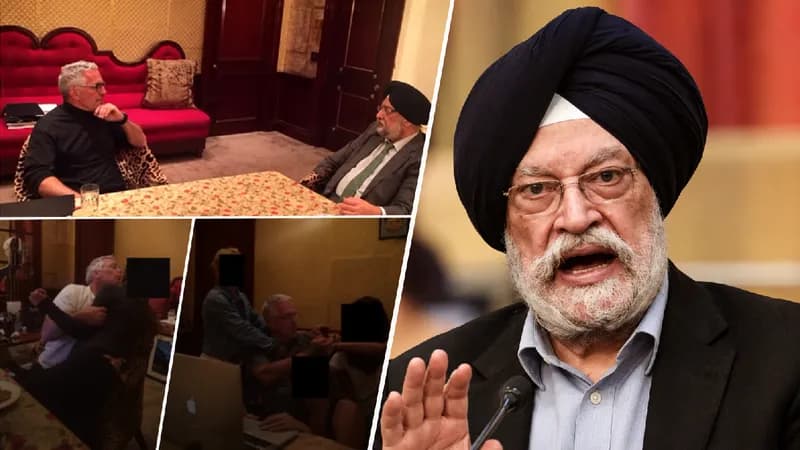
Hardeep Singh Puri faces fresh scrutiny after BJP leaves him off its Uttar Pradesh Rajya Sabha list amid questions over his past emails with Jeffrey Epstein.
A political controversy is one thing; answering uncomfortable questions about it is another. And when a controversy involves a powerful politician, the public deserves more than partisan arguments, social media memes and selective outrage.
Union Petroleum and Natural Gas Minister Hardeep Singh Puri is facing renewed political scrutiny over his past communications with convicted American sex offender Jeffrey Epstein. The controversy returned to the spotlight after the Bharatiya Janata Party (BJP) left Puri out of its latest list of eight Rajya Sabha candidates from Uttar Pradesh, announced in October 2026.
The development has fuelled fresh political speculation, particularly because Puri's current Rajya Sabha term is scheduled to end on November 25, 2026. However, the BJP's decision not to renominate him does not, by itself, establish any connection between the decision and the Epstein controversy.
The bigger question remains: what do the publicly reported communications actually establish, what has Puri said in his defence, and why are opposition leaders demanding accountability?
The controversy centres on documents released by the United States Department of Justice that brought renewed attention to Epstein's communications and connections with influential people.
Epstein, who was convicted of sex offences and later faced federal sex-trafficking charges, maintained connections with wealthy individuals, business leaders and prominent figures. His records have attracted international attention because they shed light on the people who communicated with him and the nature of those relationships.
Puri's name came under political scrutiny after references to his communications with Epstein emerged in the released material.
In February 2026, Leader of the Opposition Rahul Gandhi raised the issue in the Lok Sabha, questioning Puri's interactions with Epstein. The minister subsequently rejected allegations of wrongdoing and offered his account of the meetings and correspondence.
The issue has since become part of a wider political argument over transparency, accountability and the standards expected of people holding public office.
Importantly, a person's name appearing in Epstein-related records does not, by itself, establish criminal involvement or knowledge of his crimes. The context of the communications and any independently established evidence matter.
Puri has maintained that his interactions with Epstein were limited and professional.
Speaking to the media in February 2026, the minister said he had met Epstein approximately three or four times while associated with the International Peace Institute in New York. These interactions took place before Puri joined the Union Cabinet in September 2017.
Puri explained that his work involved international policy discussions and engagement with influential figures. He also said his interactions with Epstein were connected to delegations and professional networking rather than Epstein's criminal activities.
In an interview with NDTV on February 12, 2026, Puri addressed questions about emails exchanged in 2014 and 2015.
One exchange included a reference to Epstein's "exotic island," while another contained the phrase "have fun." These remarks attracted scrutiny because of the criminal allegations and offences associated with Epstein.
Puri argued that the language was casual and should not be interpreted as evidence of wrongdoing. He also denied visiting Epstein's private island.
The minister has described the allegations against him as baseless and rejected suggestions that his communications indicated involvement in Epstein's crimes.
His explanation is an important part of the story. Equally, the existence of an explanation does not mean public questions about the documented communications should automatically be dismissed.
The appropriate approach is to examine the available records, assess the context and distinguish established facts from political claims.
On October 5, 2026, the BJP announced eight candidates for the upcoming Rajya Sabha elections from Uttar Pradesh.
Puri was not included in the list, ruling out his renomination from the state under the announced slate.
According to The Telegraph, his Rajya Sabha term is due to expire on November 25, 2026. His omission has prompted speculation about his political future and the possibility of changes within the Union Cabinet.
The development has attracted additional attention because opposition leaders had previously demanded his resignation over the Epstein-related disclosures.
However, there is an important distinction between the facts and the speculation.
Confirmed: The BJP did not include Puri in its announced list of eight Uttar Pradesh Rajya Sabha candidates.
Confirmed: His current Rajya Sabha term is scheduled to expire on November 25, 2026.
Not established: That the BJP excluded him specifically because of the Epstein controversy.
Without a clear statement from the party establishing its reasoning, attributing the decision directly to the controversy would go beyond the available evidence.
His omission also does not automatically mean that he has resigned from the Union Cabinet or that his ministerial position has ended.
The controversy has become a political flashpoint, with opposition leaders questioning Puri's association with Epstein and demanding accountability.
Rahul Gandhi raised the issue in Parliament in February 2026. Congress leaders have argued that communications appearing in the released records warrant public scrutiny.
Other opposition parties have also criticised the minister and called for his resignation.
Their central argument is that public officials should explain their associations when those associations raise serious questions, particularly when the other person involved has a documented history of sexual offences.
The government's and minister's defenders, meanwhile, have emphasised Puri's explanation that the meetings were professional and unrelated to Epstein's criminal conduct.
That disagreement has turned the issue into another confrontation between the ruling BJP and the opposition.
But political accusations and political defences are not substitutes for evidence. Neither an opposition demand for resignation nor a minister's denial independently settles the underlying questions.
The public is entitled to scrutinise the available material without assuming that every allegation is proven or that every explanation should be accepted without examination.
This is where the debate goes beyond one minister or one political party.
The phrase "Dear Andhbhakts" has become a familiar way of challenging staunch BJP supporters on social media. In this controversy, it reflects a broader frustration with political loyalty that can sometimes overshadow uncomfortable questions.
But the same standard should apply to supporters of every political party.
If a politician you support faces legitimate questions about documented communications, demanding a clear explanation is not an act of disloyalty. Nor does questioning a politician automatically make someone a supporter of the opposition.
The reverse is equally true: criticism should not turn into an unsupported declaration of guilt.
There is a difference between questioning a public figure's judgment, examining the nature of a relationship and accusing someone of participating in criminal activity. Those are separate claims and require different levels of evidence.
In Puri's case, the reported communications and meetings have prompted legitimate public interest. His explanation that the interactions were professional should be considered alongside the available records.
What should not happen is for political supporters to treat every uncomfortable question as an attack by the opposition, or for political opponents to treat every association as proof of criminal conduct.
Accountability should not depend on which party a politician belongs to.
If supporters expect opposition leaders to answer difficult questions, they should be willing to apply the same principle to leaders they admire. Equally, critics should be prepared to acknowledge evidence that supports a politician's explanation.
That is not political neutrality for its own sake. It is the basic standard required for a credible public debate.
Another important aspect concerns online claims attempting to link Puri's family members to the Epstein controversy.
The supplied reports refer to a Delhi High Court order concerning unverified digital content and social media posts involving family members.
Such claims require particular caution.
Unverified social media posts should not be treated as established facts, especially when they involve private individuals or family members who are not necessarily public participants in the political dispute.
Readers should distinguish between material documented in official records, allegations made by political figures and claims circulating online without reliable supporting evidence.
The existence of a controversy involving a public official does not make every related claim about their family credible.
For publishers, the distinction is equally important. Reporting should focus on verifiable information and avoid repeating unsupported allegations as fact.
The BJP's decision not to renominate Puri has raised questions about its future political calculations, but the available information does not establish the reason for his exclusion.
His omission comes as the party prepares its Rajya Sabha slate from Uttar Pradesh ahead of the expiry of several sitting members' terms.
The Telegraph has reported that the BJP left out all eight sitting members in announcing its new slate. The selection has also been discussed in the context of caste representation and preparations for the next Uttar Pradesh Assembly election.
Puri's exclusion has therefore attracted attention beyond the Epstein controversy.
It may prompt questions about his political future, the composition of the next Rajya Sabha delegation and the possibility of changes within the Union Cabinet. However, these remain separate issues, and speculation should not be confused with an official decision about his ministerial position.
For now, the key confirmed development is that Puri was not included in the BJP's announced list of Uttar Pradesh Rajya Sabha candidates.
The controversy raises questions that deserve careful examination rather than instant political conclusions.
What precisely do the released records establish about the nature and frequency of Puri's communications with Epstein? How should the exchanges be understood in their original context? And what additional evidence, if any, is available to substantiate claims made by either side?
Puri has provided his explanation and denied wrongdoing. The opposition has challenged that explanation and demanded accountability.
Those positions are part of the public record, but neither should be confused with an independent finding of criminal responsibility.
The BJP's decision not to renominate Puri adds a new political development to the story. It does not, on its own, answer the questions surrounding his past interactions with Epstein.
Ultimately, a credible assessment must rest on documented evidence, reliable reporting and the distinction between association and culpability.
For citizens, the principle is straightforward: politicians should be prepared to answer legitimate questions, and allegations should be judged on evidence rather than party loyalty.
That standard should apply equally to the BJP, the Congress and every other political party.
The real test is not whether a politician belongs to your preferred party. It is whether the facts support the claims being made about them.