/
/
Sudeshna Mondal faces fresh backlash over labor room and newborn posts. Here’s what she said, what NMC ethics rules say, and why the privacy debate continues.
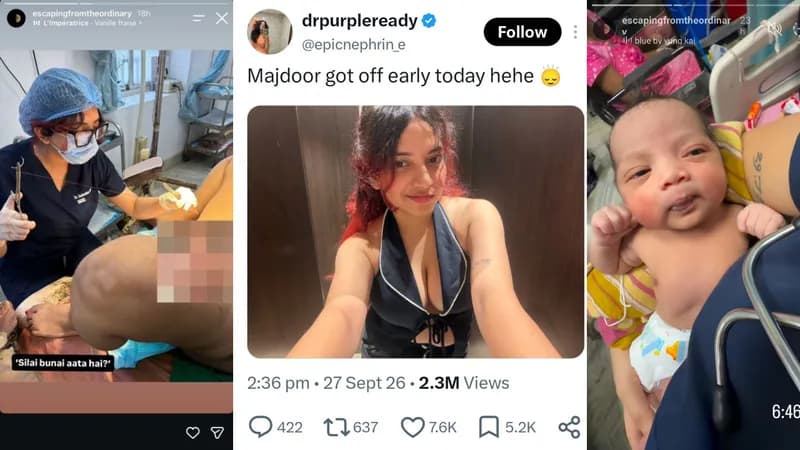
A Kolkata medical intern is back in the middle of an online storm, and this time, the conversation is getting louder.
Sudeshna Mondal, associated with Calcutta National Medical College and Hospital (CNMCH), has faced this kind of scrutiny before. Earlier this year, she came under fire after photographs and videos involving newborn babies inside hospital premises were shared online. According to reports from early September, she apologised at the time, deleted the newborn-related content, and said she wouldn't share such posts again.
But the issue hasn't gone away. Screenshots and commentary about more recent posts have started circulating on X, and the backlash has begun all over again.
The latest wave of criticism centres on images and content reportedly linked to labor-room and clinical settings, the kind of environment where patient privacy isn't just a courtesy, it's a serious professional responsibility.
Some users have raised pointed questions: should patients or newborns ever appear on a medical intern social media posts, even with faces blurred or claimed consent in place? One account publicly alleged that labor room photos of newborns had been shared without proper authorisation and called for medical authorities to take action. Others echoed that, pushing for a formal complaint to the medical council.
That said, these are allegations on social media, not findings from any regulatory body.
Mondal has responded publicly. She accused the person criticising her of going through her private Instagram account, screenshotting disappearing content, and sharing it without the full context. Her response also included a pointed personal criticism of the person who made the allegations.
Sudeshna Mondal exposes the faces of young infants on social media, it is believed by many that before namkaran showing the face of child to strangers could bring evil eye and bad luck to the child.
Calcutta Nat Medical college #amitkilhor#kilhor#sudeshnamondal#cnmchpic.twitter.com/pM5pLJCKkT— amit kilhor (@amitkilhor) September 30, 2026
This isn't a new situation. Back in September, Mondal faced criticism after posts showing her with newborns in what appeared to be neonatal and labor-room areas of the hospital began circulating. The response online was sharp and swift.
At the time, she reportedly said she had obtained consent from family members and senior postgraduate doctors and viewed the images as personal memories. After the backlash, she deleted the content and apologised.
The earlier episode also caught the attention of Dr Cyriac Abby Philips, hepatologist and widely followed medical commentator known as TheLiverDoc, who urged Mondal to take the posts down and noted that a complaint to the National Medical Commission could carry real consequences.
Another gem from doctor madam.
You got an audience, not the right to sell someone else's dignity 🙏 https://t.co/Oo8yi8YvC3pic.twitter.com/kuOllnAuA7— t. (@d3ddxo) September 29, 2026
This is where the Sudeshna Mondal Labor Room Social Media Posts debate becomes more than just an online argument, it touches on actual regulatory guidance.
The National Medical Commission's published guidance is fairly clear: registered medical practitioners should not post patients' photographs or scan images on social media. The reasoning is straightforward, once an image is posted, it can become data controlled by a platform or accessible to the public in ways that can't easily be reversed.
The NMC's 2023 professional-conduct regulations reinforce this, placing patient confidentiality, privacy, and dignity squarely within a doctor's professional responsibilities.
Earlier medical ethics rules were similarly clear, patient photographs or case reports should not be published in ways that allow someone to be identified without their explicit permission.
And here's where the nuance matters: blurring a face may lower the risk of identification, but it doesn't automatically resolve every question about consent, confidentiality, or whether clinical images belong on a public platform at all.
This is really the crux of the NMC medical ethics conversation, and it's worth being clear about.
A hospital is not a neutral space. Patients there may be vulnerable, sedated, undergoing procedures, or simply not in a position to make a fully informed decision in the moment. Newborns, obviously, cannot give consent at all, which makes proper parental or legally appropriate consent absolutely essential.
There's also a meaningful difference between taking a private photograph and posting it publicly. Even when someone genuinely believes they have permission, medical ethics involves a broader set of responsibilities, around dignity, boundaries, and what it means to treat a patient setting as something other than a backdrop for personal content.
The NMC's current code reflects exactly this understanding: patient privacy and confidentiality are professional responsibilities, not optional extras.
Chapri Doc @epicnephrin_e from Kolkata is turning unconscious patients into Instagram and Twitter content.
She is clicking them in their most vulnerable, helpless state zero consent and uploading it. Blurred on the feed. Unblurred on her phone. Who else has those photos?
This… pic.twitter.com/Ja2tenelW7— AnuCreate.in_ (@Imdead108_ybc) September 29, 2026
As of now, there is no verified NMC disciplinary action against Mondal. What's circulating are demands and calls for a complaint, which is not the same thing as a confirmed investigation or outcome.
This distinction matters more than it might seem. Online outrage can quickly blur the line between "someone called for action" and "action has been taken." That conflation isn't fair, and it isn't accurate.
Similarly, the term "criminal voyeurism" has been used by some users online, but that reflects individual opinion, not any confirmed legal determination.
The Sudeshna Mondal controversy has resonated so widely because it puts two very real things in tension with each other.
On one side: a generation of young doctors and medical interns for whom social media is just part of daily life. Hospital experiences can feel significant, emotional, educational, worth remembering. That's human.
On the other side: patients who entered a hospital for care, not to become content. They didn't agree, implicitly or explicitly, to appear on anyone's personal feed simply because the moment felt meaningful to the person holding the phone.
Both things can be true at once. And that's precisely why the medical intern social media posts debate isn't going away any time soon.
What it shouldn't become, though, is a pile-on filled with personal attacks and unverified claims. The real question, whether patient privacy was adequately protected, deserves to be answered through evidence and proper regulatory channels, not social media outrage alone.
This article is based on publicly available reports, NMC documents, and social media posts circulating as of September 30, 2026. Allegations made by individual social media users have not been treated as established facts. The situation may evolve as additional information or official responses become available.