/
/
Bengaluru Police arrest Hazarat Ali over a fake AI video showing a blast at Vidhana Soudha. Read what the viral clip showed and what police found.
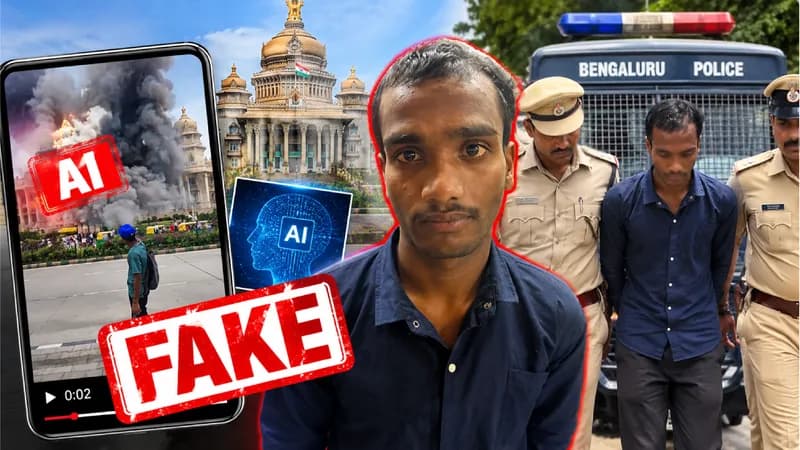
A video showing a massive explosion at Karnataka’s Vidhana Soudha may have looked alarming, but the blast was not real. The Bengaluru AI video arrest case has drawn attention after police arrested a 25-year-old man for allegedly creating and sharing an AI-generated clip that falsely depicted an attack on the state legislature building.
The accused, identified in media reports as Hazarat Ali, is a native of Koshkipur in Bihar’s Araria district. He had reportedly moved to Bengaluru a few months ago and worked as a daily-wage pipe fitter.
According to reports, the video surfaced on Instagram on Tuesday, October 20, 2026. It showed digitally manipulated footage of an explosion at Vidhana Soudha, accompanied by a caption claiming that the building had been blown up with a bomb.
Bengaluru Police registered a First Information Report (FIR) after a social media monitoring officer flagged the video. Ali was arrested on Wednesday, October 21, as investigators began examining why the clip was created and whether anyone else was involved.
One important clarification: No actual explosion occurred at Vidhana Soudha. The blast shown in the viral video was fabricated using artificial intelligence.
The video reportedly began with footage of the area outside Vidhana Soudha before transitioning to manipulated visuals showing a powerful explosion that appeared to destroy the building.
The clip also showed a person making a gesture resembling the act of pulling a trigger before the simulated blast appeared.
The Instagram account associated with the video was reported as jnx__king__h_g, with some reports using a slightly different version of the handle. The account has since been deactivated, according to media reports.
The accompanying caption reportedly read, “Vidhanasabha Uda Diya Bam se,” which translates to a claim that the Vidhana Soudha had been blown up with a bomb.
Because the video depicted an attack on an important government building, it quickly attracted attention online. Social media users tagged Bengaluru Police and demanded action against the person responsible for sharing the clip.
However, the video's dramatic visuals did not reflect a real security incident. Police confirmed that the explosion depicted in the footage was fake.
Hazrat Ali from Bihar is arrested for posting AI video of destroying Vidhan Soudha with explosion https://t.co/qZkhMiurd2
— Megh Updates 🚨™ (@MeghUpdates) October 21, 2026
The case came to light during social media monitoring by the Vidhana Soudha police.
After the video was flagged on October 20, police registered an FIR and began investigating the account responsible for uploading it.
Investigators reportedly analysed Internet Protocol (IP) logs and other digital evidence linked to the account. These digital clues helped them trace the accused in Bengaluru.
Ali was subsequently arrested on October 21.
According to reports, police booked him under Sections 353(1)(b) and 353(2) of the Bharatiya Nyaya Sanhita (BNS), 2023. These provisions concern statements or information that may cause public mischief and related offences.
The precise application of the provisions will depend on the allegations and evidence in the case. The registration of an FIR and the arrest do not, by themselves, establish guilt.
Police are questioning Ali to determine why he allegedly created and uploaded the video. Investigators are also examining whether other individuals participated in producing, editing or circulating the content.
His motive has not been publicly established in the information available for this report.
Vidhana Soudha is one of Karnataka's most recognisable government buildings and houses the state legislature. A video falsely showing an explosion at such a location can create confusion about public safety and the security of government institutions.
The problem becomes more serious when realistic-looking visuals circulate without context. People who encounter a clip through social media feeds or messaging groups may see the footage before they see a correction.
Even when no physical attack has occurred, fabricated images of an explosion can trigger fear, encourage rumours and undermine confidence in genuine news reports.
AI tools have made it easier to generate convincing scenes that never happened. While the technology has legitimate uses in filmmaking, design and entertainment, deliberately presenting fabricated footage as real can have serious consequences.
The Bengaluru case highlights the difference between creating fictional content and sharing it in a way that makes people believe a real-world attack has taken place.
The Vidhana Soudha incident comes amid broader concerns about AI-generated content being circulated as genuine footage in India.
Several recent incidents illustrate how fabricated visuals can complicate the public's understanding of breaking news.
The technology alone does not explain the harm. The way content is presented, the claims attached to it and the speed at which people share it also matter.
The Bengaluru AI video arrest is a reminder that even realistic footage should not automatically be treated as evidence of a real incident.
Before forwarding a video claiming to show an explosion, attack or emergency, consider a few basic checks:
These steps cannot identify every deepfake, but they can help prevent fabricated footage from spreading unchecked.
The investigation remains focused on the circumstances surrounding the video's creation and circulation.
Police are questioning Ali about his alleged role and investigating whether anyone else was involved. Authorities have also warned against using AI to create misleading or threatening content.
At this stage, the available reports do not establish the accused's motive or confirm whether additional individuals were involved. Those questions remain part of the investigation.
The case also raises a practical question for social media platforms: how quickly can misleading videos depicting serious public threats be identified and addressed before they reach a wider audience?
While AI-generated content can be useful and creative, fabricated footage of an apparent attack on a government building is not harmless simply because the event never occurred.
The distinction matters. A fake explosion can still cause real public concern, and determining how the video was created, shared and presented will be central to understanding the case.
The viral video showing an explosion at Karnataka's Vidhana Soudha was AI-generated, and no actual blast occurred. Bengaluru Police arrested 25-year-old Hazarat Ali on October 21, 2026, after the clip was flagged through social media monitoring.
Investigators are now examining his alleged motive and whether others helped create or circulate the video. Until the investigation establishes more facts, the allegations should be treated as allegations rather than proof of guilt.