/
/
Fact Check: A viral Mecca couple video is being linked to Saudi executions, but the clip is unrelated. Here’s what is confirmed about the Bangladesh case.
A viral video can tell a completely different story from the one attached to it online. That is exactly why a fact check is necessary after social media posts began linking a couple's video filmed in Mecca to reports about two Bangladeshi nationals executed in Saudi Arabia.
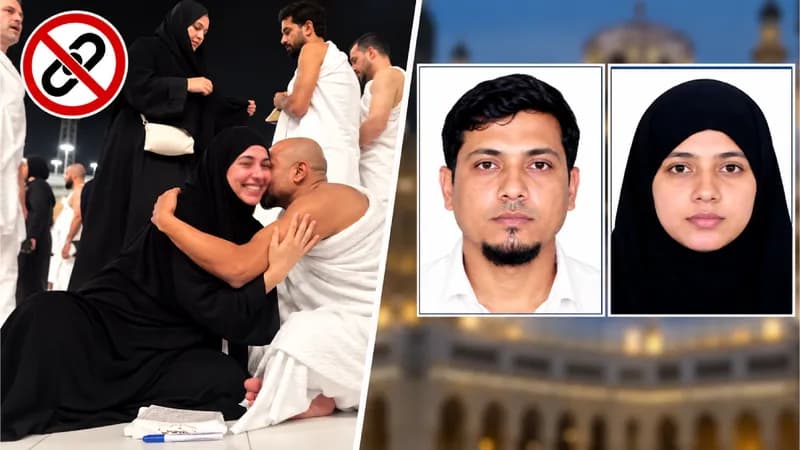
The posts have fuelled claims that a couple was sentenced to death for kissing or displaying affection near the holy Kaaba. However, the available evidence does not establish that the viral video shows the people involved in the execution case.
The viral couple video and the Saudi Arabia death sentence case must be treated as separate matters. While Saudi authorities have confirmed the executions of two Bangladeshi nationals, several details circulating on social media remain unverified.
The viral posts connect footage of a man and a woman at the Grand Mosque in Mecca with the execution of two Bangladeshi nationals. Some versions of the claim suggest that the couple was punished simply for kissing in the holy city.
However, reporting by Khaleej Times on October 20, 2026, cited a statement from an account associated with the Two Holy Mosques describing the circulating video as misleading and clarifying that it was not evidence of the executions. The Saudi Interior Ministry's announcement did not identify the people shown in the viral footage or specify the exact act involved in the case.
Consequently, the video cannot be treated as proof of what happened to the two Bangladeshi nationals.
There is also no verified evidence establishing that the couple in the circulating footage was the same pair involved in the criminal proceedings.
The distinction matters because a video filmed at a religious site does not automatically have a connection to a separate criminal case reported from that location.
The executions themselves are a separate, reported event.
According to reports citing Saudi Arabia's Interior Ministry, two Bangladeshi nationals, Nazrul Islam Abdul Basir and Siti Akhtar, were executed in the Mecca region on October 14, 2026.
Saudi authorities said the two had been convicted of committing an unspecified indecent act inside a mosque. Their sentences were imposed under ta'zir, a form of Islamic jurisprudence that allows judicial discretion in determining punishments for certain offences.
However, the official announcement did not publicly describe the alleged act in detail.
Bangladeshi media reports have identified Nazrul as a migrant worker who went to Saudi Arabia in November 2022 and worked as a cleaner. Reports have also raised questions about the charges, the legal proceedings and the lack of advance notification to the families.
According to The Daily Star, Nazrul's family said they learned of his execution through media reports and alleged that they had not been informed beforehand.
Bangladesh has sought further information from Saudi authorities about the case and the judicial proceedings.
These details make the case a serious matter, but they do not establish the claims attached to the unrelated viral footage.
There is no verified evidence that the two were executed simply for kissing.
This is one of the most important distinctions in the viral story.
Saudi authorities described the offence as an indecent act inside a mosque but did not publicly specify the exact conduct in their announcement. Some media reports have referred to allegations of adultery, while social media posts have circulated different versions involving kissing or other displays of affection.
Those claims should not be treated as interchangeable.
The fact that the authorities announced a conviction for an unspecified indecent act does not independently establish the precise conduct alleged. Nor does it prove that a kiss was the reason for the death sentences.
Reports concerning the detention records have also raised questions about the charges recorded against the two individuals and how those records relate to the official announcement.
Until more detailed and reliable documentation becomes available, the precise circumstances of the case should be described cautiously.
Social media users have also circulated claims involving a couple identified in some posts as Khadija Belgoum and Billy Rahman. The footage has been described as a pregnancy announcement filmed in Mecca.
According to the description accompanying the circulating claim, the woman reveals her pregnancy to her husband. Some online posts have attempted to connect this footage to the Saudi execution case.
However, the identities and circumstances described in those posts should not be treated as independently verified without reliable supporting evidence.
More importantly, no credible evidence has been established linking the pregnancy announcement video to Nazrul Islam Abdul Basir and Siti Akhtar or to their criminal case.
The footage therefore cannot be presented as evidence of the alleged offence or the executions.
A reliable fact check must distinguish between what a video actually establishes and what a caption claims it shows. Without verified identities and supporting documentation, linking the people in the footage to a criminal case risks spreading misinformation.
Here is a clear breakdown of the available information.
The central issue is not whether the executions occurred. It is whether the videos and claims being shared alongside the news accurately represent the people and events involved.
At present, they do not provide reliable evidence for the more sensational claims circulating online.
Major news events often generate a wave of images, videos and claims before all the facts become clear. When a story involves a religiously significant location such as Mecca, emotional reactions can make misleading posts spread even faster.
A dramatic caption may encourage people to share a video without checking when it was recorded, who appears in it or whether the footage has any connection to the reported incident.
In this case, several different claims have become mixed together: the execution of two Bangladeshi nationals, allegations about conduct inside a mosque, footage of a couple at the Grand Mosque and a separate claim about a pregnancy announcement.
Combining these elements into a single narrative can create a misleading impression, even when one part of the story is based on a real event.
Readers should be particularly cautious about posts that claim to reveal the exact reason for a death sentence when the publicly available official statement does not provide that level of detail.
Before sharing such content, it is worth checking whether reputable news organisations have verified the footage and whether the people shown have been reliably identified.
The Saudi Arabia death sentence controversy involves a real and serious reported event: the execution of two Bangladeshi nationals in the Mecca region on October 14, 2026.
However, the viral videos circulating alongside the news do not establish that the people shown were the individuals executed or that the executions occurred for the specific reasons claimed in social media captions.
Saudi authorities referred to an unspecified indecent act inside a mosque, while several details about the case remain unclear in the public reporting.
The claim linking the viral couple footage to the executions is therefore misleading.
Fact-check verdict: Misleading claim. The executions were reported by reliable news organisations, but the viral video does not prove that the people shown were the individuals involved or that the death sentences were imposed simply for kissing in Mecca.