/
/
Pakistani teacher-student and Iraqi woman-US soldier viral videos were found to be staged clips, exposing how fake leaks fuel clicks and phishing scams.

Picture this: a shocking caption drops into your feed, someone calls it a "private leak," and a link promises you the full video. That's really all it takes. Before anyone stops to ask questions, the story has already spread to thousands of people.
The Pakistani Teacher Student Viral Video and the Iraqi woman-US soldier viral video are two recent examples of exactly that, where someone took existing footage, invented a dramatic new backstory and pushed it online as though it were a real scandal.
Fact-check investigations found that both viral narratives were misleading. In each case, the videos were traced back to staged, commercially produced adult content, nothing close to the real-world incidents described in the viral posts. But this goes beyond a simple fake viral video problem. These so-called "viral leak" campaigns can quietly lead users straight into phishing scams, malware and other online traps.
One of the clips making rounds across social media and messaging apps was being pushed as a supposed "30-minute teacher-student video leak" from Pakistan.
The posts were framed to make the footage look like a genuine private recording involving a teacher and a student. Some versions even circulated a name, "Ayesha Tanveer", to make the whole thing feel more real and credible.
But when fact-checkers dug into it, they found no actual leaked recording and no evidence of a real classroom incident. The video turned out to be a scripted adult roleplay clip that had been repackaged with a completely fabricated story.
This is one of the internet's oldest tricks: grab a piece of existing footage, strip away the original context and slap on a headline designed to make people curious enough to click. Once enough accounts start sharing the same caption, the false story begins to look credible, simply because it's everywhere.

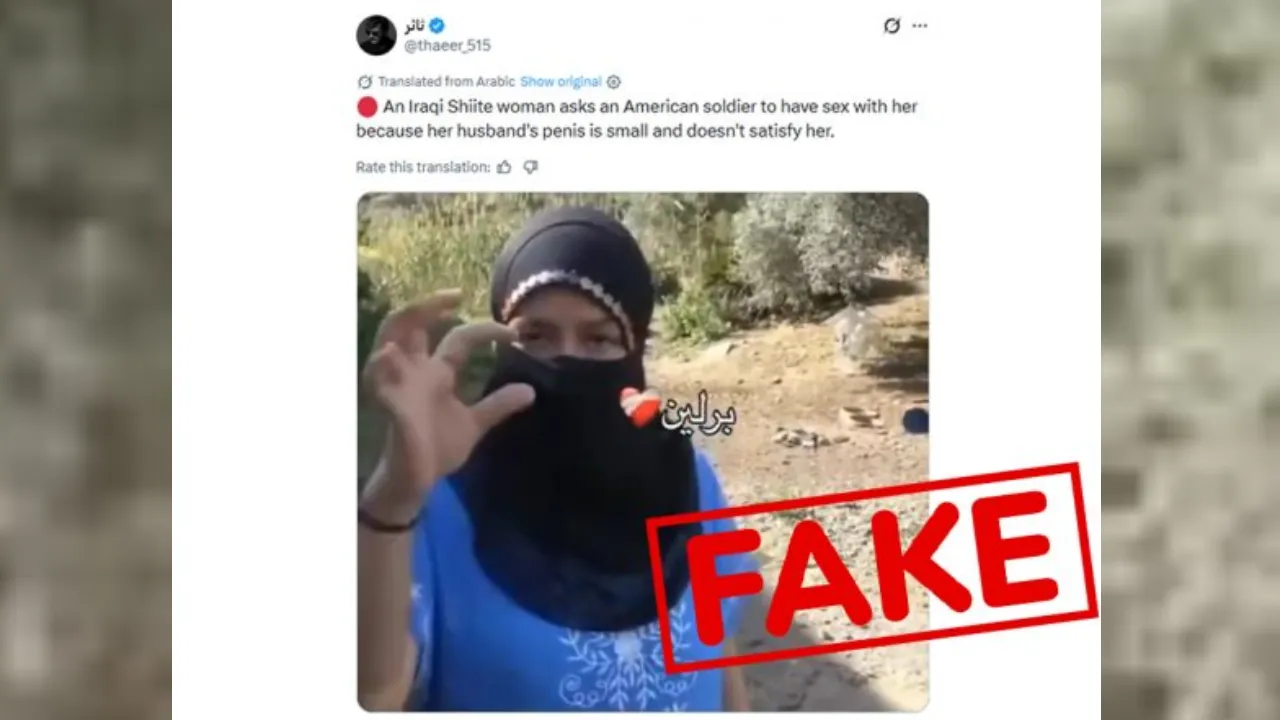
A nearly identical playbook was used with another viral clip, this one presented as an alleged encounter between an Iraqi woman and an American soldier.
The posts attached a sensational, explicit personal claim to the footage, implying the interaction had genuinely happened. The controversial framing quickly attracted attention across X and other platforms.
Fact-checkers found no credible news reports, no official documentation and no verified evidence to support any of it. The footage was traced back to a staged adult video that had been given a completely false context. Nothing in the clip connected it to the real-world event described in those viral posts.
In both cases, the verdict was the same: the captions were doing nearly all of the deceiving.
This type of misinformation follows a surprisingly straightforward formula.
Someone finds a video that's provocative or emotionally charged. They strip out the original context. Then they attach a brand-new narrative, one designed to trigger a reaction before the viewer has time to think.
These narratives typically claim the footage is one of the following:
Each of these framings is built to make people click first and question later.
The footage might genuinely exist, but that doesn't mean the story wrapped around it is real. A real video does not automatically make a viral claim true. That distinction matters more than most people realise, and it's exactly why source tracing has become such an essential part of fact-checking fake viral video content.
The problem doesn't always stop at a misleading caption.
In many of these cases, the viral posts include external links promising access to the "full video." Those links can potentially lead users to phishing pages, intrusive ads, unwanted downloads or other genuinely harmful content.
Once you click, you might be asked to:
That's when a moment of curiosity can become a real cybersecurity problem. Not every suspicious link is necessarily malicious, but anyone who sees a post promising access to a "leaked" or "exclusive" video should treat it with serious caution.
The biggest warning sign is almost always urgency. Phrases like "Watch before it gets deleted" or "Click here for the full leaked video" are specifically written to stop you from thinking twice. That pressure is the trap.
Honestly, because they're designed to.
Outrage, curiosity and shock are some of the most powerful engagement tools on the internet. A plain, ordinary post might go unnoticed. Add the words "leak," "scandal," "MMS," "secret video" or "exposed," and suddenly the same content feels urgent and irresistible.
Social media also creates a false sense of verification. When hundreds of accounts are sharing the same claim, it's easy to assume that someone, somewhere, must have checked it. In reality, most of those accounts may simply be copying the same misleading caption from a single original post.
That's how a fabricated story about a Pakistani teacher-student viral video or an Iraqi woman-US soldier viral video can travel across X, Telegram, WhatsApp and beyond, without a single person actually verifying where the footage came from.
Before you share something that seems shocking, it's worth pausing for a few seconds and asking some basic questions.
Does this story appear anywhere in credible news coverage? Is there an official statement backing it up? Does the video have a watermark or any other detail that hints at its real origin?
Reverse image or video searches can sometimes surface older versions of the same footage and expose the real source. It's also worth being suspicious whenever a post tells a dramatic story but offers zero verifiable evidence to support it.
And if the post includes a link promising the "full video", especially one that routes you to an unknown website asking for personal information or a file download, that should immediately set off alarm bells.
Often, the safest choice is also the simplest: don't click, and don't forward.
The Pakistani Teacher Student Viral Video and the Iraqi woman-US soldier viral video are a clear reminder of how easily online footage can be turned into misinformation, and how little it actually takes to deceive a large number of people.
Neither case required sophisticated editing or AI-generated imagery. The misleading captions did all the heavy lifting.
That's the part worth remembering. Not every viral video is what its description claims. Sometimes, the most convincing element of a fake viral video isn't the footage at all, it's the story someone decided to attach to it.
And when that story comes with a suspicious link, the risk goes well beyond being misled. A few seconds of curiosity could leave a user exposed to phishing scams or other digital threats they never saw coming.
In a media environment obsessed with "viral leaks," a healthy dose of skepticism might genuinely be your best line of defence.
Disclaimer: This article is published strictly for fact-checking and digital-awareness purposes. StackUmbrella does not host, distribute or link to explicit, leaked or pirated material. The viral claims discussed above are addressed to explain misinformation and potential online safety risks. Readers are advised not to search for, share or circulate unverified intimate or explicit content and to avoid suspicious links claiming to offer "full" or "leaked" videos.