/
/
A viral video shows a Pakistani man demonstrating an alleged self-driving car before the vehicle suddenly veers off and crashes into a parked police van.
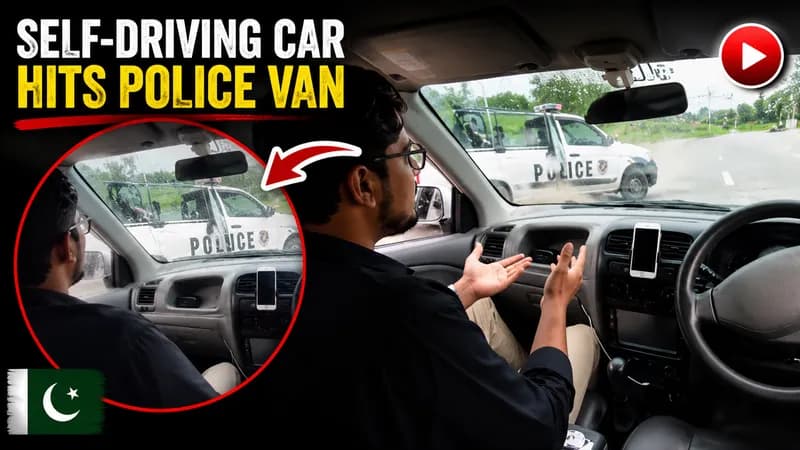
A demonstration of an alleged self-driving car in Pakistan took an unexpected turn when the vehicle suddenly veered toward a parked police van and crashed into it.
A video of the incident has circulated widely on X, showing a man sitting in the passenger seat while apparently demonstrating a vehicle that he claimed could drive without anyone behind the wheel.
For several moments, the demonstration appeared to be going according to plan. The car moved along the road while the man spoke directly to the camera and highlighted what he presented as the vehicle's autonomous capabilities.
Then the car abruptly changed direction.
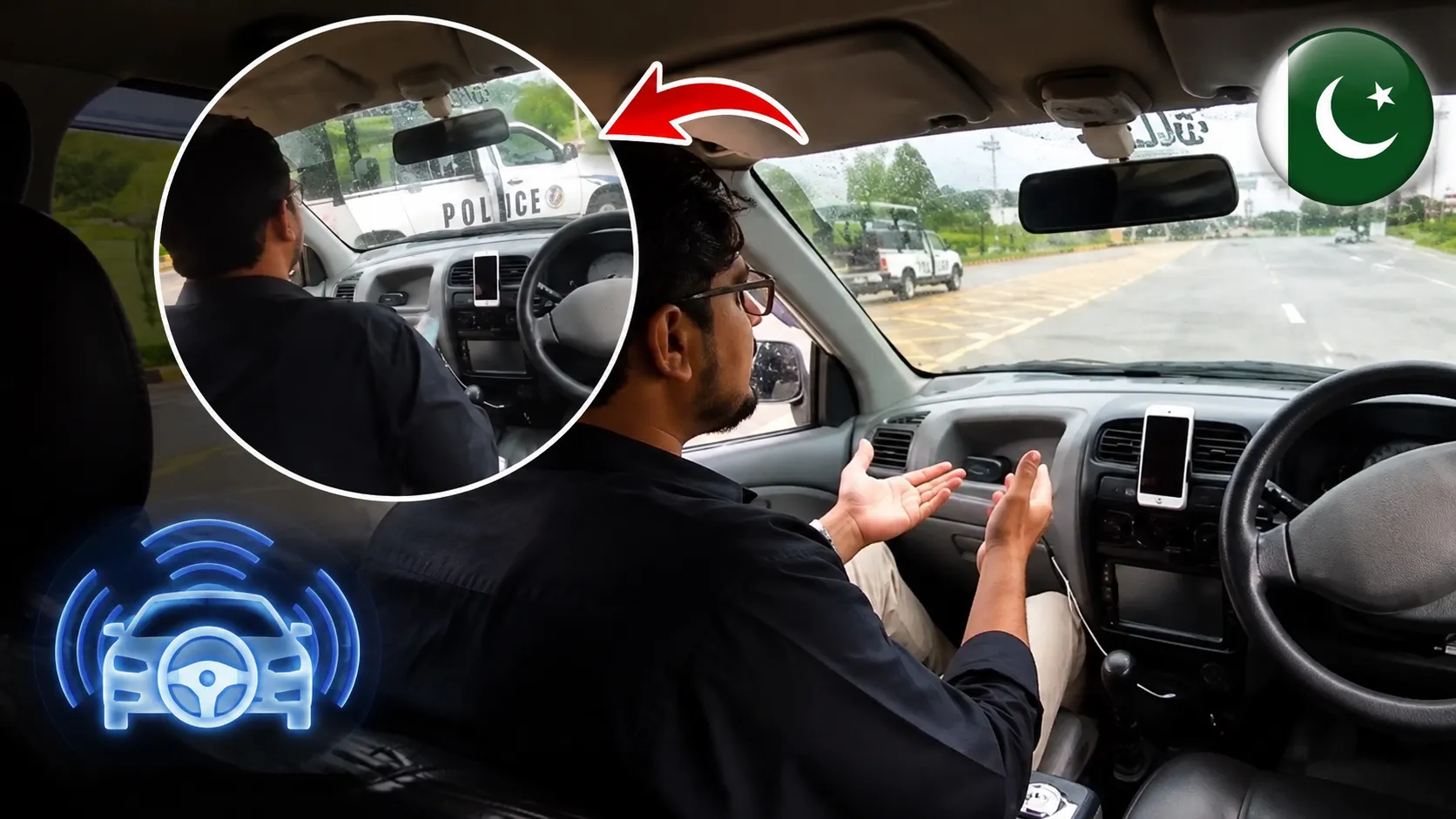
In the footage, the man can be seen sitting away from the driver's position as the car travels along the road.
He confidently tells viewers that the vehicle is navigating by itself and adds that there is no shortage of talent in Pakistan.
Shortly afterward, the steering wheel appears to turn toward the side of the road.
Rather than returning to its previous path, the vehicle moves directly toward a parked police van. The car eventually collides with the stationary vehicle, ending the demonstration almost immediately.
The video does not independently establish how the vehicle's driving system worked or whether it was genuinely fully autonomous.
Presenting Pakistan’s answer to the self driving @Tesla:
— Ranvir Shorey (@RanvirShorey) August 31, 2026
The Masla. pic.twitter.com/b5I63UYiEk
Actor Ranvir Shorey shared the clip on X, adding a humorous comparison with Tesla's autonomous-driving technology.
In his caption, Shorey referred to the vehicle as “Pakistan’s answer to the self driving Tesla” and jokingly called it “The Masla.”
The word “masla” translates broadly to “problem” or “issue,” making the caption a reference to the unfortunate outcome of the demonstration.
The timing of the crash also contributed to the video's popularity. The collision happened soon after the demonstrator had confidently praised Pakistani technological talent.
The exact reason for the collision cannot be established from the video alone.
The footage shows the steering wheel turning and the vehicle moving toward the parked police van, but it does not provide enough technical information to determine whether the incident resulted from a malfunction, an experimental control system, driver intervention, navigation failure or another factor.
It would therefore be misleading to claim that the crash proves a particular technology failed.
The video should be viewed as a demonstration that ended unsuccessfully rather than as definitive evidence about autonomous-driving technology in Pakistan.
The clip generated a mixture of jokes, criticism and more sympathetic reactions.
Some viewers focused on the irony of a supposedly autonomous vehicle ending its demonstration by crashing into a police vehicle. Others joked about what the police might have thought upon discovering that no one appeared to be sitting behind the wheel.
Another group of users took a more supportive position, arguing that experimentation with technology should not automatically be dismissed because an early demonstration failed.
The contrasting reactions reflect a broader debate around emerging technology: prototypes and experimental systems can fail, but those failures can also expose areas requiring further development and testing.
Tesla is widely associated with advanced driver-assistance and automated-driving features, making the company a natural reference point in social-media discussions about autonomous vehicles.
However, Tesla's systems should not be casually equated with an unidentified experimental vehicle shown in a viral clip.
The video does not provide enough information to determine the car's technology, level of automation, sensors, software or safety controls.
The comparison in Shorey's post was therefore clearly framed as humor rather than a technical assessment.
The footage appears to show a vehicle being presented as capable of driving without a person apparently operating the steering wheel, followed by a collision with a parked police van.
It does not, by itself, prove that the vehicle was fully autonomous, that its system was AI-powered, or that the crash was caused by a specific software or hardware defect.
Those details would require additional evidence from the vehicle's creators or an independent technical investigation.
Autonomous-driving systems must handle constantly changing road conditions, including pedestrians, parked vehicles, road markings, unexpected obstacles and other traffic.
A system that works under controlled conditions may behave differently in an unpredictable real-world environment. That's why autonomous-driving development typically involves extensive testing, safety monitoring and human oversight.
The viral Pakistani demonstration highlights the importance of those safeguards in a particularly memorable way.