/
/
A viral train clip has sparked a debate over women going braless in public, with reactions ranging from body freedom and comfort to criticism and unwanted sexualization.
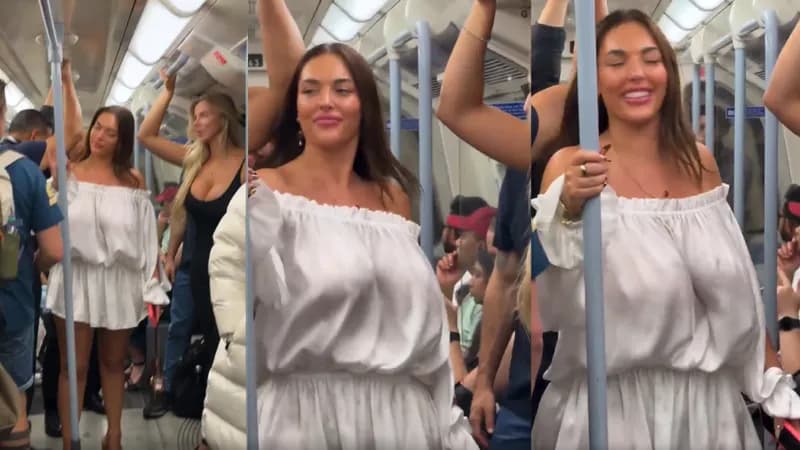
A debate over women going braless on trains is spreading across social media after a short clip triggered sharply divided reactions. What might look like an ordinary clothing choice to some viewers has quickly turned into a wider argument about comfort, personal freedom and how women are judged in public spaces.
The discussion appears to have started after a post asked women why they sometimes choose not to wear a bra. The question attracted a flood of responses, with people offering very different explanations, and, in several cases, openly criticizing women who make that choice.
Some commenters blamed the trend on a desire for attention, while others went much further with personal and insulting remarks. One response attributed the choice to a “lack of fathers” or attention, while another suggested women do it simply to attract men.
Those comments, however, were met by a very different argument from women online: wearing a bra is a personal decision, and comfort can be a perfectly ordinary reason not to wear one.
There is a broader fashion shift behind the conversation. During hot weather, bras can feel restrictive and uncomfortable, particularly when people are spending long hours outdoors or travelling.
The post-pandemic period has also seen fashion move toward looser, more relaxed clothing. A recent report on the 2026 summer trend noted that some women are choosing braless outfits because traditional bras can feel uncomfortable in extreme heat.
For many women, therefore, going braless isn't necessarily a statement. It can simply mean choosing what feels comfortable.
And that distinction is important because the online discussion often turns a basic clothing preference into a judgment about someone's character or intentions.
Women why do you stop wearing bra ? 😔 😟 https://t.co/zDZcbdE42S
— 🏀SixersCageEdge🥊 (@GraceRepublik) August 22, 2026
The available material is largely based on posts and reactions circulating on X, rather than an independently verified report establishing a specific incident involving a particular train passenger.
That means viewers should be cautious about treating every caption or interpretation attached to the clip as fact.
The social-media discussion itself is real, but claims about why an individual woman was dressed a certain way cannot be established simply by looking at a short video.
That is where the debate becomes complicated. People can have opinions about public fashion, but an outfit alone does not establish someone's intentions.
This is one of the biggest points of disagreement in the discussion, and the answer isn't as straightforward as some comments suggest.
Research into clothing perception has found that people can interpret revealing or sexualised clothing as a cue about sexual intent or availability.
But that describes other people's perceptions, not proof of what the person wearing the clothes actually wants.
In other words, someone may interpret a particular outfit as provocative without that outfit being an invitation for attention, conversation or sexual behaviour.
That distinction matters even more in a public setting such as a train, where strangers are sharing the same space.
The strongest reactions to the viral train clip appear to come from two completely different views of public clothing.
One side believes people should dress according to conventional expectations, particularly in crowded public spaces. The other argues that adults should be able to decide what they wear as long as they are not violating any applicable rules.
Then there is a third issue: sexualisation.
A woman choosing not to wear a bra can quickly become the subject of comments about her body rather than a discussion about the actual clothing choice. That is exactly why some women responding to the viral conversation pushed back against the idea that their clothing should automatically be interpreted as an attempt to attract men.
The viral debate is less about bras themselves and more about who gets to decide what is considered acceptable clothing in public.
Going braless is not new, and neither are arguments over it. What has changed is how quickly a few seconds of video can be turned into a massive online discussion, with strangers assigning motives to people they don't know.
The simplest takeaway is also the most reasonable one: wearing a bra is a personal choice, and not wearing one does not automatically communicate a person's intentions.
The viral clip may continue generating reactions, but without more verified context, viewers should separate what is actually visible from assumptions being made in the comments.
Disclaimer: This article discusses a social-media trend and reactions circulating online. The viral posts and claims may change as more information becomes available; viewers should not treat unverified social-media commentary as established fact.