/
/
SpaceX IPO: SpaceX raises a record $75 billion in the biggest IPO ever, pushing Elon Musk toward trillionaire status as investors rush into the stock.
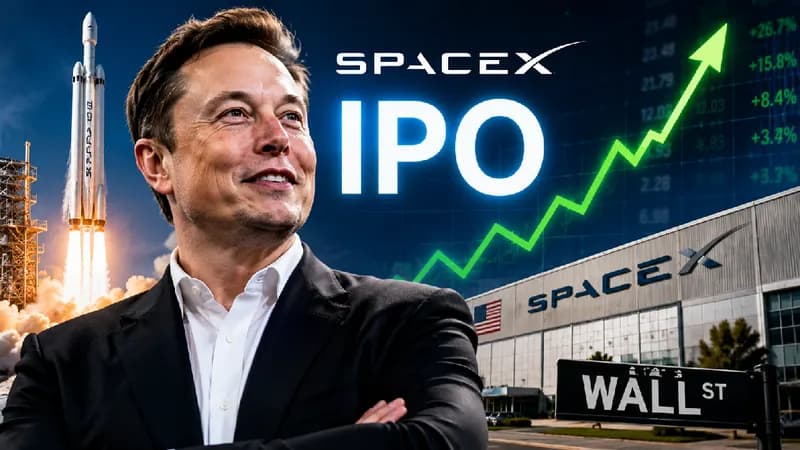
Wall Street has watched plenty of blockbuster listings over the years, but nothing quite prepared it for the SpaceX IPO.
Elon Musk's rocket and satellite company just pulled off the biggest initial public offering the world has ever seen, raising a jaw-dropping $75 billion and landing a valuation near $1.77 trillion before its first full trading session even began. The debut sent investors into a frenzy almost immediately, and market signals now point to SpaceX potentially climbing to $2.3-$2.4 trillion once trading settles down.
For Musk personally, this might be the bigger story. The IPO is expected to push his net worth past the trillion-dollar mark, making him, by most counts, the first trillionaire in history.
SpaceX sold roughly 555.6 million shares at $135 apiece, pulling in $75 billion in fresh capital. That number blows past the previous record holder, Saudi Aramco's 2019 IPO.
And the demand? Off the charts. Reports put total orders north of $250 billion, nearly four times what was actually on offer, even before pricing was locked in.
Here's a quick snapshot of the numbers:
That retail slice is unusually generous for a deal this size, giving everyday investors a shot at one of the most talked-about stock debuts in decades.
A big chunk of the buzz around the SpaceX IPO comes down to what it means for Elon Musk net worth.
Musk was already sitting on one of the largest fortunes ever assembled, thanks to his holdings in SpaceX, Tesla, X, xAI, and a handful of other ventures. Now, with the IPO behind him, Reuters calculations suggest his wealth could top $1.1 trillion, putting him in a category no one else on the planet is anywhere close to.
His stake in SpaceX alone is reportedly worth hundreds of billions. And if the stock trades anywhere near what pre-market derivatives are implying, that figure could climb even higher.
It's a moment that says a lot about how much faith investors are putting in Musk's broader vision, reusable rockets, satellite internet, AI, and eventually, getting humans beyond Earth.
Most newly listed companies are built around one core business. SpaceX isn't.
The company spans several fast-growing sectors at once:
Starlink is still the company's biggest moneymaker. The satellite internet service has reportedly grown past 8 million customers worldwide, bringing in billions of dollars a year.
For a lot of investors, SpaceX feels like a rare two-for-one, exposure to the booming space economy and the AI boom, all wrapped into a single stock.
Not everyone's popping champagne over SpaceX stock, though.
Despite revenue growth that would make most companies jealous, SpaceX is still losing money. The company brought in roughly $18.67 billion in revenue during 2025, but it also posted a net loss in the billions.
Some analysts say the current valuation has less to do with where SpaceX is today and more to do with where investors think it's headed.
Critics argue people are essentially paying for a decade-out version of SpaceX, not the one that exists right now. Supporters push back, saying old-school valuation models just aren't built to handle companies trying to create entirely new industries from scratch.
That argument isn't going away anytime soon.
So what happens to all that money? According to Musk, it's going toward several major projects already in motion.
The plan is to pour funds into:
Musk has said repeatedly that the next wave of AI growth is going to demand massive amounts of computing power and energy. Some of that infrastructure, he believes, might eventually end up in orbit.
The ripple effects of the largest IPO in history are reaching well beyond SpaceX itself.
Several analysts think the offering could temporarily siphon investment dollars away from other tech and AI stocks as traders shuffle their portfolios around. There are already reports of retail investors trimming positions in some semiconductor and AI names ahead of the listing.
There's also a bigger question lurking here: how this IPO performs could set the tone for public markets going forward. If it goes well, other heavily valued private companies, including AI startups, may feel emboldened to follow suit with their own listings later this year.
The SpaceX IPO isn't just a stock market headline, it's a turning point for technology, investing and Musk's sprawling business empire.
With $75 billion raised, a valuation pushing toward $2 trillion, and Musk possibly becoming the first trillionaire in history, this debut has already carved out its spot in financial history books. The real question now is whether SpaceX can grow into the enormous expectations now riding on its name.
For investors, this is really just the opening chapter.