/
/
Satya Nadella slammed a leaked Microsoft memo that suggested making users “addicted” to Scout AI, calling the strategy a complete non-goal.
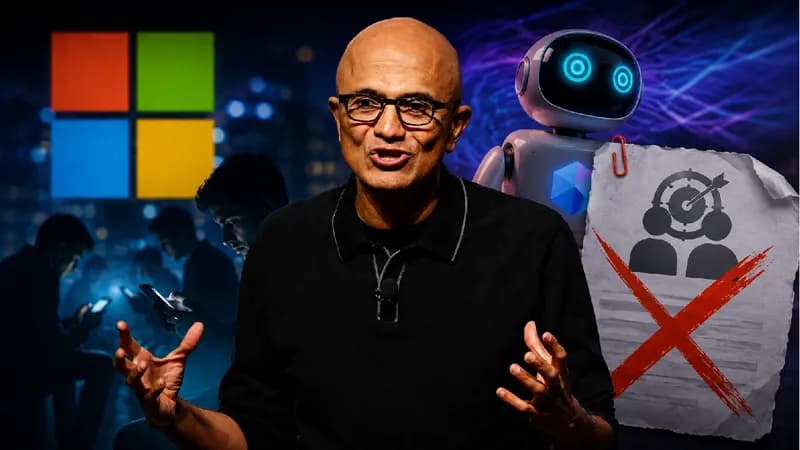
The Satya Nadella Scout AI controversy has quickly become one of the tech world's biggest talking points this week. It all began when an internal strategy memo was leaked. The document reportedly revealed a plan to get people hooked on Microsoft's new AI assistant, Scout. While the phrasing instantly triggered widespread criticism, Nadella’s pushback was swift, sharp and remarkably direct.
The Microsoft CEO publicly shut down the document's language, emphasizing that creating user dependency is “absolutely a non-goal.” Instead, he reiterated that Microsoft's true objective is to empower people, not keep them hooked on a screen.
This entire situation hits at a highly sensitive time for Microsoft. The tech giant is aggressively scaling its AI goals, positioning Scout as a cornerstone of its next-generation software ecosystem.
The backlash kicked off after tech outlets reported they had gotten their hands on an internal strategy document from the Scout team.
The memo, allegedly co-authored by Microsoft executive Omar Shahine and another senior leader, laid out a three-phase roadmap for the assistant. The real spark for the controversy was Phase One, which reportedly aimed to “make people addicted.”
According to the leaked text, the team wanted to quickly grow Scout’s user base, improve the user experience, and build tools and features that people would use every day. But when it became clear that making users dependent on the assistant was part of the plan, it immediately raised concerns.
Nadella didn’t pull any punches when addressing the issue internally.
In a message sent to Microsoft’s top engineers, he made it clear that engineering AI addiction was “absolutely a non-goal” and that the company’s actual mission is quite the opposite.
Reports indicate that Nadella highlighted what Microsoft actually wants its AI to achieve:
He also openly questioned the document itself, calling out whoever was responsible for writing and leaking it. The firm response made it obvious that leadership wanted to completely distance Microsoft from any implication that Scout was built to create unhealthy digital habits.
Microsoft officially unveiled Microsoft Scout during its recent Microsoft Build 2026 developer conference.
The company pitches Scout as an always-on AI assistant designed to handle heavy lifting and coordination across Microsoft’s productivity suite. It deeply integrates with everyday workplace tools like:
Scout represents a major step forward in Microsoft’s push toward agentic AI, a shift where intelligent assistants don't just reply to prompts, but proactively get things done for the user. Internally, the project was developed under the codename "ClawPilot" and engineered using the open-source OpenClaw framework.
This leak couldn't have come at a trickier time for the broader AI sector.
Regulators and governments across the US and Europe are already placing AI addiction concerns under the microscope, investigating whether new AI tools might drive compulsive behavior, excessive screen time, or emotional dependency. Simultaneously, tech companies are locked in a fierce race to roll out highly advanced AI assistants, coding agents, and workplace automation platforms.
In an environment this tense, an internal memo using the word “addicted” was bound to set off alarm bells. The situation is particularly awkward for Microsoft, which has always branded its AI as a tool for workplace efficiency rather than an attention-grabbing consumer app.
In the wake of the uproar, Microsoft has pushed back hard against the idea that Scout is meant to trap users in an endless loop of engagement.
A company spokesperson stated that Scout’s entire purpose is to help people clear their to-do lists faster, giving them time back rather than driving up their screen time. This messaging matches Nadella’s long-standing philosophy that AI should deliver practical, economic value in the workplace.
Even so, the leaked phrasing has reignited a massive debate over how tech companies measure user engagement, and where the line sits between making a genuinely helpful product and building an unbreakable habit.
The fallout from the Scout memo points to much larger challenges facing the AI industry as a whole.
As these AI assistants become a bigger part of everyday work and life, tech companies will have to deal with some important questions around ethical design, user dependence, transparency, responsible engagement and consumer protection.
Right now, Microsoft's main focus is simple: showing users, regulators and investors that Scout is meant to help people get things done, not keep them hooked.
Whether this specific controversy blows over quickly or sparks a deeper conversation about AI ethics remains to be seen.
The leaked memo may have only used a couple of poorly chosen words, but it started a conversation that goes far beyond Microsoft. Satya Nadella’s sharp rejection of the "make people addicted" strategy shows just how high the stakes are. As AI assistants become more powerful and present in our jobs, earning public trust is going to matter just as much as launching the next great innovation. Microsoft's quick damage control proves they know it.