/
/
Nvidia RTX Spark challenges Qualcomm Snapdragon X2 Elite with stronger AI, graphics, and memory. Here's which ARM chip wins in 2026.
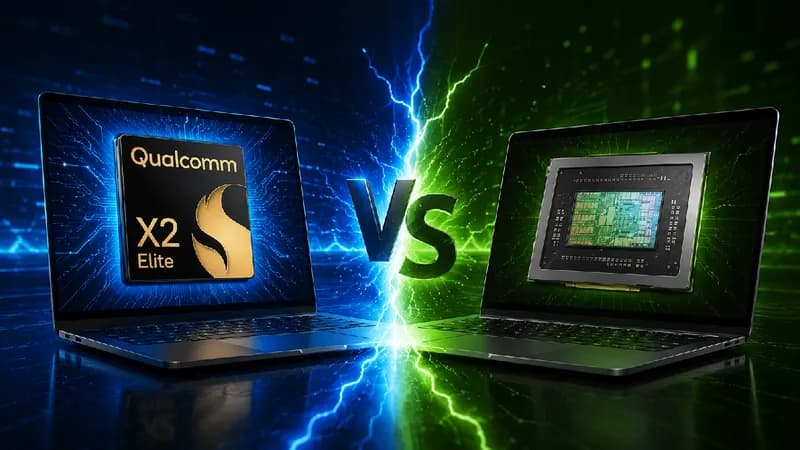
For the first time in years, Qualcomm is facing serious competition in the Windows-on-ARM market. The arrival of Nvidia’s RTX Spark platform has changed the conversation overnight, and investors noticed immediately. Qualcomm shares took a sharp hit after Nvidia revealed its new ARM-based chip at Computex 2026, showing just how serious a threat this could be for the company.
The Qualcomm Snapdragon X2 Elite vs Nvidia RTX Spark debate is now one of the most important discussions in the PC industry. Both companies are chasing the same goal: delivering Apple Silicon-like performance on Windows laptops. But while Qualcomm has a head start, Nvidia may have brought the stronger package.
Nvidia's RTX Spark is built around the company's Grace Blackwell architecture and is designed to combine CPU performance, graphics power, and AI processing into a single ARM-based platform.
The chip includes:
Unlike traditional laptop processors, RTX Spark is designed with AI workloads in mind. Nvidia says users will be able to run large AI models locally without relying heavily on cloud services.
Major manufacturers including ASUS, Dell, HP, Lenovo and Microsoft Surface are expected to launch RTX Spark-powered devices in Autumn 2026.
Qualcomm's Snapdragon X2 series is the successor to the Snapdragon X Elite that helped revive interest in Windows on ARM laptops.
The flagship Snapdragon X2 Elite Extreme brings major improvements over the previous generation:
Qualcomm claims the X2 Elite Extreme can match or even outperform Apple's M4 Pro in several CPU benchmarks. Compared to the original Snapdragon X Elite, the company reports up to 39% better single-core performance and 50% higher multi-core performance.
For users focused on productivity, office work, coding, and multitasking, Qualcomm's latest chip remains a very compelling option.
AI is where the biggest competition in computing is right now, and Nvidia is showing its strength here.
The RTX Spark offers over 100 TOPS of AI performance, putting it ahead of Qualcomm’s 80 TOPS NPU. But the real game-changer isn't just the raw numbers, it's Nvidia’s CUDA ecosystem. CUDA has been the gold standard for AI development for over a decade.
Because developers working on machine learning, generative AI, and LLMs are already deeply entrenched in CUDA-compatible tools, Nvidia gains an immediate ecosystem advantage that goes way beyond hardware specs. For AI creators and developers, the RTX Spark is shaping up to be the default Windows laptop platform.
While Qualcomm made massive strides in CPU performance with the X2 Elite Extreme, graphics performance is still its Achilles' heel.
Snapdragon laptops are perfectly fine for casual gaming and lighter creative work, but the RTX Spark changes the game entirely by packing a full Blackwell GPU architecture. It even brings support for DLSS 4.5, Nvidia’s premier AI-powered upscaling tech.
This means:
For anyone who plays games or creates content for a living, Nvidia holds a clear, undisputed advantage here.
Despite Nvidia's impressive debut, Qualcomm is far from out of the race.
The biggest advantage for Snapdragon X2 Elite laptops is simple: they're available now.
Consumers looking for an ARM-based Windows laptop today can already buy devices powered by Qualcomm's latest chips. These systems offer strong battery life, excellent CPU performance, and increasingly mature Windows-on-ARM support.
Furthermore, Qualcomm is casting a wider net by targeting more affordable AI-capable laptops. On the flip side, Nvidia's RTX Spark machines are expected to command a hefty premium, likely starting around the $1,800 mark.
For a huge chunk of buyers, real-world availability and pricing will always matter more than bleeding-edge AI specs.
The launch of the RTX Spark is easily the most monumental milestone for the Windows-on-ARM ecosystem since Qualcomm first dropped the original Snapdragon X Elite.
Healthy competition is exactly what the market needs, and Microsoft’s ARM ecosystem desperately required another heavy hitter to stir things up. Nvidia’s entrance into the arena will likely accelerate software optimizations, force developers to fix app compatibility issues faster, and push hardware manufacturers to design even better ARM machines.
Ultimately, consumers win. Instead of relying on a single chip supplier, Windows users will soon have multiple high-performance choices fighting for a spot in their backpack.
If you are looking to buy a Windows laptop today, the Snapdragon X2 Elite Extreme stands out as one of the best ARM processors on the market. It offers fantastic CPU speed, incredible battery efficiency, and plenty of AI power for the average user.
That said, Nvidia’s RTX Spark is undeniably the more ambitious project. With its superior graphics, higher AI compute ceilings, massive memory caps, and the unmatched power of the CUDA ecosystem, it is poised to become the definitive benchmark for premium ARM-based Windows laptops when it arrives later in 2026.
Right now, Qualcomm wins on availability. But by the end of the year, Nvidia might just win on everything else.