

/
/
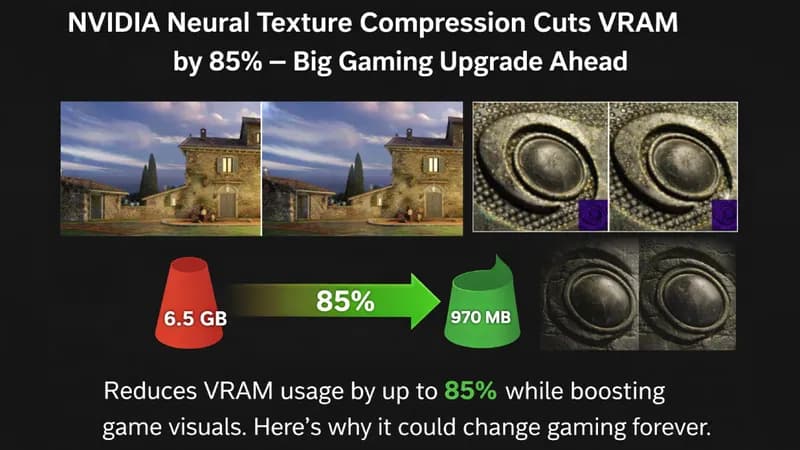
NVIDIA Neural Texture Compression reduces VRAM usage by up to 85% while boosting game visuals. Here’s why it could change gaming forever.
If you’ve ever complained about games eating up your GPU memory, this might be the breakthrough you’ve been waiting for.
At GTC 2026, NVIDIA Neural Texture Compression quietly stole the spotlight, and honestly, it deserves way more attention than it’s getting right now.
During a technical session, NVIDIA demonstrated something pretty wild. Using its Neural Texture Compression (NTC), a scene that normally consumed 6.5GB of VRAM dropped to just 970MB. That’s not a small improvement, that’s an 85% reduction in VRAM usage.
Even more surprising? The visual quality looked almost identical. No obvious downgrade, no blurry textures, none of the usual compression mess we’ve come to expect.
Here’s what stood out from the demo:
And yeah, that’s a pretty big deal in 2026, where games are easily crossing 100GB installs.
Let’s keep it simple.
NVIDIA doesn't save every little detail of a texture directly, like older methods do. Instead, it uses AI to save a compressed version of the texture, which is like a smart blueprint. Then, when the game runs, a small neural network inside the GPU rebuilds the texture in real time.
This isn’t generative AI doing random stuff. It’s deterministic, meaning it recreates the same texture every single time, no weird inconsistencies.
In practical terms, the Old method stores everything, which uses a lot of memory. The new method stores smarter data and rebuilds it instantly, using much less memory.
It’s basically GPU memory optimization done right, not just another AI buzzword.
Let’s be real, VRAM has become a serious problem lately.
Modern AAA games push GPUs hard, and even 8GB VRAM cards have started feeling outdated. That’s been frustrating for gamers who don’t want to upgrade every year.
But with NVIDIA Neural Texture Compression, things could shift:
And honestly, this feels like a smarter solution than just throwing more hardware at the problem.
Here’s the interesting part, this tech isn’t locked to NVIDIA forever.
NTC is made to work with modern GPU architectures, like those from AMD and Intel. Microsoft is also already pushing similar ideas through DirectX standards.
In other words, this could be a change that affects the whole industry, not just one company.
Still, NVIDIA has a clear advantage right now because its GPUs already use Tensor Cores, which are perfect for these AI workloads.
Here’s where things slow down a bit.
Despite being introduced years ago and now available via SDK, no major game has implemented Neural Texture Compression yet. That’s… surprising.
But not unusual either. Game development takes time, and new tech like this needs proper integration. If anything, GTC 2026 felt like NVIDIA reminding developers: “Hey, this is ready. Start using it.”
Let’s be honest, a lot of AI in gaming feels unnecessary or overhyped.
But this? This actually solves a real problem.
NVIDIA Neural Texture Compression doesn't use flashy tricks; instead, it focuses on what gamers really want: better performance, smaller game sizes, and no loss of visual quality.
If developers adopt it properly, we could see a future where game size stops exploding and GPUs stop struggling just to load textures. And honestly, that’s long overdue.
NVIDIA Neural Texture Compression isn’t just another tech demo, it’s a practical upgrade that could reshape how games handle memory. Now the ball is in developers’ court.










