

/
/
Nvidia AGI claim by Jensen Huang shocks tech world. Has human-level AI arrived or is it hype? Experts clash as debate intensifies globally.
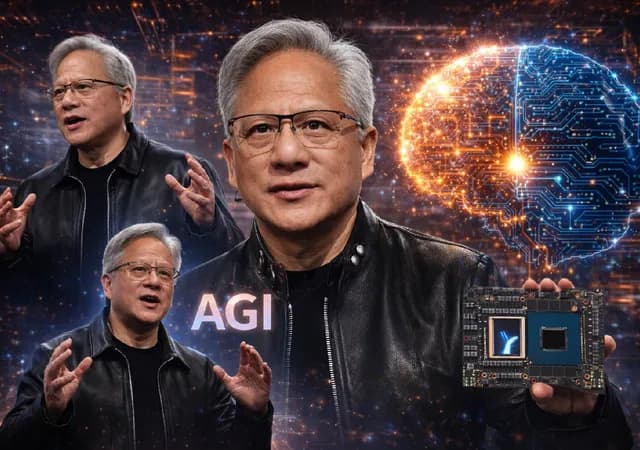
What if the future everyone warned about… is already here?
That’s the question I found myself asking after hearing the Nvidia AGI claim straight from CEO Jensen Huang. Not hinted at. Not predicted. Declared.
“I think it’s now. I think we’ve achieved AGI.”
He said it casually on a podcast, but the impact? Anything but casual.
Having followed this story closely, I can tell you, this wasn’t just another tech soundbite. It landed like a thunderclap.
Huang made the statement during a conversation with computer scientist Lex Fridman, where AGI, short for artificial general intelligence, was framed as AI capable of doing human-level work. Not narrow tasks. Entire jobs. Even running billion-dollar companies. And Huang didn’t hesitate.
He pointed toward the rise of AI agents, especially platforms like OpenClaw AI, where systems can autonomously perform tasks, build apps, and even create digital products that scale to millions.
In my view, this is where the Nvidia AGI claim gets interesting, and dangerous. Because Huang isn’t talking about theory. He’s pointing at things already happening.
Here’s what’s often missed. Just minutes after declaring AGI is here, Huang pulled the brakes. Hard. He admitted that most AI agents lose relevance quickly.
And then came the line that contradicts everything: “The odds of 100,000 of those agents building Nvidia is zero percent.”
So which is it? Have we reached human-level intelligence… or are we still nowhere close? This contradiction is exactly why the Nvidia AGI claim is dividing the tech world right now.
AGI is one of the most overused and misunderstood terms in tech, and that confusion is the real issue. Ideally, it means AI matching human intelligence across all tasks. But today, it’s often used for systems that are simply very good at specific things.
The same gap exists with AI agents. They’re meant to work fully on their own, yet most still depend heavily on human input. And while “human-level” AI should involve real reasoning and decision-making, what we have now is fast automation with limited understanding.
Even OpenAI’s Sam Altman says we’re “close,” but later called it more of a symbolic claim. Meanwhile, Microsoft’s Satya Nadella insists we’re nowhere near. That’s why Huang’s statement isn’t just bold, it’s fueling a debate no one has settled yet.
Let me be blunt. This isn’t just a tech headline.
If the Nvidia AGI claim is even partially true, the consequences are massive.
But Huang himself admits the limits. AI can build something viral. Maybe even profitable.
But can it sustain, lead, and evolve like humans? Not yet.
And that gap, that fragile, uncertain gap, is where we’re living right now.
In my view, the Nvidia AGI claim is less about reality and more about perspective.
If you define AGI loosely, yes, we’re seeing glimpses of it. AI can code. Write. Design. Automate workflows. Even simulate creativity.
But if you define AGI strictly, true human-like reasoning, long-term planning, emotional intelligence, we’re still far away. And that’s the uncomfortable truth.
The Nvidia AGI claim isn’t just a statement. It’s a signal. A signal that the line between human and machine intelligence is no longer clear. And once that line disappears completely, there’s no going back.










