

/
/
Nvidia is building space AI modules with Starcloud to power orbital data centres, solving energy demand and enabling real-time AI beyond Earth
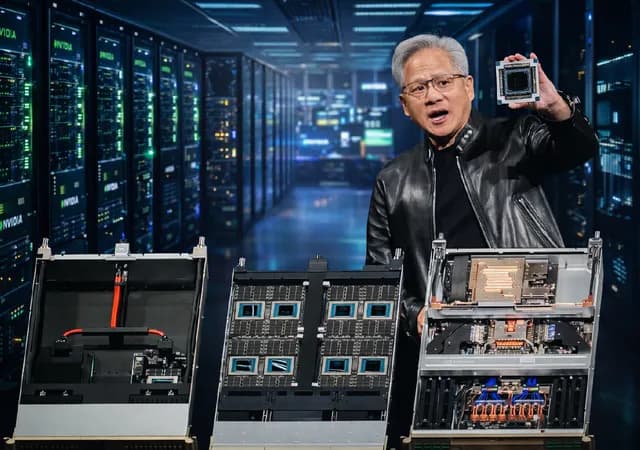
The race for artificial intelligence dominance just left Earth’s surface, and this might be the most ambitious move we’ve seen yet. Nvidia has officially stepped into space computing, announcing plans to power orbital data centres using its latest AI technology.
At its GTC 2026 conference in San José, CEO Jensen Huang revealed a new system called the Vera Rubin Space-1 module, designed to run AI workloads directly in orbit. Partnering with startup Starcloud, Nvidia is preparing for a satellite launch expected in November 2026, what the company calls the “cosmic debut” of this technology.
Let’s be clear: this isn’t just another tech announcement. This could fundamentally change how AI infrastructure works.
Here’s the real issue driving this move, AI is insanely power-hungry. Data centres on Earth are already consuming massive electricity, and with AI models growing larger, the demand is only getting worse.
Nvidia’s answer? Take computing to space.
In orbit, satellites can harness continuous solar energy, avoiding power shortages and cutting dependence on land-based infrastructure. That’s a huge deal. No land acquisition issues, no local resistance, and theoretically unlimited sunlight.
Key highlights of this plan include:
In simple terms, Nvidia isn’t just scaling AI, it’s relocating it.
The Vera Rubin Space-1 module is not a small upgrade, it’s a leap. Nvidia claims it can deliver up to 25 times more AI computing power than its H100 GPU in space environments.
That kind of performance opens doors for running large language models directly in space, real-time satellite data analysis, autonomous decision-making systems and faster geospatial intelligence processing.
And it doesn’t stop there. Nvidia is also deploying platforms like IGX Thor and Jetson Orin to enable edge computing in orbit, basically turning satellites into smart, independent systems instead of passive data collectors.
This is where things start to feel futuristic. Satellites won’t just send data, they’ll think.
Nvidia isn’t doing this alone. Starcloud is playing a key role, and its upcoming satellite, Starcloud-1, is expected to be a game changer.
About the size of a small refrigerator, this satellite is projected to deliver 100 times more computing power than previous space systems. That’s not incremental growth, that’s explosive.
Starcloud’s CEO Philip Johnston even made a bold prediction: “In 10 years, nearly all new data centres will be built in outer space.”
That might sound extreme, but given the current pace of AI growth, it’s not as far-fetched as it seems.
This idea sounds wild at first. Data centres in space? Really?
But when you break it down, it actually makes a lot of sense:
Major players and startups are already jumping in, including Axiom Space, Kepler Communications and Planet Labs. This isn’t a one-company experiment, it’s the beginning of a new tech ecosystem.
That said, it’s not all smooth sailing. Space is brutal.
There are serious technical risks:
If Nvidia and its partners can solve these challenges, this could redefine computing. If not, it could remain an expensive experiment.
This isn’t just futuristic hype. It feels inevitable.
AI demand is exploding, and Earth simply may not be enough to sustain it long term. Nvidia’s move to build AI infrastructure in space might sound bold today, but in hindsight, it could look obvious.
If this works, we’re not just talking about better AI, we’re talking about a completely new layer of global computing infrastructure floating above us.
And yeah, that’s as crazy, and exciting, as it sounds.










