

/
/
Nvidia DLSS 5 brings AI-powered photoreal lighting to RTX 50 GPUs transforming game visuals but sparking debate over artistic control and realism in 2026 launch
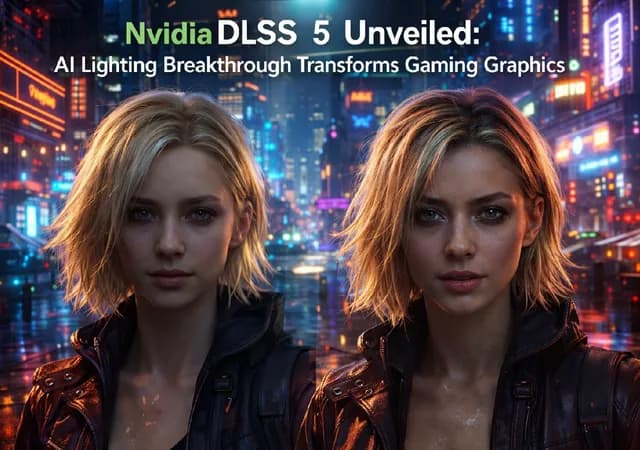
Nvidia just pulled off something big, like, genuinely industry-shifting big. The company showed off the Nvidia DLSS 5 at GTC 2026, and if the early demos are any indication, gaming graphics may never look the same again. But here is the twist: not everyone is celebrating.
This isn’t just another performance boost. This is Nvidia trying to redefine how games look, and that’s where things get interesting… and a little uncomfortable.
For years, DLSS has been about boosting frame rates and making games smoother. Nvidia DLSS 5 flips that idea completely. It’s not about performance anymore, it’s about photorealism.
Using a real-time neural rendering model, DLSS 5 analyzes simple inputs like color and motion vectors and then rebuilds lighting and materials using AI. The result? Games that look closer to Hollywood CGI than traditional rendering.
In demos shown across titles like Starfield, Assassin’s Creed Shadows and Hogwarts Legacy, the improvements were obvious:
And the wild part? The original game assets, geometry and textures, remain unchanged. The AI does all the heavy lifting.
Here’s where the Nvidia DLSS 5 gets a bit futuristic. The AI model doesn’t just enhance visuals, it understands scenes.
It can distinguish between skin, hair, water, and metal, applying different lighting behaviors to each. That’s a massive leap from traditional rendering pipelines.
Nvidia says this approach bridges the gap between real-time graphics and cinematic visuals. And honestly, after seeing the demos, that claim doesn’t feel exaggerated.
But, and this is important, it’s still a work in progress. Early builds showed minor errors, especially in screen-space rendering. Nvidia calls this a “snapshot,” with improvements expected before the Fall 2026 release.
Let’s talk practicality.
During demos, Nvidia reportedly used two RTX 5090 GPUs, one for running the game and another dedicated to DLSS 5 processing. That’s… not exactly consumer-friendly.
Yes, Nvidia promises it will run on a single RTX 50-series GPU at launch. But the big question remains:
How demanding will this actually be?
If DLSS 5 uses too many resources, it could end up being a niche feature instead of a big breakthrough. And gamers have seen this story before.
Here’s where things get spicy.
Not everyone is impressed with the Nvidia DLSS 5. Some early reactions are calling it:
And honestly? I get the concern.
In some comparisons, character faces looked noticeably different, almost like a beauty filter had been applied. That raises a serious question:
If AI is altering how a game looks, is it still the developer’s vision?
Nvidia insists developers will have control over intensity, color grading, and where effects are applied. But the debate isn’t going away anytime soon.
This feels very similar to what happened with AI in photography and video, exciting, powerful, but also a little… unsettling.
Despite the controversy, big studios are already on board. Nvidia confirmed support from major developers like Bethesda, Capcom, Ubisoft, and Tencent.
Some of the games expected to support Nvidia DLSS 5 include:
Developers seem optimistic, especially about how the tech enhances immersion. And to be fair, when it works well, it really works.
Nvidia DLSS 5 is impressive. Probably the biggest leap in graphics since ray tracing.
But it also feels like a shortcut.
Instead of waiting for hardware to catch up, Nvidia is using AI to “fake” realism. And while that sounds harsh, it’s not necessarily a bad thing, it’s just… different.
The real concern is control. If developers can fine-tune it, DLSS 5 could be revolutionary. If not, we might end up with games that all look oddly similar, filtered through the same AI lens.
Nvidia DLSS 5 is expected to roll out in Fall 2026 for RTX 50-series GPUs. Until then, expect:
Because one thing is clear, this isn’t just a tech upgrade.
It’s a philosophical shift in how games are created and experienced.
And whether you love it or hate it… you’re definitely going to notice it.










