/
/
Ravi Tamta successfully tests HAPIDA SKYNeX, an electric flying pod in Uttarakhand. The prototype showcases India's growing innovation in personal air mobility.
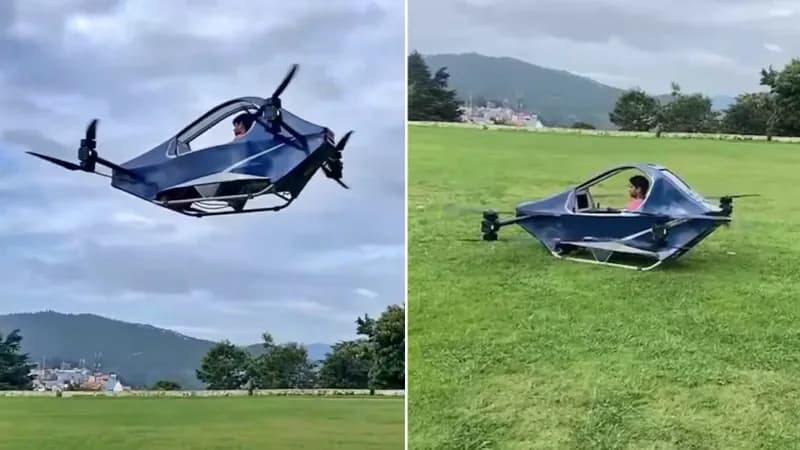
Something that most of us have only seen in science-fiction films quietly became real in the hills of Uttarakhand. The Ravi Tamta Electric Flying Pod has completed its first public test flight in Almora, where local innovator Ravi Tamta took the wraps off his fully electric personal flying vehicle, the HAPIDA SKYNeX. It's still a prototype, yes, but watching it lift off the ground has got people genuinely excited about where personal air transportation in India could be headed.
Behind the project is Tamta's own startup, Hapida Sky Private Limited, built on years of quiet, determined research into cleaner and smarter ways to move through difficult terrain.
The test happened in Almora district, right in the heart of Uttarakhand, where Tamta flew the HAPIDA SKYNeX prototype with one passenger on board. The single-seater runs entirely on electricity, built on upgraded drone technology, and is designed for vertical take-off and landing, no runway needed, zero direct emissions.
Seeing it actually fly was the biggest milestone the project has hit so far.
Videos from the test spread fast on social media, and the reaction was something, people calling it one of the most genuine examples of homegrown innovation to come out of rural India in recent memory.
A remarkable innovation has emerged from Kaflikhan village near Jageshwar Dham in Almora, Uttarakhand. Young innovator Ravi Tamta has successfully tested the prototype of HAPIDA SKYNeX, an electric personal flying vehicle developed by his company, Hapida Sky Private Limited.
— Manjeet Negi (@manjeetnegilive) August 7, 2026
This… pic.twitter.com/Vyn9CE8BGr
Most experimental aircraft still depend on aviation fuel. The HAPIDA SKYNeX doesn't. It's fully electric, and that's a big part of what makes it stand out.
Ravi Tamta's goal has always been straightforward: build a personal electric flying vehicle that's safe, affordable and kind to the environment, something that could actually solve real problems, especially in mountain regions where getting from one place to another by road can eat up your entire day.
The vehicle brings together:
It still needs more development and testing before anyone talks seriously about commercial use, but the fact that it flies is a meaningful start.
Tamta didn't arrive at this idea in a lab. He arrived at it on the road.
A trip of roughly 40 kilometres in the Almora region can take around 90 minutes because the roads wind endlessly through the mountains. His vision is for an electric flying vehicle to cut that same journey down to 10 or 15 minutes. That's not just convenience, in a region where road connectivity can be the difference between life and death in an emergency, it's genuinely significant.
If the technology keeps developing, the possibilities are real:
After the flight, Tamta was candid about what it took to get here. Years of experimentation, failed attempts, and constant refinement. This isn't someone who stumbled into aviation, he's been building things for a long time.
Before HAPIDA SKYNeX, he worked on a GPS-enabled smart stick, mobile charging devices and ideas around electric vehicle charging. The flying pod is the most ambitious thing he's done, but it fits a pattern of someone who doesn't wait for resources to show up before he starts building.
Online, the response has been genuinely warm. People praised Tamta for showing that cutting-edge technology doesn't have to come from a Silicon Valley garage or a well-funded corporate lab. It can come from a small town in the Himalayas.
The phrase "desi innovation" showed up in a lot of posts, and others used the moment to call on authorities to put real support behind independent engineering efforts like this one. It's also quietly burnishing Uttarakhand's reputation as a place where innovation suited to mountain life is starting to take root.
It's worth being clear-eyed here. HAPIDA SKYNeX is still an early prototype, and there's a long road between a successful test flight and something the public can actually use.
Before that happens, the vehicle will need:
That's true of any personal air mobility technology, and it's not a knock on the project. It's just how responsible aviation development works.
The successful test of the Ravi Tamta Electric Flying Pod isn't just a feel-good viral story. It's a signal that Indian innovators are working seriously on the kind of next-generation transport that the rest of the world is also chasing. HAPIDA SKYNeX has a long way to go before it's ready for production, but its first flight proves that locally grown ideas, built without massive funding or international backing, can still push boundaries.
If testing goes well and regulatory approvals follow, HAPIDA SKYNeX could one day genuinely reshape how people move through India's mountains, making it cleaner, faster and a little less dependent on roads that the terrain never made easy to build in the first place.