

/
/
India slips to 6th largest economy in IMF rankings due to weaker rupee and GDP revisions. Growth stays strong, rebound likely by 2027 ahead.
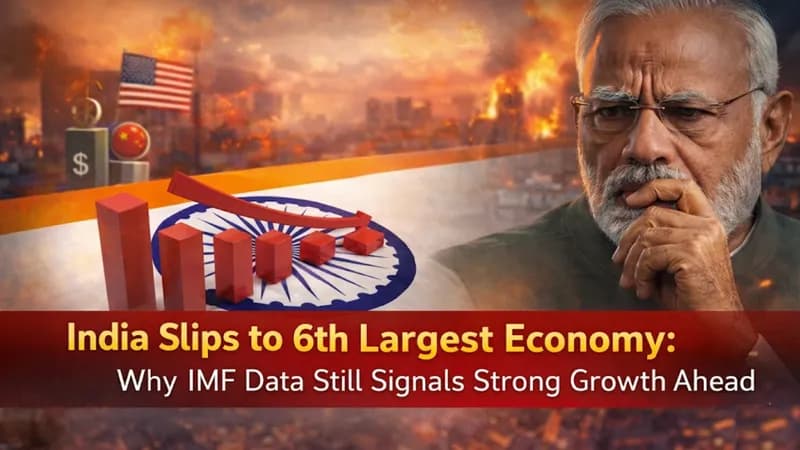
India slips to 6th largest economy, and yes, that headline will grab attention. But if you stop there, you miss the real picture. According to the International Monetary Fund’s latest April 2026 World Economic Outlook, India is now the world’s sixth-largest economy in nominal GDP terms. It now sits behind the United States, China, Germany, Japan, and the United Kingdom.
But let’s be honest, this is more about math and currency than actual economic weakness.
India’s economy has not suddenly slowed down or collapsed. In fact, the country continues to be one of the fastest-growing major economies in the world. The ranking change is mainly because global GDP tables are measured in US dollars, and when the rupee weakens, India’s economy looks smaller on paper. That’s the uncomfortable truth many dramatic headlines skip.
The biggest reason is simple, the rupee lost value against the US dollar.
When India’s GDP is converted into dollars, a weaker rupee reduces the final number. Even if factories produce more, services grow, and consumption rises, the converted dollar value can still fall behind another country with a stronger currency.
That’s exactly what happened.
India’s nominal GDP for 2025 is estimated around $3.92 trillion, while the UK is placed near $4 trillion, pushing India down one spot. Japan remains ahead at roughly $4.44 trillion.
Another factor was India’s GDP base year revision and methodology updates, which adjusted some nominal figures lower than earlier estimates. These technical revisions may sound boring, but they matter in global rankings.
This is where perspective matters.
A country’s rank in nominal GDP is not the same as economic health. India is still expanding faster than most advanced economies. IMF data continues to project India among the strongest major growth stories globally, with growth estimates above many developed nations.
That means jobs, infrastructure, domestic demand, digital services, manufacturing push, and investment momentum still remain central to India’s story.
The scoreboard changed, but the team is still playing well.
The rupee hasn’t weakened in isolation. Several global factors are adding pressure:
India imports a huge share of its crude oil needs, so when oil prices rise, dollar demand increases. That naturally affects the currency. And once again, when the currency moves, global GDP rankings move too.
Very likely, yes.
Several projections suggest India could regain higher positions in the coming years. Some estimates indicate India may move back above the UK by 2027 and challenge Japan after that. Longer-term forecasts still place India among the top three economies by the early 2030s if growth momentum continues.
That is why this moment should be seen as a pause, not a reversal.
Here’s my honest view: India gets too emotionally attached to rank numbers.
Being fourth, fifth, or sixth matters symbolically, but ordinary people care more about incomes, jobs, inflation, roads, business opportunities, and quality of life. Those are the real indicators that define whether growth is meaningful.
A stronger rupee would help. Better exports would help. Lower dependence on imported energy would help even more.
But panic over one IMF table? That would be misplaced.
Yes, India slips to 6th largest economy in the latest IMF ranking. But the fall is driven largely by currency movement and technical revisions, not by a broken economy. India remains one of the world’s fastest-growing major nations, and the long-term story is still alive. If reforms continue and external pressures ease, this dip may soon look like a temporary detour rather than a major setback.









