/
/
A CNG car exploded while refueling near Karjan in Vadodara, damaging two nearby vehicles. No one was inside the car when the blast occurred.
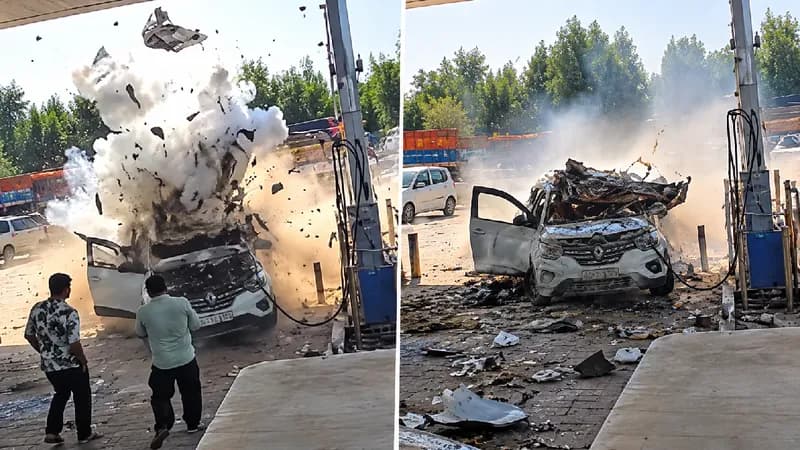
A sudden blast at a CNG station near Karjan in Gujarat's Vadodara district turned a routine refuelling stop into a frightening scene on October 1. A Renault Triber fitted with an aftermarket CNG kit reportedly exploded while being refuelled, sending pieces of metal and glass across the area.
The incident happened at a CNG station on National Highway-48, opposite Jindal Company. According to reports cited by NDTV and The Times of India, the explosion badly damaged the rear portion of the car and also affected two vehicles parked nearby.
The biggest relief came from one crucial detail: nobody was inside the CNG car when the explosion happened. That helped prevent what could have been a far more serious incident.
According to reports, the explosion occurred during the afternoon while the vehicle was undergoing CNG refuelling.
The blast reportedly tore apart the rear section of the Renault Triber, with fragments flying into the surrounding area. Two nearby vehicles were also damaged in the incident.
Emergency teams were called to the spot after the explosion. Firefighters and police responded and brought the situation under control while an investigation was launched into what caused the blast.
Some bystanders were reportedly hurt with minor injuries, although the available reports indicate there were no major casualties.
A massive explosion erupted while a CNG car was being refuelled at a fuel station near Karjan on National Highway-48 in Gujarat.
The blast tore apart the rear section of the vehicle, sending metal and glass fragments flying across the area. Two nearby vehicles were also damaged… pic.twitter.com/D3sjfZqFO2— NDTV (@ndtv) October 3, 2026
The exact cause has not yet been conclusively established.
Early reports have pointed towards a possible technical fault or excessive pressure involving the CNG tank. However, these remain preliminary possibilities, and the final cause would depend on the investigation and technical examination of the vehicle and its CNG system.
The fact that the Renault Triber reportedly had an aftermarket CNG kit is also relevant. However, it would be premature to conclude that the aftermarket installation itself caused the explosion without an official finding.
The Karjan incident has once again drawn attention to basic precautions around CNG refuelling.
Passengers are generally advised to step out of the vehicle while CNG is being filled and follow the instructions of station personnel. The engine should be switched off, and people should keep away from the immediate refuelling area as instructed.
CNG systems are designed with multiple safety measures, but a vehicle's condition, installation quality, maintenance and the refuelling equipment can all matter when investigating an unusual incident.
For owners of cars with aftermarket CNG kits, regular inspection by qualified technicians and proper maintenance are especially important.
While videos and posts from the incident have circulated online, social media footage alone cannot establish why the vehicle exploded.
Authorities will need to examine the damaged vehicle, CNG cylinder, valves, fittings and refuelling equipment before reaching a definitive conclusion.
For now, the most significant fact is that the car was reportedly unoccupied when the blast happened. The incident could have had much more serious consequences had people remained inside or been standing immediately beside the vehicle.
The Karjan explosion is therefore a stark reminder that CNG refuelling should be treated as a safety-sensitive process, not simply a routine stop at a fuel station.