Why Is Lord Jagannath's Idol Different from Other Hindu Gods? The Fascinating Legend Behind It
Have you ever wondered why Lord Jagannath's idol looks so different from other Hindu deities? Unlike most idols, Lord Jagannath has no fully formed hands or feet, and His large round eyes and unique appearance immediately stand out.


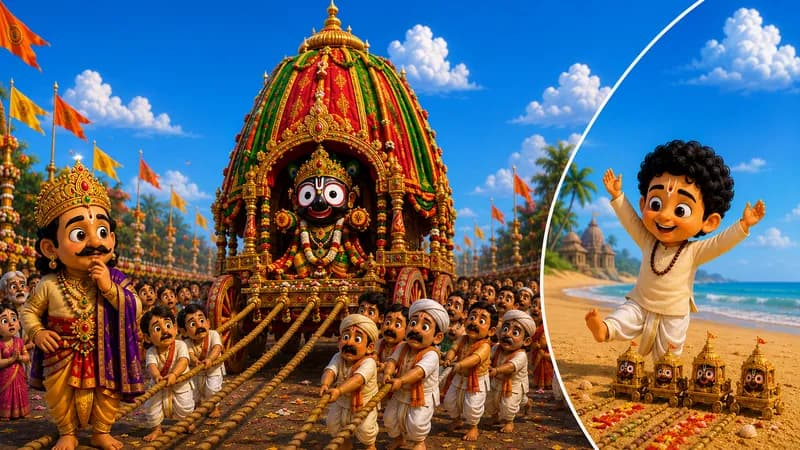
Was the idol left unfinished, or is there a deeper spiritual meaning behind it? According to Hindu tradition, there is a fascinating legend that explains this extraordinary form.
The Story Begins After Lord Krishna's Departure
According to Hindu beliefs, after Lord Krishna completed His earthly journey, the city of Dwarka was submerged beneath the sea. While His physical body disappeared, many traditions believe that His divine essence, often referred to as the Brahma Tattva (divine spiritual energy), continued to exist.
This sacred belief forms the foundation of the Jagannath tradition.
King Indradyumna's Divine Dream
Many years later, King Indradyumna, a devoted ruler of ancient Odisha, is believed to have received a divine vision of Lord Krishna.
In the dream, the Lord instructed the king to search for His sacred presence and build a magnificent temple dedicated to Him.
Following the vision, the king's men discovered a mysterious log of wood on the seashore. According to legend, the wood was unlike any ordinary timber and was considered divinely blessed.
The Mysterious Sculptor
As the story goes, an elderly carpenter arrived at the king's palace and offered to carve the idols.
Many devotees believe this mysterious craftsman was Lord Vishwakarma, the divine architect of the gods, in disguise.
He agreed to create the idols on one condition: no one should open the workshop door for 21 days while he worked.
The king accepted the condition, and the sculptor began his work in complete privacy.
The Promise Was Broken
For several days, sounds of carving could be heard from inside the workshop. However, on the fifteenth day, everything suddenly became silent.
The queen grew worried, fearing that something terrible had happened to the elderly craftsman. Unable to control their concern, the king ordered the door to be opened before the agreed time.
Inside, the carpenter had disappeared.
In his place stood the wooden idols of Lord Jagannath, Lord Balabhadra, and Goddess Subhadra. Their hands and feet were not fully carved, yet their divine presence filled the room.
According to the legend, a heavenly voice told the king not to grieve, explaining that this unfinished-looking form was the Lord's chosen appearance and that He wished to be worshipped in this form during the present age.
The Sacred Tradition of Nabakalebara
One of the most unique traditions associated with Lord Jagannath is Nabakalebara, which means "new body."
Approximately every 12 to 19 years, depending on a specific astronomical alignment, the wooden idols of Lord Jagannath, Lord Balabhadra, Goddess Subhadra, and Sudarshana are replaced with newly carved ones.
During this sacred ritual, devotees believe that a mysterious and highly revered spiritual element, known as the Brahma Padartha, is transferred from the old idols to the new ones.
The ceremony is conducted in complete secrecy, and the exact nature of this sacred element remains unknown to the public.
The Spiritual Meaning of Lord Jagannath's Form
Devotees believe that Lord Jagannath's unique appearance carries a powerful spiritual message.
His large eyes symbolize His ability to watch over every devotee without discrimination. His simplified form reminds people that God is beyond physical perfection and that true devotion comes from faith and love rather than outward appearance.
The idol teaches that divine grace is available to everyone, regardless of status, background, or identity.
Lord Jagannath's idol is not considered incomplete by devotees. Instead, it represents a unique and sacred form chosen by the Lord Himself, according to Hindu tradition.
For millions of devotees, the story of Lord Jagannath is a reminder that spirituality is rooted in devotion, compassion, and faith—not in external appearance.
Note: The events described in this article are based on Hindu religious traditions and devotional beliefs. They are part of sacred mythology and should be understood as matters of faith rather than established historical or scientific fact.