

/
/
UPI transaction failed despite enough balance? Know the top reasons behind payment failures, server issues, wrong PIN, bank limits and fixes.
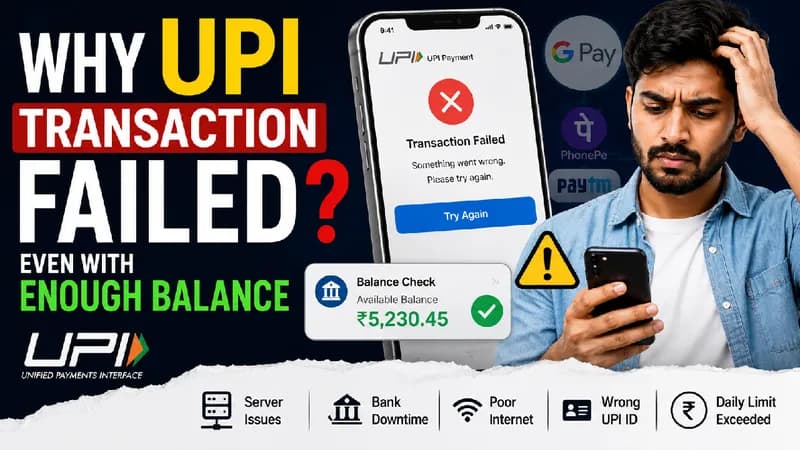
UPI transaction failed: A failed UPI payment has become one of the most irritating parts of daily life in India right now. The frustrating part is that many users are seeing the same message again and again even when there is enough money sitting in their bank account. One second the payment screen says “processing,” and the next second the transaction fails without any proper explanation.
The problem is now so common that many people have started keeping cash as backup again. That says a lot about how dependent India has become on digital payments.
UPI has made payments incredibly fast and convenient over the last few years. From tea stalls to shopping malls, almost everyone accepts it. But the system still depends heavily on servers, banks, apps and internet stability working together perfectly. The moment one thing breaks, the entire payment chain collapses.
The biggest reason behind a UPI transaction failed error is usually not low balance. In most cases, the issue comes from technical or banking-side problems.
This is probably the most common reason users face payment failures.
A UPI payment depends on:
If even one server slows down or crashes, the payment may fail instantly.
This usually happens during Salary days, Festival shopping periods, Evening peak hours, and Flash sales and ticket bookings.
Sometimes the problem is simply weak mobile internet. Even a short network interruption can stop authentication midway.
A lot of people immediately blame apps like PhonePe, Google Pay or Paytm, but many times the actual problem is the bank servers not being able to handle heavy traffic.
Another common issue is incorrect recipient information.
A payment may fail if:
What makes this worse is that people usually notice the mistake only after the transaction fails multiple times.
Double-checking the receiver’s details before sending money may sound basic, but it still saves people from unnecessary stress.
A lot of users don’t realize that banks and UPI apps come with daily transaction limits.
Even if your account has ₹50,000, your payment may still fail if:
Some banks also apply risk-based restrictions when they notice unusual payment activity.
This is one of those hidden banking rules most users only discover after repeated failures.
Entering the wrong UPI PIN multiple times is another major reason behind failed transactions.
For security reasons:
People often panic when this happens, thinking their account has a serious issue. In reality, it is usually a temporary security lock.
This part rarely gets enough attention. Sometimes the issue is not with the bank at all. Sometimes the UPI app itself is the problem. If the app is outdated or overloaded, payments can fail even when there’s enough balance.
Some common app-related problems include Old app versions, Corrupted cache files, Session timeout issues and Device compatibility bugs.
Usually, simple things like updating the app, clearing the cache, or restarting the phone fix the problem way quicker than just waiting around for it to work again.
This is the part a lot of people should know. If the money gets deducted but the payment fails, the amount usually comes back automatically within a few hours or a couple of business days. In most cases, the money is not lost permanently.
Still, payment delays create panic because people expect UPI to work instantly every single time now.
And honestly, that expectation is fair. India’s digital payment ecosystem has grown so rapidly that users now treat UPI failures like service breakdowns rather than technical glitches.
Here are a few practical things that genuinely help:
If the money still doesn’t come back in expected time, contact your bank or the app’s customer support with the transaction ID.
There is no doubt that UPI changed digital payments in India forever. It made cashless payments normal even in small towns and local markets. But frequent payment failures are becoming difficult to ignore now.
The reality is simple, India’s UPI ecosystem is growing faster than the infrastructure supporting it.
Until banks improve server capacity and payment networks become more stable during peak hours, users will continue facing random transaction failures, even when their bank balance looks perfectly fine.










