

/
/
Telegram Banned in India: India restricts Telegram until June 22 ahead of NEET 2026 re-exam, citing paper leak scams and misinformation targeting students.
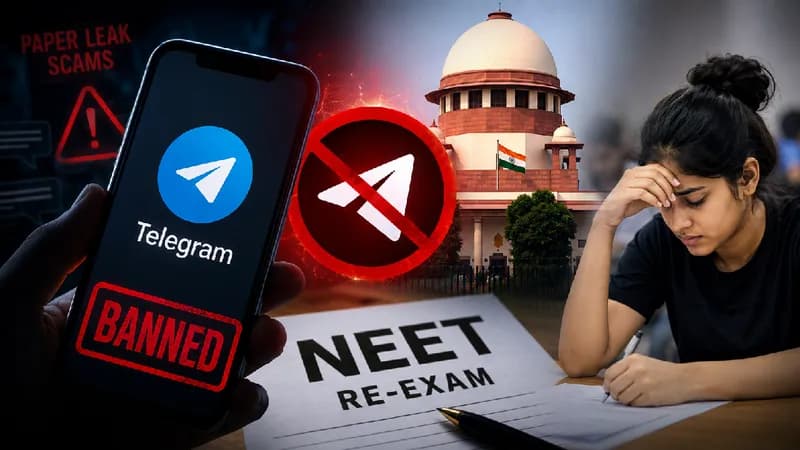
Telegram Ban in India: Just a week before one of India’s highest-stakes exams, the government has dropped a bombshell by restricting Telegram across the country. This drastic move is aimed straight at curbing alleged fraud linked to the upcoming NEET 2026 Re-Exam, but it has immediately reignited a massive debate over paper leaks, student trust, and whether blocking an entire app is actually the right call.
The temporary restriction will remain in place until June 22, one day after the NEET-UG 2026 re-exam scheduled for June 21. Authorities have also directed Telegram to disable its message-editing feature in India until June 30.
The Ministry of Electronics and Information Technology acted on recommendations from the National Testing Agency (NTA), which claimed that organised cheating networks were using Telegram channels, groups and bots to target NEET candidates.
According to the NTA, several Telegram channels openly advertised supposed access to examination papers and demanded payments ranging from thousands to several lakh rupees from students and their families.
Officials stressed that no genuine NEET question paper exists outside the secured examination process and warned candidates against falling for such claims.
The move comes after the original NEET-UG 2026 examination, conducted on May 3, was cancelled following allegations of a paper leak. The controversy triggered protests across the country and renewed scrutiny of India's examination system.
Nearly 2.28 million candidates had appeared for the exam at more than 5,000 centres nationwide.
One of the key reasons cited by officials involves Telegram's platform design.
Authorities argue that Telegram allows administrators to operate large anonymous channels with massive subscriber bases. But the biggest red flag for investigators was the app's message-editing feature. Currently, users can edit an old post while keeping its original timestamp.
The NTA claims this feature was allegedly used to create misleading screenshots suggesting exam papers had been leaked before tests took place. According to officials, administrators could edit old messages after an examination ended and insert actual question papers, creating what appeared to be proof of an earlier leak.
To prevent such claims from spreading ahead of the re-examination, the government has temporarily disabled the feature in India.
The wider investigation into the NEET mess has been handed over to the Central Bureau of Investigation (CBI), and several arrests have already been made.
State cybercrime units are also cracking down hard. In a major bust, Ahmedabad Cyber Crime officials uncovered an interstate fraud ring operating through Telegram channels.
Investigators traced financial transactions worth approximately ₹1.5 crore and examined communications involving hundreds of candidates.
Meanwhile, the Indian Cyber Crime Coordination Centre (I4C) has reportedly helped remove numerous channels, bots and groups promoting fake exam papers and misleading information.
While the government insists the restriction is necessary to protect candidates, the decision has attracted sharp criticism from digital rights groups and cybersecurity experts.
The Internet Freedom Foundation (IFF) described the move as ineffective and argued that ordinary users are being penalised for failures elsewhere in the examination ecosystem.
Critics point out that many students rely on Telegram for study groups, revision materials and doubt-clearing sessions, especially in the crucial days before a major examination.
Cybersecurity researcher Nisarga Adhikary also questioned how effective the restriction would really be. She pointed out that people who are determined to get around platform blocks can often find other technical ways to do it.
The main criticism is straightforward: if paper leaks are happening because of insiders, printing processes, or logistical failures, then restricting a messaging app may be treating the symptom rather than the actual problem.
For lakhs of aspiring doctors, the upcoming NEET re-exam is about more than just another test. It represents a second chance after months of uncertainty, allegations and public outrage.
The NTA maintains that the examination system remains secure and has urged candidates to ignore rumours circulating online. Officials say around one lakh students are expected to sit for the re-examination, with admit cards already downloaded by a large number of candidates.
Still, the sheer scale of this Telegram Ban in India shows just how desperate authorities are to stop misinformation from derailing the exam again. Whether this unprecedented digital lockdown actually saves the day, or just fuels a bigger argument about internet freedom and broken exam systems, will become clear the second the exam wraps up.
One thing is certain: India's fight against exam fraud has moved out of the classrooms and straight onto our smartphones.










