

/
/
The InStalker app has recently attracted significant attention from Instagram users curious about who may be viewing or interacting with their profiles.
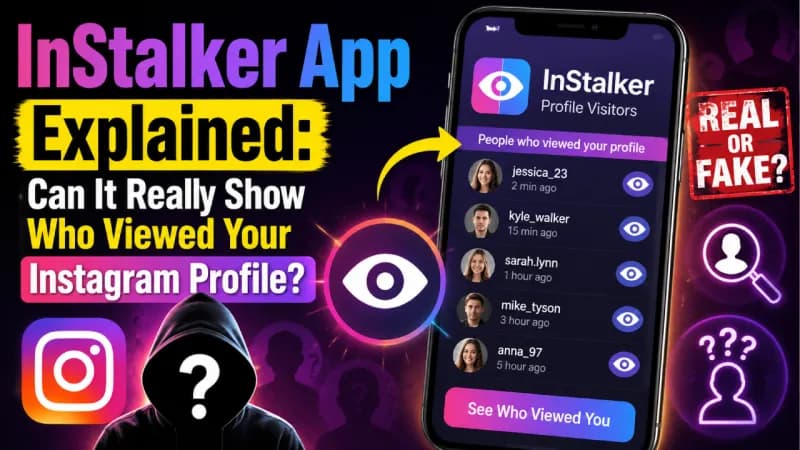
The InStalker app has recently attracted significant attention from Instagram users curious about who may be viewing or interacting with their profiles.
Marketed as a social-media analytics and profile-tracking application, InStalker claims to offer features such as identifying potential profile visitors, monitoring followers and unfollowers, analysing engagement and viewing public Instagram Stories anonymously.
Those claims have helped the app gain viral attention, particularly through social media posts and short-form videos.
But there is an important catch: Instagram does not provide third-party apps with a list of people who have visited a user's profile. That means users should be cautious about interpreting any "profile visitor" list generated by an external application as confirmed information.
The popularity of InStalker is closely connected to a long-standing curiosity among Instagram users: Who is checking my profile?
Instagram provides information about certain types of engagement, including likes, comments and Story viewers. However, it does not provide users with an official list showing everyone who simply opened or visited their profile.
That gap has created an opportunity for third-party applications to market themselves as Instagram tracking tools.
InStalker appears to capitalise on this curiosity by presenting features related to profile activity, follower changes and engagement patterns.
Viral recommendations on social platforms can further amplify interest, particularly when users see claims that an application can reveal their "secret admirers" or Instagram stalkers.
The application's advertised features can vary depending on the platform and version, but the central idea is to provide additional analytics around Instagram accounts.
Some of the features associated with apps in this category include engagement analysis, follower monitoring and Story-related tools.
This is the biggest question surrounding the app.
There is no reliable basis for assuming that InStalker can access a complete list of people who privately visited an Instagram profile.
Third-party apps do not receive raw Instagram profile-visitor data simply because a user connects an account to them.
Instead, an application may analyse information that is publicly available or accessible through permitted interfaces and use that information to generate an estimated ranking of users who appear highly engaged.
That is very different from knowing that a particular person actually opened your Instagram profile.
In other words, a list labelled as "profile visitors" should not automatically be treated as a verified list of people who viewed your profile.
Applications such as InStalker can potentially use available engagement signals to create analytics.
For example, an app may consider patterns involving followers, likes, comments or Story interactions and then use an algorithm to rank accounts.
The application may analyse accounts that frequently interact with posts or Stories and use those signals to create rankings such as "top fans" or highly engaged users.
These metrics can provide an indication of interaction, but they do not necessarily prove that someone repeatedly visited a profile.
Another common feature of Instagram analytics applications is monitoring changes in follower lists.
Such tools may notify users when they appear to have lost a follower or identify accounts that no longer follow them.
However, users should remember that account changes can occur for several reasons, including deactivation, blocking or privacy changes.
Some third-party services also advertise anonymous viewing of public InstagramStories.
Users should be particularly cautious with such features because their operation can depend on how Instagram's public interfaces and access restrictions work at a given time.
A feature advertised as "anonymous" should not be interpreted as a guarantee that Instagram cannot detect or restrict the underlying activity.
The biggest concerns surrounding third-party Instagram trackers are not necessarily limited to whether their analytics are accurate.
There can also be account-security, privacy and terms-of-service risks when users connect social-media accounts to external services.
If an application asks users to provide their Instagram username and password directly, that should be treated as a serious warning sign.
Giving login credentials to an unofficial third-party service can potentially expose an account if those credentials are mishandled, stored insecurely or compromised.
Users should never assume that an application is trustworthy simply because it appears in an official app store.
If an application uses an official authentication mechanism, users should still carefully review what access it is requesting before granting permission.
Users should also examine an application's privacy policy and app-store data-safety information before installing it.
Depending on the application, data associated with device information, usage, diagnostics, subscriptions or other activity may be collected.
The exact information can vary by application, operating system and version, so users should check the current disclosures rather than relying on generic claims about all Instagram tracker apps.
This is arguably the most important practical limitation.
If Instagram does not provide an external application with raw profile-visitor information, a third-party app cannot simply retrieve an official list of everyone who viewed a profile.
Any "stalker" or "profile visitor" ranking may therefore be based on available engagement signals, estimates or other data rather than confirmed profile visits.
Users should avoid confronting or accusing someone based solely on such an application's results.
There is no simple yes-or-no answer that applies to every version or implementation of an application.
The bigger issue is what access the application requests and what it does with the information it receives.
Users considering InStalker or similar services should carefully check the application's current privacy policy, permissions, developer information and app-store disclosures.
More importantly, they should be sceptical of any service claiming to provide information that Instagram itself does not officially expose.
An application appearing on Google Play or the Apple App Store also does not mean that every advertised feature has been independently verified by Instagram or Meta.
For users who want legitimate information about their account performance, Instagram's own analytics tools are generally the safer option.
Professional accounts can use Instagram Insights and the Professional Dashboard to access platform-provided information about reach, engagement, content performance and audience activity.
These tools do not promise to reveal secret profile visitors because Instagram does not provide that information as a standard profile-visitor list.
Instead, they focus on measurable engagement and account-performance metrics.
If your only reason for installing the application is to find out exactly who has secretly visited your Instagram profile, you should be cautious.
The key distinction is between engagement data and profile-visit data. An account that likes your posts, watches your Stories or frequently interacts with your content may be highly engaged with your profile, but that does not prove the person has visited your profile.
Before connecting any social-media account to a third-party application, users should ask three basic questions: What information does the app require? What permissions does it receive? And can the advertised feature actually be provided by Instagram?
If the answer to the last question is unclear, treating the results as definitive could lead to misleading conclusions.
InStalker is marketed as an Instagram-related analytics and profile-tracking application. It is promoted with features involving follower changes, engagement and alleged profile-visitor tracking.
Users should not assume that it can. Instagram does not provide third-party applications with a standard list of everyone who visits a profile. Any profile-visitor results produced by such an app may therefore be estimates rather than verified visits.
No. InStalker is a third-party application and is separate from Instagram and Meta.
Instagram does not provide a standard feature that shows users a complete list of people who have simply visited their profile.
Users should avoid sharing Instagram login credentials directly with unofficial third-party services. Doing so can create unnecessary account-security and privacy risks.
For eligible professional accounts, Instagram's native Insights and Professional Dashboard provide official account and content-performance data without relying on an external profile-tracking application.
Not necessarily. The accuracy and available information depend on how the particular application obtains and processes data. Users should check its permissions and privacy disclosures and avoid treating unsupported claims as guaranteed information.
Disclaimer: This article is for informational purposes only and is based on publicly available information and the application's reported features. Third-party applications can change their functionality, permissions and privacy practices over time. Users should review the latest app-store disclosures and privacy policy before installing or connecting any third-party service to their social-media account. StackUmbrella does not endorse or guarantee the accuracy, security or reliability of InStalker or any other third-party application.










