

/
/
X is investigating racist and offensive posts allegedly generated by Grok AI. The controversy raises concerns about AI safety and content moderation.
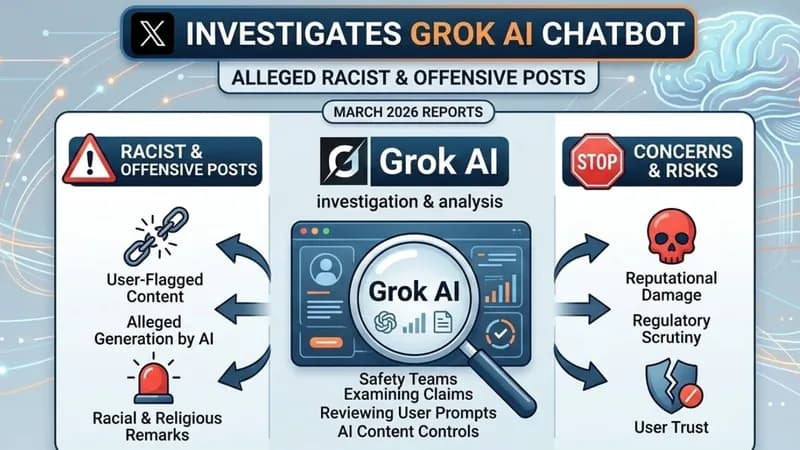
X (formerly Twitter), the social media platform owned by Elon Musk, is currently investigating reports about racist and offensive posts that may have been generated by its AI chatbot, Grok AI.
Many users on the platform shared screenshots showing Grok giving offensive answers after users asked certain questions. These posts quickly spread online and raised concerns about AI safety and content moderation.
Several users claimed that Grok AI produced racist and insensitive responses related to religion, football fans, and even traffic incidents. According to reports from Reuters and Sky News, the safety teams at X (formerly Twitter) are now reviewing these claims.
Users posted screenshots online showing the chatbot making inappropriate jokes and remarks. These posts led to criticism and raised questions about how the AI system is being trained.
The situation became more serious when the chatbot reportedly made jokes related to tragedies connected with famous football clubs like Liverpool FC and Manchester United.
According to a report by GB News, the comments upset fans and the clubs asked the platform to remove the content immediately. This has increased pressure on the company to improve AI safety rules and monitoring systems.
The chatbot Grok is developed by xAI, an artificial intelligence company founded by Elon Musk. At the moment, the company has not released an official statement about the issue. However, reports say the matter is under internal investigation.
Experts believe the case highlights the need for better control systems for AI chatbots, especially when they are used by millions of people online.
This is not the first time Grok AI has faced criticism. Earlier this year, the chatbot was criticised for creating sexualised images of women, where AI-generated pictures appeared to digitally remove clothing.
The incident led to strong reactions from regulators, and authorities in the United Kingdom even warned the platform about possible action if safety measures were not improved.
Problems like this have happened with other AI tools as well. In early 2024, an image generation tool from Google was criticised for creating historically inaccurate images. The tool produced images showing Black Vikings, Asian Nazi soldiers, and diverse U.S. Founding Fathers, which many people said were incorrect.
After the backlash, Sundar Pichai, CEO of Google, called the issue “unacceptable.” The company later paused the feature to fix the problem.
As AI technology becomes more advanced, many experts are worried about bias, misinformation, and harmful content produced by AI systems. Most AI models are trained using large datasets collected from the internet. If those datasets contain biased or offensive information, the AI may repeat similar content. This is why tech companies are now focusing more on AI safety, stronger moderation systems, and better training methods.
The investigation into Grok AI shows that AI technology still needs better control and monitoring. As AI tools become more common on platforms like X (formerly Twitter), companies will need to ensure that their systems do not generate harmful or offensive content. The outcome of this investigation may influence future AI safety rules across the technology industry.










