

/
/
Mark Zuckerberg tests AI tools at Meta to assist CEO tasks, raising questions about AI replacing leaders. Here is what it means for the future of management.
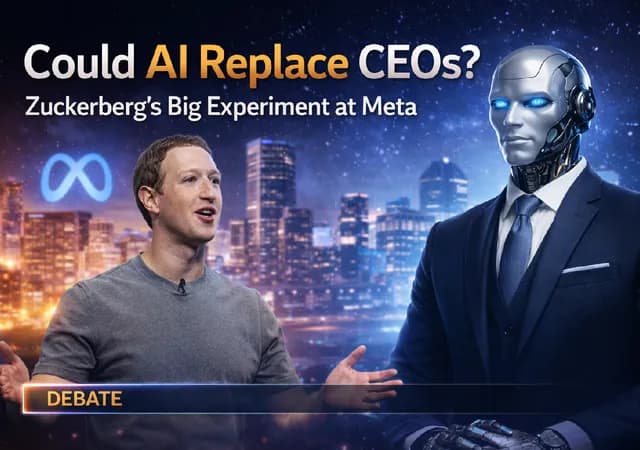
The idea of AI replacing CEOs once sounded like science fiction. Now, it’s quietly becoming reality, and Mark Zuckerberg is leading that shift.
According to recent reports, the Meta CEO is testing an internal AI assistant designed to help him manage leadership tasks. This isn’t just another productivity tool. It’s a serious attempt to rethink how top-level decisions are made inside one of the world’s biggest tech companies.
And honestly, this should make everyone, from executives to employees, pause and think.
Zuckerberg’s AI experiment is not happening in isolation. Meta has been aggressively pushing artificial intelligence across its operations.
The AI system can instantly retrieve important business data, reduce dependency on multiple management layers, and help top-level leaders make faster decisions without delays.
Zuckerberg does not have to wait to receive reports from teams and can just ask the AI and have answers provided in real time. That is a massive change in the functioning of the companies.
Meta is also building tools like “Second Brain” and “MyClaw,” which can analyze documents, access chat logs, and even assist in communication across teams. Internally, these tools are already being compared to an “AI chief of staff.”
This is a clear indication that the concept of AI replacing CEOs is not about changing the leader instantly but rather through gradual integration.
The Bigger Shift: AI Moves Into the Corner Office
What’s happening at Meta reflects a larger trend across the tech industry.
During a recent summit, OpenAI CEO Sam Altman openly said that AI could one day do a better job than human CEOs. Even Google CEO Sundar Pichai hinted that AI might eventually replace him. That’s not casual talk anymore.
Meta is spending billions on AI infrastructure, such as massive data centers and advanced systems. Reports suggest the company could spend over $100 billion on AI by 2026.
At the same time, there are discussions about layoffs as companies shift toward automation and efficiency.
So yes, AI replacing CEOs is now part of a broader transformation, not just a headline.
If AI can assist CEOs, what happens to everyone else?
Meta is already trying to “flatten” its organization, which means fewer layers of management, more power to individual contributors, and faster communication and execution.
In simple terms, companies can begin operating with fewer middle managers and more AI-driven systems. Although this makes it efficient, it also poses an uncertainty to jobs.
We’ve already seen tech layoffs linked to AI adoption. And this trend may accelerate.
This is where things get complicated.
Yes, AI can analyze the data quicker than any human being. It is able to analyze trends, forecast the results and even propose strategies.
But leadership is not just about data. It entails emotional intelligence, ethical decision-making, crisis and human relationship management. These are areas where AI still struggles.
Zuckerberg's AI is more like an assistant than a replacement right now. It helps him get things done faster, not get in the way.
But if AI keeps getting better, the line between "assistant" and "decision-maker" could quickly become less clear.
Let’s be honest, AI replacing CEOs won’t happen overnight.
But what Zuckerberg is doing is important because it moves the conversation from theory to reality. This is the first real step toward AI entering the highest level of corporate power. And once that door opens, there’s no going back.
In the coming years, we might not see AI completely replacing CEOs, but we will definitely see CEOs who rely heavily on AI to run companies. Zuckerberg’s experiment is a signal, not an exception. AI is no longer just a tool for analysts and engineers; it is becoming a strategic partner at the top.
Whether it replaces CEOs or not, one thing is clear that leadership is evolving, and the future CEO will work with AI sitting right next to them. And the future CEO might not work alone, they might work with AI sitting right next to them.










