/
/
Skyroot Vikram-1 creates history as India's first private orbital rocket reaches space, placing payloads in orbit and opening a new era for India's space sector.
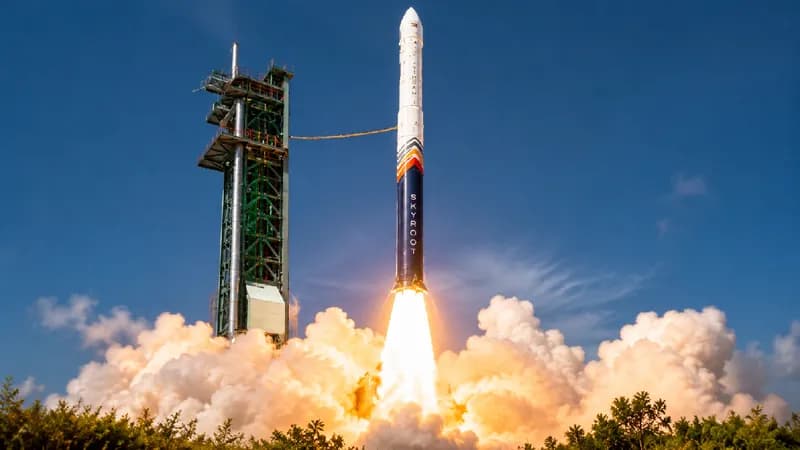
Something incredible happened on Saturday morning, and if you haven't heard about it yet, you should. The Skyroot Vikram-1 Launch did what many thought was still years away, it carried multiple payloads all the way into Low Earth Orbit, making Skyroot Aerospace the first Indian private company to pull off an independent orbital-class rocket launch. This isn't just a win for one company. It's a turning point for the entire private space sector India has been quietly building for years, and it puts the country in rare company globally where private firms have actually done this.
The rocket lifted off from ISRO's Satish Dhawan Space Centre in Sriharikota at 12:05 pm IST. Under Mission Aagaman, the seven-storey vehicle flew for just under 16 minutes before releasing its payloads into an orbit sitting roughly 450 km above Earth.
Let's be clear about what this really means.
Before Saturday, if you wanted to launch a satellite from Indian soil, ISRO was your only option. No Indian private company had ever designed, built and successfully flown an orbital-class rocket on its own, until now. That changes everything.
Skyroot Aerospace confirmed after liftoff that Vikram-1 had completed its final burn and placed all payloads exactly where they needed to be, calling it a historic milestone for both the company and the country. And honestly, it's hard to argue with that.
None of this would have been possible without India's 2020 space reforms either. Throwing open launch infrastructure and satellite development to private players was a bold call, and the Skyroot Vikram-1 Launch is arguably the clearest proof yet that it was the right one.
🚨 𝗟𝗶𝗳𝘁𝗼𝗳𝗳 𝗼𝗳 𝗦𝗸𝘆𝗿𝗼𝗼𝘁 𝗔𝗲𝗿𝗼𝘀𝗽𝗮𝗰𝗲'𝘀 𝗩𝗶𝗸𝗿𝗮𝗺-𝟭 𝗿𝗼𝗰𝗸𝗲𝘁 𝗮𝘁 𝟭𝟮:𝟬𝟱 𝗣𝗠 𝗜𝗦𝗧 𝗳𝗿𝗼𝗺 𝘁𝗵𝗲 𝗙𝗶𝗿𝘀𝘁 𝗟𝗮𝘂𝗻𝗰𝗵 𝗣𝗮𝗱 𝗮𝘁 𝗦𝗛𝗔𝗥! 🚀
The era of commercial spaceflight has begun in India 🇮🇳#Skyroot | #Vikram1pic.twitter.com/yba2WRW1Ck— ISRO Spaceflight (@ISROSpaceflight) July 18, 2026
Standing nearly seven storeys tall, Vikram-1 was built from the ground up to serve the booming global small-satellite market. Here's what sets it apart:
A lot of the technologies you see here weren't invented overnight. Many were first tested on Skyroot's Vikram-S suborbital mission back in 2022 and then refined and scaled up for the orbital version. It was a smart, methodical approach, and it paid off.
Mission Aagaman was never just about proving the rocket could fly. It was about showing the rocket could actually do something useful when it got there.
Six payloads made the journey, pulling in customers from both India and abroad:
But some of the most talked-about items on board had nothing to do with technology. A lotus called Cosmic Bloom, crafted from lab-grown diamonds, flew into orbit alongside a miniature gold rocket carrying microscopic sculptures honouring Vikram Sarabhai, Nobel laureate C.V. Raman and former President Dr. A.P.J. Abdul Kalam.
And then there was the personal touch that caught everyone's attention, a handwritten "Vande Mataram" postcard from Prime Minister Narendra Modi, sharing space with handwritten notes from scientists, engineers and members of the Skyroot team themselves. It was the kind of detail that makes you stop and feel the weight of what just happened.
Word travels fast when history is made. Shortly after the launch confirmed success, PM Modi personally called Skyroot Aerospace co-founders Pawan Kumar Chandana and Naga Bharath Daka to pass on his congratulations.
He took a moment during that conversation to acknowledge the young engineers who made it happen, saying they had strengthened India's space ambitions and inspired a whole new generation of problem-solvers.
Later, he went further, describing the Skyroot Vikram-1 Launch as a defining moment in India's space journey and noting that growing private sector involvement is speeding up innovation and encouraging young Indians to think bigger.
Spoke to the team of Skyroot Aerospace and congratulated them on the successful launch of Vikram-1.
— Narendra Modi (@narendramodi) July 18, 2026
This is a defining moment in India’s space journey. The growing participation of our private sector is opening new frontiers and accelerating innovation.
This achievement will… pic.twitter.com/epWjOY8yKa
One successful launch is a milestone. But Skyroot Aerospace is thinking well past milestones.
Co-founder and CEO Pawan Kumar Chandana has talked openly about what the company is really building toward: a "cab service to space." The idea is straightforward. Instead of satellite operators waiting months or even years for a slot on a large shared rocket, they could book a dedicated launch shaped around their exact orbital needs, on their timeline.
It's a model built for the small satellite industry, where the hunger for faster, more flexible launch options is only going to grow. And Skyroot expects most of its customers to come from global commercial markets, sectors like agriculture, communications, navigation, disaster management and Earth observation.
Skyroot Aerospace was founded in 2018 by former ISRO engineers Pawan Kumar Chandana and Naga Bharath Daka, two people who knew the space industry inside out and saw an opening that nobody had yet stepped through.
The company became India's first space-tech unicorn, hitting a valuation of around $1.1 billion. Its first real proof of concept came in November 2022, when Vikram-S became India's first private rocket to reach space, even if it was a suborbital flight.
Vikram-1 is the next leap, orbital, deliberate and successful. The company now plans additional developmental flights before moving into regular commercial operations, with production at its Hyderabad facilities expected to ramp up to roughly one rocket per month.
The Skyroot Vikram-1 Launch isn't just good news for one Hyderabad-based company. It signals something much bigger happening in India's relationship with space.
With over 400 space startups now active following government reforms, the private space sector India has built is starting to show what it's genuinely capable of. Private companies are no longer on the sidelines, they're designing launch vehicles, building satellites and developing technologies that can compete on the world stage.
What Mission Aagaman proved is that India's first private rocket reaching orbit wasn't a one-off moment of luck. It was the result of years of deliberate work, and it's just the beginning. As government agencies and private innovators increasingly work alongside each other, India's position in the global space economy could shift faster than most people expect.
Saturday was a big day. But in hindsight, it may end up looking like just the starting line.