/
/
PM Modi’s Sweden visit boosts India-Sweden ties with AI, trade, defence and green energy deals under a new Strategic Partnership.
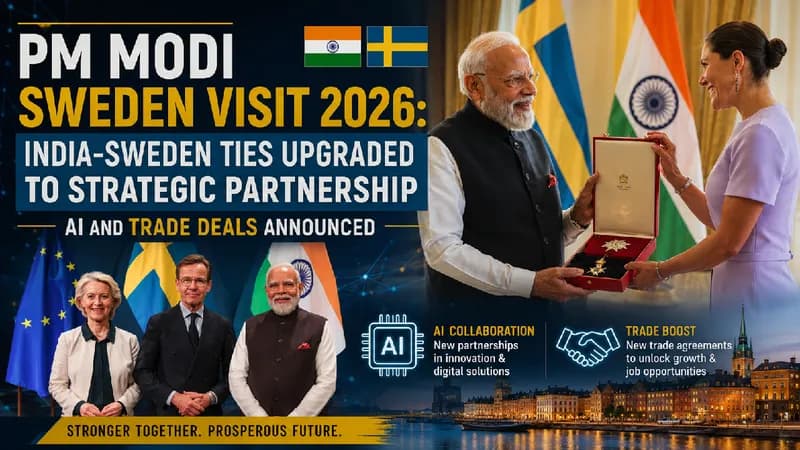
Prime Minister Narendra Modi wrapped up his Sweden visit with what easily looks like one of India’s strongest European diplomatic moments this year. During talks in Gothenburg with Swedish Prime Minister Ulf Kristersson, India and Sweden officially upgraded their relationship to a full-fledged Strategic Partnership, signaling that the two countries are now thinking far beyond traditional trade ties.
And honestly, this wasn’t just another ceremonial foreign visit filled with photo-ops and speeches. The outcomes were concrete, business-focused, and politically important at a time when Europe is actively looking for trusted partners outside old supply chains.
The biggest takeaway from the PM Modi Sweden visit is simple: India wants a much deeper role in Europe’s technology, AI, defence, and green energy future, and Sweden seems fully on board.
The talks between Modi and Kristersson covered almost every major growth sector right now, artificial intelligence, semiconductors, space technology, defence manufacturing, clean energy, sustainable mobility, digital infrastructure and advanced research collaborations.
India and Sweden also adopted a Joint Action Plan for 2026-2030. The target is ambitious: double bilateral trade and investment within five years. Current trade between the two countries stands at nearly $7.75 billion, and both sides now want that figure to rise sharply by 2030.
A major announcement during the visit was the launch of the India-Sweden Technology and Artificial Intelligence Corridor, often referred to as SITAC. The corridor is expected to connect startups, industries, researchers and innovation ecosystems from both countries.
That matters because Sweden has long been seen as one of Europe’s strongest innovation economies, while India is rapidly becoming the world’s largest digital and AI growth market. From a strategic perspective, this partnership makes complete sense.
What stood out during the visit was the shift in tone. India and Sweden are no longer treating each other as simple economic partners. The new framework revolves around four pillars:
This is a much more serious geopolitical alignment than earlier India-Sweden engagements.
Modi also highlighted cooperation in green hydrogen, circular economy projects and sustainable infrastructure. Sweden’s expertise in clean technology combined with India’s manufacturing scale could genuinely become a powerful global combination if implemented properly.
In fact, the visit strongly reflected Europe’s growing interest in India as a stable long-term partner in a world increasingly shaped by supply-chain uncertainty, AI competition and geopolitical tensions.
One of the emotional highlights of the trip came when Crown Princess Victoria, Crown Princess of Sweden presented Modi with Sweden’s prestigious Royal Order of the Polar Star, one of the country’s highest honours for foreign leaders.
Modi dedicated the award to India’s 1.4 billion citizens and called it a recognition of India-Sweden friendship.
Symbolically, the award carried significant diplomatic weight. European nations generally reserve such honours for leaders they view as important long-term strategic partners.
The visit also included several softer cultural moments that helped humanise the diplomatic meetings. Bengali cultural performances, Tagore references and traditional Indian welcomes from the diaspora added warmth to the otherwise policy-heavy visit.
Another major undercurrent during the Sweden visit was the growing India-European Union relationship.
Modi and European Commission President Ursula von der Leyen both referenced the recently concluded India-EU Free Trade Agreement discussions, with Modi famously repeating von der Leyen’s description of it as the “Mother of All Deals.”
That phrase alone shows how seriously both sides are taking future India-Europe economic integration.
Sweden appears ready to become one of India’s strongest gateways into Europe’s innovation ecosystem. And from India’s perspective, partnerships with technologically advanced democracies like Sweden help diversify strategic dependencies away from traditional power blocs.
The visit was not limited to big diplomacy alone.
India and Sweden also announced plans for a dedicated SME and Startup Platform aimed at boosting entrepreneurship, innovation and youth employment. The two countries are also exploring deeper defence manufacturing cooperation, with Swedish firms increasingly showing interest in producing in India rather than simply exporting products.
That’s an important shift because it aligns directly with India’s long-running “Make in India” strategy.
Modi also met business leaders, including Maersk Chairman Robert Maersk Uggla, discussing investments in ports, logistics and green shipping.
A lot of foreign visits disappear from headlines within 24 hours. This one probably won’t.
The PM Modi Sweden visit matters because it reflects a larger global shift: Europe wants stronger partnerships with India in technology, manufacturing, AI and resilient supply chains. Meanwhile, India is positioning itself not just as a market, but as a strategic innovation partner.
If even half the announcements made in Gothenburg are implemented properly, India-Sweden relations could enter an entirely new phase over the next decade.
And politically, Modi leaves Sweden with something every leader values during global diplomacy, strategic agreements, investment promises, technology partnerships and international recognition all in one trip.
PM Modi visited Sweden for bilateral talks, industry meetings and the India-Nordic Summit discussions focused on trade, AI, defence and green technology cooperation.
It is a new upgraded diplomatic framework between India and Sweden covering trade, security, AI, emerging technology, sustainability and innovation.
The India-Sweden Technology and Artificial Intelligence Corridor (SITAC) is a new initiative to boost cooperation in AI, startups, research and digital technologies.
Modi received Sweden’s Royal Order of the Polar Star, one of the country’s highest honours for foreign leaders.
Both countries aim to double bilateral trade and investment within the next five years.