

/
/
PM Modi announces fast-track courts for paper leak cases as NEET protests continue. Students still demand Dharmendra Pradhan's resignation.
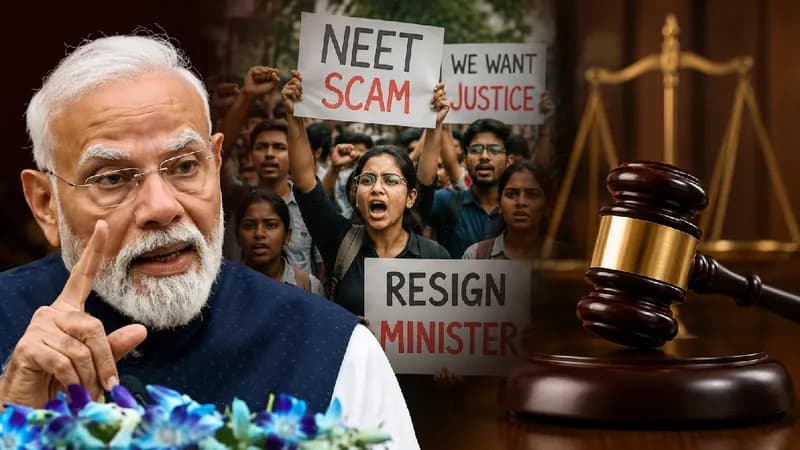
The future of millions of students has become the biggest political issue in the country. PM Modi fast-track courts for paper leak cases is now the Centre's latest response to weeks of nationwide protests, but many students insist that justice means much more than speedy punishment.
Prime Minister Narendra Modi on Thursday announced that the government will establish fast-track courts to ensure swift trials and strict punishment for those responsible for examination paper leaks. The announcement comes after nearly two months of protests triggered by the cancellation of the NEET-UG 2026 examination following allegations of leaked "guess papers."
Posting on X, the Prime Minister said that nothing is more important than the welfare and future of India's youth. He added that authorities have been directed to take all necessary steps and warned that those who damage students' futures "will not be spared."
The Centre's decision aims to accelerate criminal proceedings against those accused of leaking examination papers, an issue that has repeatedly affected recruitment and entrance examinations across India.
The government said the move is another step toward protecting students and restoring confidence in the examination system.
However, the announcement stopped short of addressing the main political demand emerging from the protests, the resignation of Union Education Minister Dharmendra Pradhan.
The protests began after NEET-UG 2026 was cancelled on May 12 over allegations that leaked "guess papers" had compromised the examination, which was taken by more than two million aspirants.
Students, backed by the Cockroach Janta Party (CJP) and several opposition leaders, have continued demonstrations at Delhi's Jantar Mantar and in multiple cities across the country.
Their central demand remains unchanged:
Many protesters argue that punishing accused individuals after a leak occurs does not solve the deeper problem of repeated failures in securing major national examinations.
The protests have turned increasingly tense over the past few days.
According to police, clashes between protesters and security personnel from July 20 to July 22 resulted in injuries to more than 118 police personnel and protesters. Officials said stone-pelting and vandalism occurred during parts of the demonstrations, while protesters alleged excessive use of force by police.
One 19-year-old student reportedly suffered severe eye injuries and faces the risk of vision loss, making the incident one of the most emotional moments of the ongoing agitation.
Fresh clashes were also reported on Wednesday night, with police using tear gas and baton charges after violence broke out near Jantar Mantar.
As security tightened, the Delhi Metro Rail Corporation temporarily closed 16 metro stations around central Delhi to manage crowds and maintain law and order.
Congress leader Rahul Gandhi dismissed the Prime Minister's announcement as insufficient.
He accused the government of allowing India's education system to deteriorate and reiterated three demands:
Meanwhile, BJP leaders defended the government's decision, saying fast-track courts demonstrate the Centre's commitment to ensuring that no guilty person escapes punishment.
The Cockroach Janta Party welcomed the Prime Minister's acknowledgement of the issue but maintained that fast-track courts address only the aftermath of paper leaks.
Party leaders argued that the real challenge is preventing leaks before they occur and fixing systemic weaknesses in the examination process.
The party once again repeated its demand that Dharmendra Pradhan resign, stating that accountability must begin at the highest level.
The protests also sparked wider public debate after NEET aspirant Harsh Dubey's emotional remarks during a television discussion went viral.
Questioning reservation policies while discussing the examination crisis, Dubey's comments triggered fresh nationwide conversations on merit, quotas and equal opportunities in competitive exams.
Although separate from the government's latest announcement, the viral exchange has broadened public discussion around the future of India's education system.
The controversy has now reached the courts as well.
The Delhi High Court is scheduled to hear a Public Interest Litigation seeking an NIA investigation into the July 20 "Sansad Chalo" protest and related incidents. The petition also seeks the transfer of police cases connected to the demonstrations to a specialised investigating agency.
Meanwhile, disruptions over the issue continued in Parliament, with protests by both the NDA and INDIA bloc affecting proceedings.
The government's announcement of fast-track courts marks its strongest response yet to the paper leak controversy. Whether that will calm public anger remains uncertain.
For thousands of students who believe their careers have been thrown into uncertainty, punishment for offenders is only one part of the solution. They continue to demand accountability, structural reforms and confidence that future examinations will be conducted fairly.
As protests continue and legal proceedings move forward, the examination paper leak controversy is rapidly becoming one of the biggest education and political challenges facing the government in 2026.









