/
/
NEET topper Panshul Bansal's protest remark has divided social media as supporters praise his focus while critics call it insensitive amid the paper leak row.
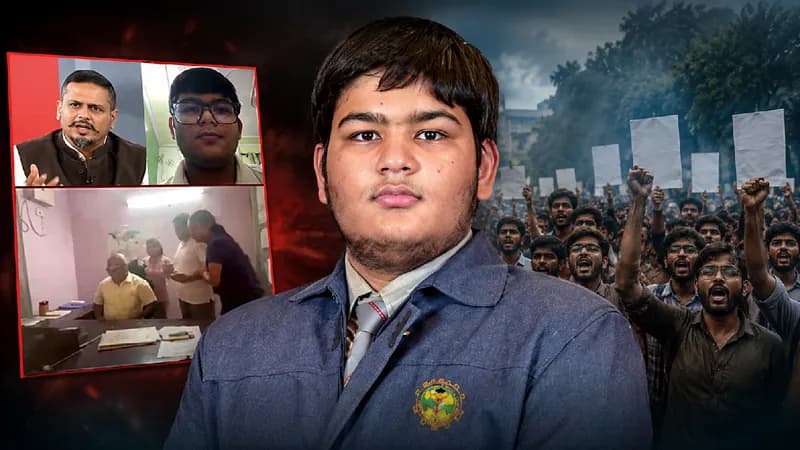
Not many interview clips manage to divide an entire country overnight, but then again, not many interviews feature someone like NEET topper Panshul Bansal. One comment, a few seconds long, and suddenly everyone had something to say. Supporters called him an inspiration. Critics called him tone-deaf. And somewhere in between, millions of exhausted NEET aspirants found themselves caught in yet another storm, this time, not about exam centres or answer keys, but about whether studying and protesting can even exist in the same sentence.
The timing, of course, made everything sharper. The NEET 2026 paper leak controversy hasn't gone away. If anything, it's only grown louder.
So what exactly did he say?
Panshul Bansal, who finished with All India Rank (AIR) 2 in the NEET re-exam results, scoring an impressive 715 out of 720, sat down with NDTV and was honest about his choice. When the original examination was cancelled, he didn't head to the streets. He went back to his books.
The original NEET-UG exam was held on May 3 and cancelled on May 12 following allegations of a NEET 2026 paper leak. A fresh examination was then conducted on June 21 under tighter security, and the NEET re-exam results were finally declared on July 16.
When asked about skipping the NEET protest, Bansal's answer was disarmingly straightforward:
"I thought, why should I go to the protest? Instead, I could be studying at home and improving my skills and improving my score."
He also shared something that put his improvement into perspective, he had already scored around 706 in the original exam before bumping it up to 715 in the re-test. That's not just consistency. That's deliberate, focused growth under pressure.
Real Students :
— ANVAYA (@Anvaya4u) July 22, 2026
Here what NEET topper has to say: I didn’t want to waste time protesting. I wanted to spend that time studying and improving my score. #NEETpic.twitter.com/YbIIgbzmry
What's striking about NEET topper Panshul Bansal's approach is how unremarkable it sounds on paper, and yet how difficult it must have been to actually follow through on it when everything around him was uncertain.
Rather than overhauling his entire routine, he stuck with what was already working:
No dramatic pivots, no crash course overhauls. Just quiet, daily discipline when most people around him were understandably distressed.
His next goal? MBBS at AIIMS New Delhi, with a long-term interest in specialising in surgery, and given what he's already shown, it's hard to bet against him.
The moment the interview clip started circulating on X, Instagram, and pretty much everywhere else, it took on a life of its own.
The BJP was quick to share the video, framing it as a powerful example of focus and resilience in the face of difficult circumstances. And honestly, that framing landed well with a significant chunk of viewers who saw NEET topper Panshul Bansal as proof that perseverance pays off.
But that wasn't the only read people had.
For a large number of students still reeling from the chaos of the NEET 2026 paper leak, the remark stung. They weren't at the NEET protest because they had nothing better to do, they were there because they felt the system had failed them. Seeing someone frame protest as a distraction, even if that wasn't exactly the intent, hit a nerve.
A lot of the debate then shifted to a more philosophical question: should studying and protesting even be treated as opposites? Many pointed out that one student's personal choice doesn't, and shouldn't, invalidate another's decision to speak up.
There were also claims floating around that influencers were being paid to either support or oppose the protests. Worth noting: none of these claims have been backed by verified evidence. They remain unverified for now.
🚨🚨 BJP's PR campaign has begun.
— 100rav X (@HereToTroll72) July 22, 2026
NDTV interviewed the NEET AIR 2 topper after AIR 1 chose not to give an interview. The segment focused on the student saying "he'd rather study than join the protest".
Influencers are being approached to create content praising the government… pic.twitter.com/XR3M14y35x
Meanwhile, the NEET protest itself hasn't slowed down.
Thousands of students across the country have taken to the streets, demanding real answers about the alleged paper leak and calling for the resignation of Union Education Minister Dharmendra Pradhan. The anger isn't performative, it comes from a place of genuine exhaustion after months of uncertainty.
Dharmendra Pradhan has pushed back, accusing opposition parties of using students as political pawns while insisting that the government remains committed to both reform and accountability. Opposition leaders, unsurprisingly, aren't letting go, they continue to demand stronger action and greater transparency over the entire NEET 2026 paper leak episode.
The CBI probe into the alleged paper leak is still ongoing.
At its core, the debate around NEET topper Panshul Bansal's remarks is really about something much bigger.
For one group of students, his story is genuinely motivating, a reminder that it's possible to stay grounded and keep performing even when the ground is shaking. For another group, the issue was never really about him at all. It's about fairness. It's about whether India's most critical medical entrance exam can be trusted. It's about what happens to the lakhs of students who prepared just as hard but didn't get the same outcome, and whether anyone in authority is truly being held responsible.
Both of those feelings are real. And both have found a home in this conversation.
What started as a personal interview has quietly turned into a nationwide mirror, reflecting anxieties about merit, mental health, institutional integrity, and what it means to protest versus persevere.
As NEET counselling gets underway and the investigation continues, none of this is going away quietly. NEET topper Panshul Bansal's comment may have been the spark, but the fire underneath, the broader, deeply felt concerns about the NEET 2026 paper leak and the future of the examination system, was already burning long before he said a word.