

/
/
The Madhya Pradesh government has issued fresh directions for the Mukhyamantri E-Scooty and Motorized Vehicle Scheme, under which eligible Class 12 students from government higher secondary schools receive financial assistance to purchase a vehicle.
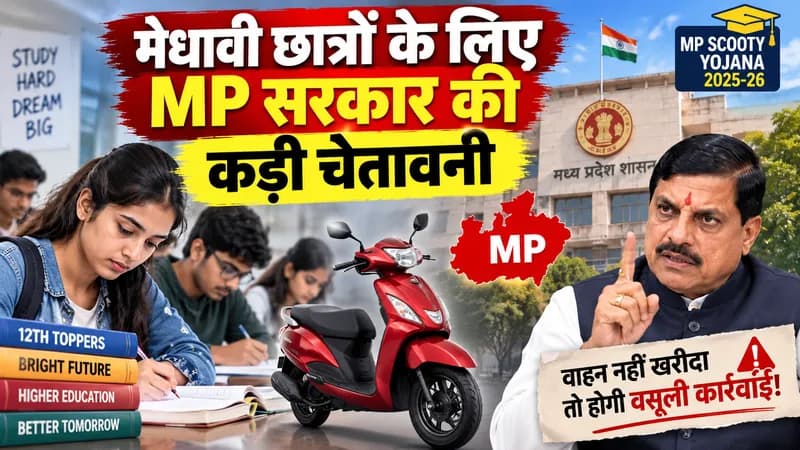
The Madhya Pradesh government has issued fresh directions for the Mukhyamantri E-Scooty and Motorized Vehicle Scheme, under which eligible Class 12 students from government higher secondary schools receive financial assistance to purchase a vehicle.
Under the rules for the 2025-26 academic session, students who meet the eligibility conditions and top their respective government schools after securing more than 70% marks in Class 12 are covered by the scheme.
The government has also made it clear that beneficiaries cannot simply receive the money and choose not to purchase the eligible vehicle. If the vehicle is not purchased after the funds are transferred, recovery proceedings may be initiated.
The scheme is designed to provide eligible high-performing students from government higher secondary schools with financial assistance for purchasing an electric scooter or another eligible motorized vehicle.
For the 2025-26 academic session, the benefit is linked to students who achieve more than 70% marks in the Class 12 examination and are the toppers of their respective government schools, according to the information provided in the latest government directions.
The student can select an eligible vehicle according to the applicable scheme rules.
The maximum financial assistance has been fixed according to the type of vehicle.
Electric scooter: Up to ₹1.20 lakh
Motorized vehicle: Up to ₹90,000
The amount transferred is intended specifically for purchasing the eligible vehicle. The directions state that the funds cannot be used to purchase another type of vehicle.
The vehicle amount will be transferred to the student's bank account. If the student does not have a bank account, the amount can be transferred to the account of a parent or guardian.
Eligible students will receive the financial assistance through their bank accounts. Where the student does not have an account, the payment can be made to the account of the student's parent or guardian.
Registration, insurance and accessories are to be paid to the concerned vehicle dealer according to the scheme's prescribed process.
The government has put responsibility on the district education authorities to ensure that beneficiaries actually purchase the vehicle after receiving the funds.
If a student receives the money but does not purchase the eligible vehicle, recovery proceedings can be initiated for the amount.
The directions also provide for proposed punitive action against the student, parent or guardian and the concerned District Education Officer in such cases, according to the information supplied for the scheme.
Yes. The directions state that if the beneficiary does not purchase the vehicle, recovery of the amount can be sought not only from the student but also from the parent or guardian.
Vidisha District Education Officer N.K. Ahirwar was quoted in the supplied information as saying that an FIR could also be registered at the police station against the parent in such circumstances.
The exact application of criminal proceedings would depend on the facts of an individual case and the applicable legal process.
No, not immediately.
Under the new directions, a vehicle purchased through the scheme cannot be sold or transferred to another person for three years.
A three-year hypothecation is to be recorded when the vehicle is registered, creating a restriction on its sale or transfer during that period.
More than 7,500 students are expected to receive financial assistance under the scheme this year, according to the supplied information.
The funds are scheduled to be transferred online at a state-level programme at the Subhash Utkrisht Higher Secondary School campus in Bhopal.
The event is scheduled for September 19, with Chief Minister Mohan Yadav expected to transfer the amount online.
A district-level committee will oversee implementation of the scheme.
The committee will be headed by the District Collector, with the District Transport Officer, District Treasury Officer and District Education Officer serving as members.
The District Education Officer will have responsibility for ensuring that beneficiaries purchase the vehicle after receiving the sanctioned funds.
The latest directions make the purchase requirement an important condition of the scheme. Eligible students can choose an electric vehicle within the prescribed financial limit, while the assistance for a motorized vehicle is capped at ₹90,000.
Students or their parents cannot treat the transferred amount as unrestricted cash for another purpose. If the eligible vehicle is not purchased, recovery proceedings may follow.
The three-year restriction on sale or transfer is another significant condition. Beneficiaries should therefore understand the scheme's terms before accepting the financial assistance.
The maximum amount specified for an electric scooter is ₹1.20 lakh. For a motorized vehicle, the maximum assistance is ₹90,000.
According to the supplied government directions, the scheme covers toppers of government higher secondary schools who scored more than 70% in the Class 12 examination for the 2025-26 academic session, subject to the scheme's eligibility conditions.
No. The financial assistance is intended for the eligible vehicle covered by the scheme. The supplied directions specifically state that another type of vehicle cannot be purchased using the amount.
Recovery proceedings can be initiated for the amount. The directions also provide for proposed punitive action in such cases.
The supplied statement from Vidisha's District Education Officer says that an FIR may be registered against the parent in such circumstances. Any such criminal action would be subject to the facts of the case and applicable legal procedures.
No. The directions prohibit the student from selling or transferring the vehicle for three years. A three-year hypothecation is to be recorded at the time of registration.
More than 7,500 students are expected to receive funds under the scheme this year, according to the information provided.









