/
/
A US federal court has revoked the naturalised citizenship of Gurmeet Singh, an Indian-born former taxi driver serving a 20-year prison sentence for a 2011 rape and kidnapping.
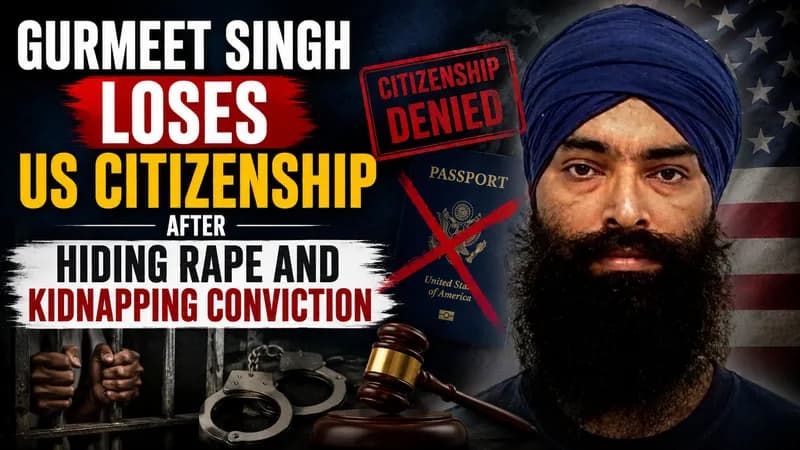
A US federal court has revoked the naturalised citizenship of Gurmeet Singh, an Indian-born former taxi driver serving a 20-year prison sentence for a 2011 rape and kidnapping.
The US District Court for the Eastern District of New York entered judgment in a civil denaturalisation case after prosecutors established that Singh concealed the serious criminal conduct during the process through which he became a US citizen.
The Justice Department announced the ruling Monday, describing it as a case involving citizenship obtained through fraud and concealment.
Singh, now 55, remains incarcerated at Shawangunk Correctional Facility in New York.
According to the US Justice Department, Singh failed to disclose his criminal conduct during his naturalisation proceedings.
The underlying crime occurred in May 2011, only weeks before Singh submitted his application for US citizenship. He subsequently became a naturalised US citizen on October 19, 2011.
He was later prosecuted in New York and convicted of first-degree rape and second-degree kidnapping as a sexually motivated felony.
The federal denaturalisation case focused on his alleged concealment of the conduct when seeking citizenship.
Attorney General Todd Blanche said the ruling demonstrates that citizenship obtained through fraud does not prevent subsequent legal action.
According to court and Justice Department records, Singh was working as a taxi driver in New York when he picked up a female passenger who fell asleep during her journey home.
Prosecutors said Singh drove her to an isolated location.
When the woman awoke, authorities said Singh was holding a knife to her throat. He restrained and blindfolded her before sexually assaulting her.
The victim eventually escaped and sought help from people nearby.
Singh was subsequently prosecuted and convicted in connection with the attack.
Singh was convicted in 2014 in New York over the 2011 assault.
He received a 20-year prison sentence for the rape and kidnapping convictions.
The timing of the crime became central to the later citizenship proceedings because the attack occurred shortly before Singh filed his naturalisation application.
Federal prosecutors argued that his failure to disclose the conduct meant that he had improperly obtained the benefits of US citizenship.
Singh became a US citizen on October 19, 2011, according to Justice Department records.
His immigration history began much earlier. He entered the United States in February 1992 as a temporary visitor on a visa that was authorized for no more than six months.
He remained in the country after that period without authorization for several years.
A family-based immigration petition later enabled him to obtain permanent resident status in June 2000.
Nearly 11 years later, he completed the naturalisation process and became a US citizen.
Attorney General Todd Blanche described the case as an example of the government's efforts to challenge citizenship obtained through deception.
Assistant Attorney General Brett A. Shumate of the Justice Department's Civil Division said Singh had unlawfully obtained the privileges associated with US citizenship by concealing serious criminal conduct.
US Attorney Joseph Nocella Jr. for the Eastern District of New York also pointed to the ruling as a warning about the consequences of providing false or incomplete information during the naturalisation process.
The Justice Department said it would continue pursuing denaturalisation referrals involving citizenship obtained through fraud.
A federal court order requires Singh to surrender his citizenship documents, including his naturalisation certificate and US passport, by September 16.
The citizenship ruling does not end his existing criminal sentence. Singh remains imprisoned while serving the 20-year sentence resulting from his New York convictions.
His current incarceration is at Shawangunk Correctional Facility in Ulster County, according to the information provided.
Denaturalisation is the legal process through which a person's naturalised US citizenship is revoked.
Unlike natural-born US citizens, naturalised citizens can, in certain circumstances, have their citizenship challenged in federal court if the government establishes legally sufficient grounds.
One important basis is fraud or material concealment during the naturalisation process.
Denaturalisation is not an automatic consequence of every criminal conviction. The government generally must establish the applicable legal grounds in court.
In Singh's case, the federal proceeding centered on whether his concealment of the 2011 criminal conduct meant he had unlawfully obtained naturalisation.
Singh is currently serving his 20-year sentence at Shawangunk Correctional Facility in Ulster County, New York.
Following the federal court's denaturalisation order, he must surrender his US citizenship documentation by September 16.
The citizenship proceeding is separate from the criminal case that resulted in his imprisonment.
The case illustrates how information provided during the US naturalisation process can remain legally significant even after citizenship has been granted.
For the Justice Department, it also underscores the government's position that naturalised citizenship obtained through material deception can be challenged through federal court proceedings.
The ruling does not suggest that every naturalised citizen with a criminal record can automatically lose citizenship. The circumstances and legal basis for each denaturalisation action must be considered separately.
Disclaimer: This article is based on information from the US Department of Justice, federal court proceedings and publicly reported case details. Allegations and court findings are presented in their appropriate legal context. This report is for informational purposes only and should not be considered legal advice.