/
/
Raghav Chadha fake followers controversy explodes after follower drop. Instagram bot claims, backlash, and credibility questions dominate social media.
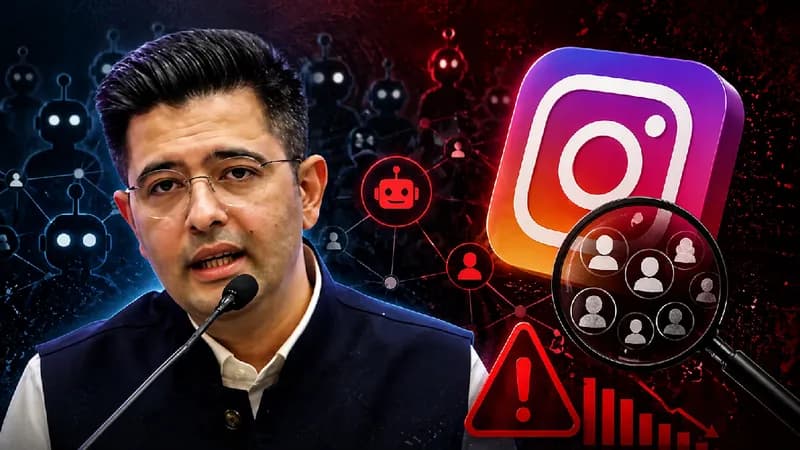
The Raghav Chadha fake followers controversy is now one of the biggest political-social media stories of the day. What began as a sharp drop in Instagram followers has quickly turned into a wider debate about fake popularity, online image management, and whether digital numbers can still be trusted.
Reports suggest Raghav Chadha lost a significant number of followers after his recent political switch, and soon after that, allegations surfaced that suspicious accounts started following him in bulk. Those claims have not been independently proven, but they have been enough to set social media on fire.
According to multiple reports, Chadha’s Instagram account saw a noticeable decline in followers in a short span of time after his move from AAP to BJP. Soon after, online commentators and creators began claiming that many newly added followers looked inactive or suspicious.
Users pointed to accounts with patterns such as:
Now, to be fair, these signs alone do not automatically prove bot activity. Many real users also keep blank or private accounts. But when hundreds or thousands of such profiles appear together, people naturally start asking questions.
The controversy became even bigger after Dhruv Rathee shared a viral video discussing Raghav Chadha’s falling follower count. In the video, he said that millions of people had stopped following Chadha and that suspicious accounts were being added to maintain the numbers.
Rathee pointed out a number of follower profiles that looked inactive because they didn't have profile pictures, posts, or much engagement. He also said that some of these accounts seemed like they were newly made, which led to fresh speculation across social media.
His video quickly went viral, turning the issue from a follower-count discussion into a larger debate about digital image management in politics. Whether people agreed with him or not, the video clearly pushed the story into mainstream attention.
Soon after the video went viral, Prakash Raj reacted publicly, adding another layer to the controversy. Prakash Raj is known for being honest about politics, so when he replied with sarcasm and humor, many people thought it was a sharp jab at Chadha.
— Prakash Raj (@prakashraaj) April 28, 2026
His reaction gained traction because it came at a time when criticism was already building. Supporters of Chadha called it unnecessary trolling, while critics said it reflected the wider public mood.
When celebrities join political conversations, the reach multiplies instantly. That is exactly what happened here. What was already a trending topic became an even bigger social media flashpoint after Prakash Raj’s response.
😂😂😂. #justaskingpic.twitter.com/FF80jIgPqS
— Prakash Raj (@prakashraaj) April 25, 2026
Because this is no longer just about one politician’s follower count. It is about something bigger, credibility.
In today’s politics, social media numbers are often treated like public support. High followers mean influence. Viral posts mean relevance. But if people begin to believe those numbers can be artificially boosted, the entire game changes.
And honestly, that is the real reason this controversy matters.
The public is getting smarter. People now understand that likes, views, and followers do not always equal genuine support. That blind trust in numbers is fading fast.
Yes, and that is not new.
Across the internet, many third-party services claim to sell followers, likes, comments, and views for cheap prices. Some use automated bots, while others use networks of low-quality or incentive-driven accounts. Social platforms regularly crack down on this behavior, but the industry still exists.
That said, there is an important difference between:
Right now, much of the discussion around Chadha falls into the second category.
Even if no formal proof emerges, the damage can still be real.
Why? Because public trust works on perception. If people think your support is fake, it hurts your image. In politics, perception can be as powerful as facts.
That's why leaders and public figures should pay less attention to vanity metrics and more attention to real engagement. A smaller but real audience is worth a lot more than fake numbers that no one trusts.
The backlash online has been intense. People who don't like him are making fun of the situation, people who do like him are defending him, and people who don't have an opinion are talking about how easy it is to fake online popularity.
This is exactly how modern controversies grow: one data point, one viral claim, then a nationwide debate.
There are three possible outcomes. The controversy may fade away in the next few days. More evidence could surface and make the issue even bigger. Platforms remove suspicious accounts, which changes the numbers again.
No matter what happens next, this episode has already shown how deeply public life is tied to digital validation.
The Raghav Chadha fake followers controversy is not just about Instagram numbers. It's about a trust issue in online politics. Followers can increase or drop overnight, but once people lose trust, rebuilding credibility becomes far more difficult. That is the lesson every public figure should remember.
It refers to viral allegations that suspicious Instagram accounts followed Raghav Chadha after reports of a major follower drop.
There is no independently verified proof in the public domain at this time. Most claims are based on online analysis and social media discussion.
Reports suggest that the decline is a result of his recent political move, which was widely criticised online.
Some common signs are blank profiles, no posts, low activity, and recently created accounts. But these signs alone are not enough to prove anything.
Because it makes us think more deeply about trust, influence, and whether the number of followers really shows public support.