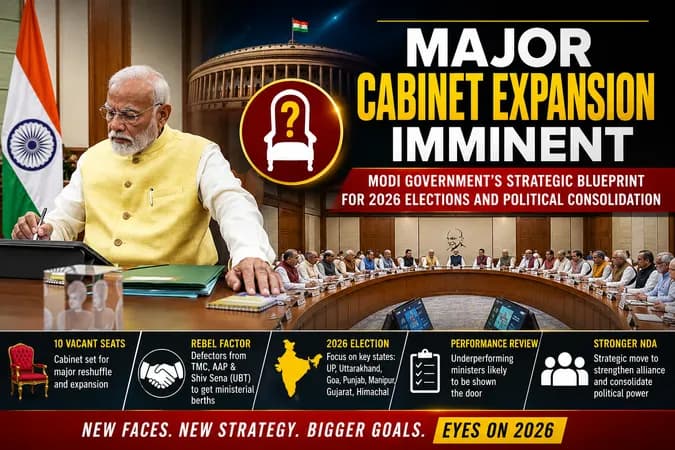
Major Cabinet Expansion Imminent: Modi Government’s Strategic Blueprint for 2026 Elections and Political Consolidation
A significant reshaping of India’s political landscape is on the horizon. The Narendra Modi-led central government is poised to undertake its first major cabinet expansion and reshuffle of its third term.
New Delhi– A significant reshaping of India’s political landscape is on the horizon. The Narendra Modi-led central government is poised to undertake its first major cabinet expansion and reshuffle of its third term. With nearly two years of the current administration’s tenure completed, a comprehensive review of ministerial performance, coupled with pressing political imperatives, has culminated in a finalized roadmap for this critical restructuring.
Advertisment
While official dates remain under wraps, sources indicate that the swearing-in of new ministers could occur as early as July 5, prior to the monsoon session, or immediately upon the Prime Minister’s return from his international trip on July 11.
The Numbers Game: Vacancies and Strategic Exits
The current Union Cabinet comprises 72 ministers, including 30 Cabinet Ministers, 5 Ministers of State with independent charge, and 36 Ministers of State. However, the legal limit permits up to 81 ministers, corresponding to 10% of the Lok Sabha’s strength. This leaves9 vacant positions.
The situation has become more acute with Minister George Kurian’s resignation, bringing the total number of empty seats to10.
Advertisment
Furthermore, the upcoming reshuffle is expected to result in further vacancies. MinistersPankaj ChaudharyandHarsh Malhotraare likely to be relieved of their duties to assume new organizational responsibilities as BJP state presidents in their respective regions. Similarly,Ravneet Singh Bittuis expected to step down following the conclusion of his Rajya Sabha term. These departures will create a fresh slate for new entrants, signaling a clear shift in the government’s operational strategy.
The "Rebel Factor": Rewarding Loyalty and Strengthening the NDA
In a move that underscores the volatile nature of contemporary Indian politics, the primary driver for this expansion appears to be the integration of "rebel" MPs who have defected from opposition ranks to support the ruling National Democratic Alliance (NDA).
Reports suggest that ministers from theTrinamool Congress (TMC),Aam Aadmi Party (AAP), and theShiv Sena (UBT)who have broken ranks to support the Modi government are in line for ministerial berths.
Advertisment
TMC Defectors:Approximately 20 MPs have already shifted allegiance, significantly bolstering the NDA’s numerical strength in Parliament.
Shiv Sena Split:The consolidation of the Eknath Shinde faction, which Home Minister Amit Shah has acknowledged as a major political victory, is expected to result in ministerial positions for its members.
This strategy serves a dual purpose: it rewards loyalty in a high-stakes environment and further isolates opposition parties by incentivizing defections.
Election 2026: The Hidden Agenda Behind the Reshuffle
The timing of this expansion is no coincidence. With assembly elections looming inseven critical states—Uttar Pradesh, Uttarakhand, Goa, Punjab, Manipur, Gujarat, and Himachal Pradesh—the central government is recalibrating its approach to maximize electoral gains.
Advertisment
The proposed cabinet expansion is heavily influenced by the need to address specific social and regional equations in these states. By increasing representation from these regions within the central government, the BJP aims to:
Strengthen Local Narratives:Deploy influential local leaders who can sway public opinion.
Counter Opposition Influence:Neutralize opposition strongholds by offering alternative power centers.
Administrative Efficiency:Ensure that government schemes are implemented effectively to garner public support ahead of the polls.
Performance Review: The "Report Card" Doctrine
Prime MinisterNarendra Modi recently held a high-level meeting with senior civil servants to review the performance of all ministries. This "report card" exercise has reportedly identified underperforming ministers, whose removal is now considered a foregone conclusion.
The message from the top is clear:competence and electoral utility are the only metrics that matter.Those who have failed to deliver on promises or who lack political relevance in the face of upcoming elections will likely be shown the door.
What’s Next?
As the nation awaits the official announcement, the political machinery is already in motion. The inclusion of new faces, the exit of underperformers, and the strategic alignment of resources for the 2026 elections mark a pivotal moment for the Modi 3.0 government.
Whether this reshuffle will stabilize the government’s standing or ignite further political turbulence remains to be seen. However, one thing is certain: the stakes have never been higher, and the coming weeks will define the trajectory of Indian politics for the next decade.
A 24-year-old Ghaziabad woman says her former boyfriend confined and assaulted her in a Meerut hotel before chasing her in Abu Lane. Police sealed the hotel.
A 19-year-old DU student was found dead in a Faridabad OYO hotel. Police are investigating murder as her neighbour remains missing and evidence is examined.
Hardeep Singh Puri faces fresh scrutiny after BJP leaves him off its Uttar Pradesh Rajya Sabha list amid questions over his past emails with Jeffrey Epstein.
Bihar's Monu Meturbala, 19, has reportedly run 8,000 km to visit 12 Jyotirlingas after his mother's recovery. Here's the story behind his Shiva pilgrimage.
Bhopals Vijay Iyer has built a ₹25,000 smart helmet display featuring 360-degree CCTV, solar power, a first-aid kit and a fire extinguisher to promote road safety.
Sameer Hussain death case: A Delhi delivery worker died after an alleged assault over a torn ₹10 note. Police arrested two accused as the probe continues.