

/
/
A viral Delhi Metro couple romance video has reignited debate over public behaviour, with social media users divided on decency, privacy and action.
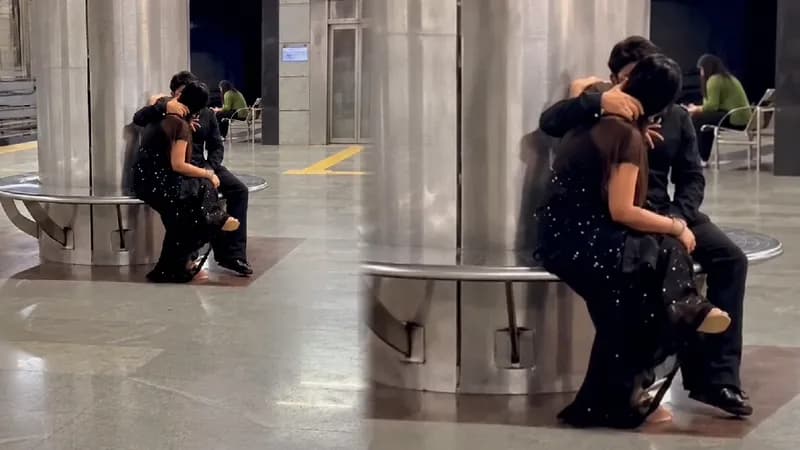
A Delhi Metro couple romance video is once again drawing attention on social media, reopening the familiar debate over what is acceptable behaviour in public spaces and where the line between personal freedom and public decorum should be drawn.
The video, which has been widely shared across social media platforms, allegedly shows a couple involved in a romantic moment inside the Delhi Metro. The footage has not been independently verified by this publication. However, its circulation has triggered strong reactions online, with many users demanding stricter action against behaviour they consider inappropriate in a public transport system.
At the same time, some social media users raised a different question: was secretly recording and sharing strangers online also a violation of privacy?
A post shared by social media user Suraj Maurya on September 1 questioned the growing number of viral incidents involving couples in the Delhi Metro and other public places.
The user argued that the metro is meant for the convenience of ordinary commuters and that such behaviour can make families and people travelling with children uncomfortable.
“Love is fine in its own place, but decorum is also essential in public spaces,” the post broadly argued while calling for clearer guidelines and action from the Delhi Metro authorities.
The post had received thousands of views at the time the details were shared.
Another viral post, shared on August 27, also claimed to show a couple romancing in the Delhi Metro. That post attracted significantly higher engagement and pushed the issue into a wider public debate.
दिल्ली मेट्रो में कपल के रोमांस का वीडियो वायरल होने के बाद एक बार फिर सार्वजनिक जगहों पर मर्यादा को लेकर सवाल उठ रहे हैं।
— Suraj Maurya🇮🇳 (@SurajMaurya03) September 1, 2026
मेट्रो आम लोगों की सुविधा के लिए है, किसी के निजी रोमांस का अड्डा नहीं। ऐसे मामलों को देखकर बच्चों और परिवारों के साथ सफर करने वाले लोगों को भी असहजता होती… pic.twitter.com/9dK8zuIcNN
Many users reacting to the posts argued that public transport comes with a responsibility to respect fellow passengers.
Some said rules should not be limited to tickets, luggage and safety but should also address passenger behaviour. Others expressed concern that families and children often travel in the same coaches and may feel uncomfortable witnessing intimate behaviour.
One user wrote that the metro should be used for travelling rather than turning it into a place for public romance.
Another user said that in the race to go viral, people sometimes forget that they are sharing a public space with strangers.
Several commenters also tagged the Delhi Metro Rail Corporation, commonly known as DMRC, asking when stricter action would be taken against such incidents.
The criticism reflects a larger frustration visible online: many commuters believe public spaces should remain comfortable for everyone, regardless of age or background.
The reaction, however, was far from one-sided.
While many criticised the couple seen in the viral footage, others questioned the ethics of secretly recording strangers and uploading their private moments to social media.
One commenter bluntly argued that the person filming the video without consent deserved criticism too.
Another user questioned what exactly was wrong with the couple's behaviour, arguing that public reactions can sometimes be more aggressive than the incident itself.
There were also comments suggesting that the video could potentially be edited or artificially generated, although no evidence was provided to establish that the footage was fake or AI-generated.
That makes verification especially important. Viral videos often spread much faster than confirmed information, and social media reactions should not automatically be treated as proof of what happened before or after the recorded moment.
The latest Delhi Metro couple romance video highlights two separate but connected issues.
The first is public behaviour. A metro coach is a shared space used daily by office workers, students, senior citizens, families and children. Behaviour that makes a significant number of fellow passengers uncomfortable can understandably trigger demands for better enforcement of public conduct rules.
The second issue is privacy.
In the age of smartphones, almost every unusual moment can be recorded within seconds and uploaded online. A person may be criticised for their behaviour, but the act of secretly filming and publicly sharing someone else's image without context also raises serious ethical questions.
This is where the debate becomes more complicated than simply choosing one side.
Public spaces do not mean people automatically surrender every expectation of privacy. At the same time, shared spaces require a certain level of consideration for those around us.
The Delhi Metro has repeatedly found itself at the centre of viral videos over the past few years, with clips showing everything from unusual outfits and arguments to dancing, pranks and alleged romantic behaviour.
Social media has amplified these moments dramatically. What might once have remained a brief incident witnessed by a few passengers can now become a nationwide debate within hours.
That creates an uncomfortable cycle: unusual behaviour gets recorded, the video goes viral, people react strongly, and the attention itself encourages more people to chase viral fame.
The result is that the Delhi Metro often becomes more than just a transport system in the social media imagination. It becomes a ready-made stage for viral content.
Calls for stricter action are now growing again following the latest viral posts.
Commuters who support stronger enforcement argue that public transport authorities should have clear behavioural guidelines and act when passengers cross acceptable boundaries.
But any action also needs to be based on verified facts rather than internet outrage.
A short viral clip rarely provides the complete context of an incident. Authorities would need to assess whether any existing rules were actually violated before taking action.
The bigger solution may lie in a balanced approach: clear rules for maintaining a comfortable environment inside metro coaches, proper enforcement when those rules are violated, and greater awareness about responsible behaviour from both passengers and people recording them.
The viral Delhi Metro video has once again exposed a debate that goes beyond one couple or one coach.
Public spaces belong to everyone, and basic decorum matters, especially in a crowded transport system used by families, children and daily commuters. At the same time, viral outrage should not give people a free pass to secretly record strangers and turn them into social media content without considering privacy and context.
Romance itself is not the issue. The real question is whether personal behaviour is appropriate for a shared public environment, and whether the rush to expose, record and shame people online is creating another problem of its own.
Until there is verified information or an official response regarding the specific viral footage, the incident should be viewed primarily as a social media-triggered debate rather than a confirmed case requiring assumptions about those involved.
Disclaimer: This article is based on viral social media posts and public reactions. The authenticity and context of the video have not been independently verified.









