Google Gemini Omni Flash Launches: AI Video Editing and Creation Gets a Massive Upgrade
Google launches Gemini Omni Flash, a powerful AI video model that creates and edits videos using text, images and audio prompts.


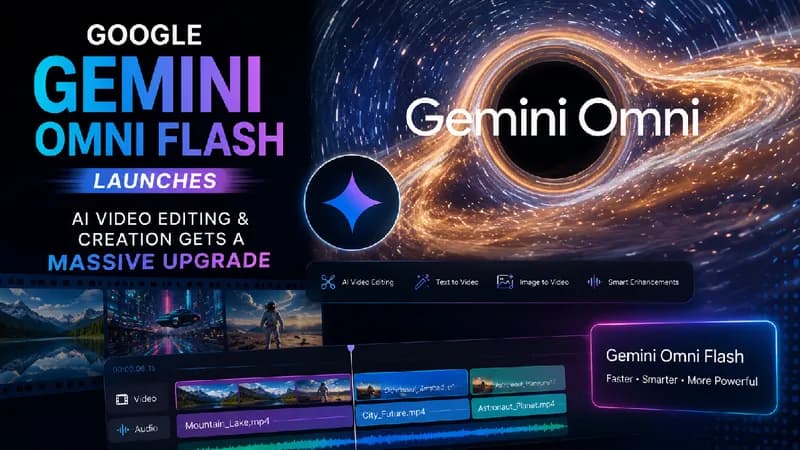
Google has officially entered a new phase of the AI race with the launch of Gemini Omni Flash, a powerful new multimodal model designed to create and edit videos using simple conversational prompts. Announced during the company’s I/O 2026 developer conference, the tool is already creating serious buzz across the tech world, and honestly, it feels like one of Google’s biggest AI moves yet.
The company says Gemini Omni Flash can take text, images, audio and video as inputs and turn them into fully generated videos with realistic motion, better physics and stronger character consistency. More importantly, users can edit those videos just by chatting with the AI naturally, without needing complex editing software.
For creators, YouTubers and even casual users, this could completely change how content gets made online.
What Is Gemini Omni Flash?
Gemini Omni Flash is the first model in Google’s new Gemini Omni family. According to Google DeepMind CTO Koray Kavukcuoglu, the idea behind Omni is simple but ambitious: “create anything from any input.”
That means users can combine Text prompts, Existing videos, Images, Voice references and Audio clips, and the AI understands all of them together instead of treating them separately.
Google demonstrated several examples during I/O 2026, including turning sculptures into floating bubbles, changing mirror reflections into liquid animations and transforming real-world scenes into cinematic visuals with a single prompt.
The most impressive part? The edits remain surprisingly consistent. Characters do not randomly change faces, objects stay in place and the physics look more believable than many current AI video tools.
AI Video Editing Through Conversation
This is where Google seems to be aiming directly at mainstream users.
Instead of timeline editing or learning advanced software, Gemini Omni Flash lets people simply “talk” to the AI. Want the weather to change in a video? Ask it. Need a different background? Describe it naturally.
Google says every new instruction builds on the previous one, allowing creators to refine scenes over multiple edits without losing continuity.
Frankly, this is the kind of feature that could make traditional editing software feel intimidating and outdated for casual creators.
Gemini Omni Flash Is Coming to YouTube Shorts and Google Flow
Google confirmed that Gemini Omni Flash is rolling out now to:
- The Gemini app
- YouTube Shorts
- Google Flow
- Google Flow Music
The company is also bringing native mobile apps for Flow and Flow Music, making AI video creation easier on smartphones.
Google Flow itself is evolving into something bigger than a simple AI generator. It is becoming an AI creative studio with conversational agents, custom AI tools and collaborative workflows.
This signals something important, Google does not just want to compete with AI tools anymore. It wants to build the entire creator ecosystem around Gemini.
Digital Avatars and Deepfake Concerns
One of the more controversial features is AI-generated avatars.
Users will be able to create digital versions of themselves using their face and voice. Google says it will require identity verification steps during onboarding to reduce misuse and deepfake risks.
Every video generated using Gemini Omni Flash will also include Google’s SynthID watermark system for AI detection.
That safeguard matters because realistic AI video tools are becoming incredibly powerful, and honestly, a little scary too.
The internet already struggles with misinformation and manipulated media. A tool this advanced will absolutely raise new questions about authenticity online.
Google’s Bigger AI Strategy Is Becoming Clear
The launch of Gemini Omni Flash also shows how aggressively Google is pushing AI across every product it owns.
At I/O 2026, the company announced updates for Search, Gmail, YouTube, Android and Workspace, all heavily tied to Gemini AI. The message was obvious: Google wants AI to become the default layer across the internet.
And unlike earlier AI demos that felt experimental, Omni Flash feels consumer-ready. That may be the biggest takeaway from all of this.
For years, AI video generation looked flashy but impractical. Gemini Omni Flash finally feels like something everyday creators might actually use regularly, especially with direct integration into YouTube Shorts.
Whether people love that future or fear it, one thing is becoming impossible to ignore: AI-generated video is moving from novelty to mainstream faster than expected.
And Google clearly wants to lead that shift.