/
/
A researcher accidentally discovered a new gravitational corridor to Mars that could slash travel time from 6–9 months to just 3–5 months. This breakthrough could revolutionize human spaceflight, reduce radiation risks, and make crewed Mars missions more feasible.
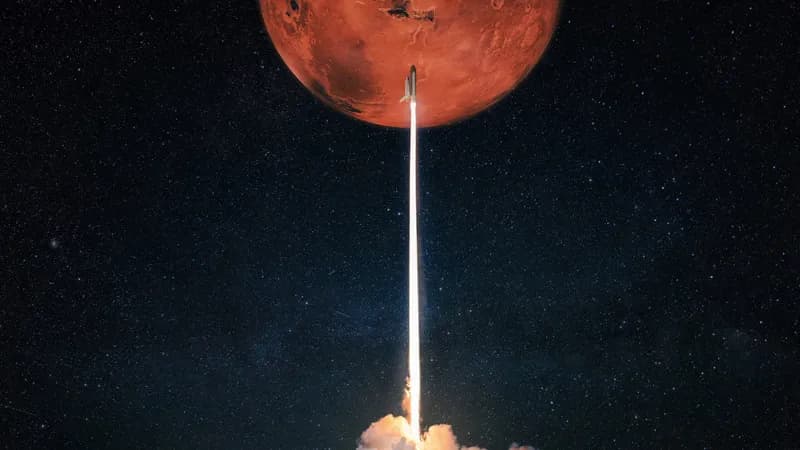
What if the biggest breakthrough in Mars exploration didn't come from a billion-dollar research initiative or a team of hundreds working for decades — but from a single scientist who wasn't even looking for it? That's exactly what happened in one of the most surprising space travel discoveries in recent memory. A researcher studying orbital mechanics stumbled upon a potential shortcut to Mars travel time that could, in theory, cut the journey from roughly nine months down to just four or five. If you've ever wondered whether we'll see humans on Mars in our lifetime, this discovery just made that possibility a whole lot more real.
The scientist's own words say it best: "I was not looking for this." That kind of accidental genius has a long history in science — from penicillin to the microwave oven — but rarely does it show up in the cold, mathematical world of astrodynamics. Let's break down what was found, why it matters, and what it could mean for the future of human spaceflight.
To understand why this Mars travel discovery is such a big deal, you first need to appreciate just how painfully slow the trip to Mars currently is. Under the best circumstances — using what's called a Hohmann transfer orbit — a spacecraft takes about 6 to 9 months to reach Mars. That's not just inconvenient. It's genuinely dangerous. Astronauts would be exposed to cosmic radiation, muscle atrophy, bone density loss, and the psychological toll of isolation for the better part of a year, just to get there.
The new discovery involves a class of trajectories known as low-energy transfer paths, sometimes connected to what mathematicians call the "Interplanetary Transport Network" (ITN). These are essentially gravitational highways that exist between planets, shaped by the combined pull of the Sun, Earth, Mars, and other bodies in the solar system. Scientists have known these paths exist in a general sense, but plotting practical, human-viable routes using them has been elusive — until now.
The researcher involved was reportedly running computational models on a completely different problem — optimizing fuel efficiency for satellite positioning around Earth — when the algorithm spat out something unexpected. The numbers pointed to a resonant orbital path that, when extended outward, aligned almost perfectly with Mars's position during certain launch windows. It wasn't supposed to be there. But there it was.
After verifying the results multiple times and consulting with colleagues, the team confirmed they'd identified a previously unmapped gravitational corridor that could serve as a faster Mars mission route. The phrase "I was not looking for this" apparently came directly from the lead researcher's notes, and it's become something of a motto for the discovery.
Okay, let's get into the mechanics — don't worry, we'll keep it digestible. Traditional Mars missions use what are called Hohmann transfers: you launch when Earth and Mars are in a specific alignment, you fire your engines to escape Earth's gravity, and then you coast along an elliptical arc until you reach Mars's orbit. It's fuel-efficient, but it's slow, and you're at the mercy of those launch windows, which only open every 26 months.
The newly identified shortcut works differently. Rather than fighting against gravitational forces or simply coasting through them, the route threads through a series of gravitational "pinch points" created by the Sun and planets acting in concert. Think of it like a river current: instead of rowing straight across, you find the current and let it help carry you diagonally to the other bank, faster and with less effort.
Part of what makes this route viable is a specific chain of gravitational assists — essentially slingshot maneuvers — that a spacecraft could use in sequence. We've seen single gravitational assists before; the Voyager probes used Jupiter's gravity to gain speed and fling themselves toward the outer solar system. But a chained series of precisely timed assists, leveraging smaller bodies and Lagrange points along the way, is a far more complex proposition. The new algorithm reportedly identifies windows where this chain becomes not just possible, but actually practical for crewed spacecraft.
Here's where things get really interesting — and really hopeful. Early analysis suggests the route doesn't necessarily require exotic propulsion systems like nuclear thermal drives or ion engines, though those would certainly help. In theory, a spacecraft using conventional chemical propulsion (the kind we already have) could take advantage of this trajectory, provided it launched during the correct window. That said, more advanced propulsion would make the shortcut even more dramatic, potentially pushing the travel time down further still.
You might be thinking: scientists have been talking about faster Mars travel for years, so what makes this different? Fair question. The honest answer is that most previous "breakthroughs" were either theoretical dead ends, required propulsion technology we don't have yet, or saved only a few weeks at best. A discovery that could genuinely slash Mars travel time in half — from 6-9 months down to 3-5 months — is in a completely different league.
Consider the implications:
Unsurprisingly, the response from the broader scientific community has been a mixture of excitement and healthy skepticism — which is exactly how science is supposed to work. Several astrodynamics researchers who've reviewed preliminary findings have called the discovery "genuinely surprising" and "worth serious investigation." Others have pointed out that computational models don't always survive contact with real-world orbital mechanics, and that significant validation work remains.
NASA and the European Space Agency have both reportedly been briefed on the findings. Neither has made an official public statement confirming they're actively pursuing the route, but sources suggest internal working groups have been formed to assess feasibility. Private space companies, including those with explicit Mars ambitions, are also said to be paying close attention.
For this to move from exciting paper to actual mission planning, several steps need to happen. First, independent verification — other teams need to run the same calculations and confirm the corridor exists and is stable. Second, simulation-based mission planning to model how a real spacecraft would handle the trajectory, including fuel loads, communication delays, and contingency maneuvers. Third, and perhaps most critically, the research needs to survive peer review and be published in a major journal where the entire global scientific community can scrutinize it.
None of that is a quick process. But given the magnitude of the potential payoff, there's strong motivation to move fast.
It's worth stepping back and appreciating what this moment represents for space travel innovation more broadly. We're living through a genuinely remarkable era of space exploration. Launch costs have dropped dramatically thanks to reusable rockets. Life support technology is getting better every year. And now, potentially, the fundamental route we take to reach our nearest planetary neighbor might be about to get a serious upgrade.
The history of exploration on Earth is filled with stories of shortcuts that changed everything — the discovery of ocean currents, mountain passes, trade winds. Space has its own version of those paths, woven into the fabric of orbital mechanics, and we're only just beginning to map them. The fact that a scientist accidentally finds a shortcut to Mars that cuts travel time in half while working on something else entirely? That's not just a good science story. It's a reminder that curiosity, computation, and a willingness to follow unexpected data can unlock doors we didn't even know existed.
Elon Musk has talked about sending humans to Mars by the late 2020s. NASA's official plans target the 2030s. China has its own ambitious Mars program. All of these timelines are constrained, in part, by the sheer danger and difficulty of that long journey through deep space. A route that meaningfully reduces travel time doesn't just make the mission more comfortable — it could be the difference between a mission that's feasible and one that isn't.
Think about it from a risk management perspective. The longer a crew is in transit, the more things can go wrong: equipment failures, medical emergencies, psychological breakdowns. Every day you shave off the journey is a day less of exposure to those risks. If this new Mars route discovery holds up under scrutiny, it won't just accelerate the timeline — it could fundamentally change the safety calculus for sending humans to the Red Planet.
And beyond Mars, the principles underlying this discovery might apply to other destinations too. If gravitational corridors of this kind exist between Earth and Mars, similar structures likely exist throughout the solar system, potentially offering new routes to the asteroid belt, the moons of Jupiter, and beyond. One accidental discovery could be the first thread pulled on a much larger tapestry.
Under the best current conditions, using a standard Hohmann transfer orbit, a spacecraft takes approximately 6 to 9 months to reach Mars. The exact time varies depending on the positions of Earth and Mars in their respective orbits, which change over time. Launch windows only open roughly every 26 months when the planets are favorably aligned.
Early analysis of the newly discovered trajectory suggests it could cut the travel time roughly in half, potentially bringing the journey down to somewhere in the range of 3 to 5 months. However, this is still in the early stages of verification. The actual time savings would depend on the specific launch window, spacecraft propulsion capabilities, and final trajectory refinements.
Interestingly, preliminary findings suggest that existing chemical propulsion systems could potentially take advantage of the new route, particularly if a spacecraft launched during precisely the right window. That said, more advanced propulsion technologies — such as nuclear thermal propulsion or high-efficiency ion drives — would enhance the benefits further and could push travel times down even more dramatically.
As of now, neither NASA nor any major space agency has made an official public confirmation of the discovery or announced plans to use it. However, reports indicate that internal teams at several agencies have been briefed and are actively assessing the findings. The research still needs to go through formal peer review before it can be considered scientifically validated.
The specific identity of the lead researcher hasn't been broadly disclosed pending formal peer-reviewed publication of the findings. What's known is that the discovery was made accidentally during computational modeling work focused on a separate orbital mechanics problem, and the lead scientist's own description of the moment — "I was not looking for this" — has become the widely quoted summary of how the breakthrough came about.
Potentially, yes. The underlying principles involve gravitational corridors created by the combined gravitational influence of the Sun and planets, which are a feature of orbital dynamics throughout the solar system. If the Mars corridor is confirmed, researchers may look for similar low-energy transfer paths to other destinations, including the asteroid belt, outer planet moons, and even interplanetary staging points for deeper space exploration.
That depends on several factors: how quickly the discovery is validated, whether mission planners can design a feasible spacecraft profile around the trajectory, and the overall readiness of crewed Mars missions in general. If the discovery holds up and gains traction, it could realistically influence mission planning for programs targeting the 2030s — potentially making those missions safer and more viable than they would otherwise be.
Science has a funny way of surprising us. The biggest leaps forward often don't come from the projects specifically designed to achieve them — they come from curious minds following unexpected data wherever it leads. The potential shortcut to Mars travel time discovered by a researcher who was, by their own admission, looking for something else entirely, is a perfect example of that phenomenon.
Whether this discovery ultimately makes it through the rigorous validation process and shapes future Mars missions remains to be seen. Science is a process, not a press release, and the hard work of verification, peer review, and real-world testing lies ahead. But the early signs are genuinely exciting. A new Mars route discovery that could slash space travel time in half wouldn't just be a technical achievement — it would be a turning point in the human story of reaching for other worlds.
Keep watching the science on this one. If it holds up, it might just be the breakthrough that finally makes the dream of humans on Mars not just possible, but imminent.