

/
/
Rajkummar Rao supports NEET protest as his deleted reply about the Modi Hai Toh Mumkin Hai song sparks debate over celebrity politics and public pressure.
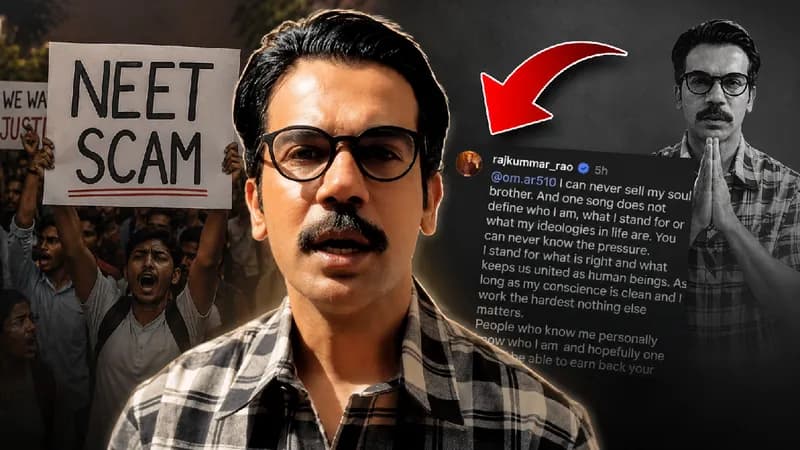
"When young people say they are not being heard, the conversation rarely stays limited to education." That's exactly what we saw play out online after Rajkummar Rao NEET Protest support set off a fierce political debate across social media platforms.
The National Award-winning actor stepped forward to show solidarity with students protesting alleged NEET-UG 2026 examination irregularities. He called for dialogue, peace, and a fair education system, and honestly, it seemed straightforward enough at first. But things got complicated fast when people started digging up his earlier appearance in the political promotional song "Modi Hai Toh Mumkin Hai", questioning whether his current stance was all that consistent with his past work.
And then there's the deleted Instagram reply, which has since become the loudest part of this whole story.
Rao's message wasn't combative. He kept it grounded, urging both students and authorities to sit down and talk rather than clash.
He wrote that young people deserve to be heard with dignity, fairness, and respect, and that violence from any side only pushes real solutions further out of reach. He also made a point of linking India's long-term growth to having a fair education system, asking authorities to show more empathy and asking protesters to participate responsibly.
What he notably didn't do was point fingers, at the government or at students. The statement was about compassion, conversation, and educational reform. Nothing more, nothing less. At least, that was the intention.
Rajkumar Rao busted how he was pressurrized & paid to do,
Modi-Modi pic.twitter.com/KBUaTVvy1i— Gss🇮🇳 (@Gss_Views) July 22, 2026
The moment Rao posted his support, people started showing up in the comments with receipts. Specifically, they brought up the Rajkummar Rao Modi Hai Toh Mumkin Hai promotional video from 2025.
One Instagram user called him out directly, accusing him of promoting government messaging through that song while now publicly backing student protests.
Rao replied. And then he deleted it.
But screenshots travel fast. What circulated widely shows him writing:
"I can never sell my soul... One song does not define who I am, what I stand for or what my ideologies in life are. You can never know the pressure."
He also reportedly said he hoped critics would one day "earn back your respect", a line that raised its own set of eyebrows.
The Rajkummar Rao deleted comment is now everywhere, and Rao hasn't publicly explained what he meant by "pressure." No follow-up statement, no clarification, just silence.
Predictably, that deleted reply split people right down the middle.
His supporters make a reasonable point, actors work under professional obligations all the time, and one project shouldn't be treated as a life manifesto. People are more complex than their filmographies.
But critics aren't letting it go that easily. Their main gripe is the timing: why address the Rajkummar Rao deleted comment issue only after publicly backing student protesters? The optics, they argue, look like damage control.
Several news organizations have picked up the story. Some have also flagged that the viral screenshot itself hasn't been independently verified beyond its sheer spread online. Rao has neither confirmed the comment nor denied it, which hasn't exactly helped cool things down.
Rao isn't alone in speaking up. Bollywood student protest support has been building steadily, with a long list of film personalities joining the chorus around the NEET paper leak protest.
Names like Salman Khan, Naseeruddin Shah, Shabana Azmi, Prakash Raj, Sonu Sood, Dia Mirza, Vir Das, Soha Ali Khan, Bhumi Pednekar, and Huma Qureshi have either shown up at protest sites or put out public statements standing with students.
The common thread across most of these voices: keep it peaceful, demand transparency, and hold authorities accountable for examination irregularities.
The demonstrations at Delhi's Jantar Mantar continue to centre on some very specific, unchanged demands:
Student groups have been clear, the nationwide attention hasn't shifted their goals. They want answers, not applause.
Here's the thing, Rao's original post was about education and peaceful dialogue. That was it. But the Rajkummar Rao deleted comment pulled the entire conversation into something far bigger: a debate about celebrity endorsements, political messaging, and whether the professional choices public figures make can ever be truly separated from who they are as people.
Without any further word from the actor, the word "pressure" in that deleted comment is doing a lot of heavy lifting. What did he mean? Contractual pressure? Social pressure? Industry pressure? Nobody really knows, and he hasn't elaborated.
For now, the online debate carries on, while the students at the heart of this movement keep their eyes on what actually matters, examination reforms and real accountability.
One thing this whole episode makes crystal clear: public figures today are held to a level of scrutiny that connects every past decision to every current statement. There's no escaping the timeline anymore.









