CJI Surya Kant’s ‘Cockroach’ Remarks Trigger Bigger Debate on Judicial Speech and Institutional Limits
CJI Surya Kant’s “cockroaches” remark has reignited debate over judicial restraint, oral observations and institutional credibility in India.


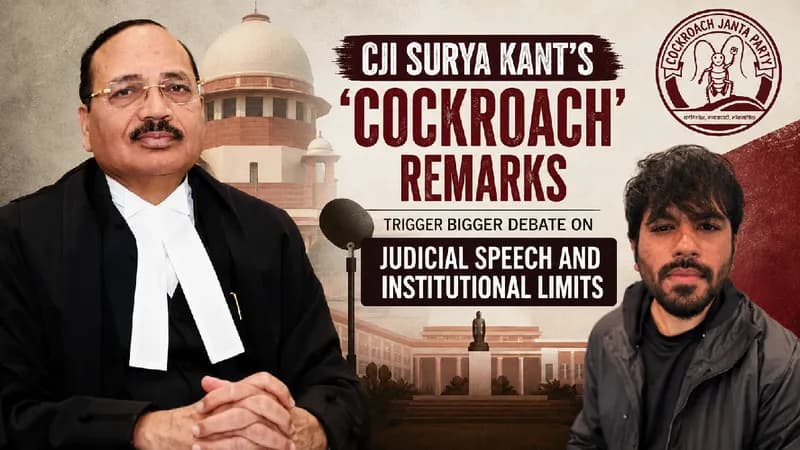
The controversy around the CJI Surya Kant’s “cockroaches” remark is no longer just about one courtroom exchange. What began as a sharp oral observation during a hearing has now opened a much deeper debate about how judges speak, how courts are perceived, and whether institutional authority can afford careless language in the age of viral media.
During a hearing related to senior advocate designations on May 15, Chief Justice Surya Kant reportedly described some individuals as “cockroaches” and “parasites of society.” The comments quickly spread across television debates, legal circles and social media platforms, triggering criticism from lawyers, activists and young internet users.
A day later, the Chief Justice clarified that his criticism was directed only at individuals entering professions using fake degrees and not at unemployed youth in general. But by then, the damage had already moved beyond clarification. The remarks had become part of a wider conversation about judicial restraint and institutional accountability.
Why the Remarks Became So Controversial
Courtrooms are not silent spaces. Judges routinely ask difficult, provocative and even uncomfortable questions during hearings. Many of these observations never become part of final judgments. But in today’s media environment, oral remarks often travel faster than written orders.
That is exactly what happened here.
Critics argued that words like “cockroaches” and “parasites” crossed the line from judicial questioning into language that appeared dehumanising. Supporters of the Chief Justice, meanwhile, pointed to the clarification and argued that oral exchanges in court are frequently misunderstood when taken out of context.
The issue, however, is larger than one clarification. Legal experts say the controversy highlights an old constitutional tension: judges need freedom to test arguments in court, but they are also expected to maintain restraint because every word from the Bench carries institutional weight.
The Supreme Court Has Faced This Question Before
India’s judiciary has actually dealt with this issue before. The most important reference point is the 2021 judgment in Chief Election Commissioner vs M.R. Vijayabhaskar.
That case emerged during the second wave of COVID-19 when the Election Commission of India objected to harsh oral observations made by the Madras High Court over political rallies during elections.
A Bench led by former Chief Justice D. Y. Chandrachud refused to stop the media from reporting oral observations. But the judgment also made an important distinction: the official opinion of a court exists in written judgments and orders, not in spontaneous oral remarks made during hearings.
At the same time, the Supreme Court warned judges against using “scathing” or unnecessarily harsh language directed at individuals or institutions.
That balance is now back at the centre of public debate.
Judicial Oral Remarks Are Meant to Test Arguments
One reason courts allow wide-ranging oral exchanges is because judges often test legal arguments aggressively before reaching conclusions.
One well-known example came up during the 2023 same-sex marriage hearings in Supriyo vs Union of India. At the time, the judges’ comments in court made it seem like they were open to broader recognition of gender identity and same-sex relationships. Yet the final judgment took a more restrained legal position.
This is why lawyers repeatedly stress that courtroom observations should not automatically be treated as judicial conclusions.
Still, experts point out that there is a difference between sharp questioning and language that appears insulting or dismissive.
That distinction is now being discussed across legal and political circles after the recent Supreme Court oral observations controversy.
Social Media Turned a Courtroom Moment Into a Political Flashpoint
What makes this episode different from older controversies is the speed of digital reaction.
Within hours, clips and interpretations of the remarks spread across platforms like Instagram and X. The outrage also fuelled the rise of the satirical “Cockroach Janta Party,” a meme-driven online movement that tapped into youth frustration over unemployment, institutional disconnect and political language.
The online campaign exploded in popularity and even overtook the Instagram following of the Bharatiya Janata Party within days, according to social media tracking reports.
That sudden viral backlash showed how quickly courtroom remarks can escape legal boundaries and enter mainstream political culture.
For many younger users online, the controversy was not only about judicial speech. It became symbolic of a broader frustration with institutions perceived as disconnected from economic realities facing India’s youth.
The Debate Over Judicial Restraint in India Is Growing
The latest controversy has revived discussion around the 1997 Restatement of Values of Judicial Life, a code adopted by the Supreme Court that asks judges to avoid public controversy and maintain institutional dignity.
Legal scholars argue that public trust is the judiciary’s strongest source of authority. Unlike elected governments, courts depend heavily on credibility and moral legitimacy.
That is why even oral observations matter.
In earlier decades, many courtroom exchanges stayed confined within legal circles. Today, every remark can become a headline within minutes. Judges are no longer speaking only to lawyers inside a courtroom. They are effectively speaking to a national audience watching in real time.
That shift has fundamentally changed the pressure around judicial communication.
The Real Question Goes Beyond One Remark
The debate now is not simply whether the Chief Justice’s words were misinterpreted or taken out of context. The larger issue is whether India’s courts need a more modern understanding of public communication in the social media era.
The judiciary still insists that oral observations are distinct from final rulings. Constitutionally, that distinction remains valid. But politically and socially, the gap between the two is shrinking fast.
And that may be the real institutional challenge exposed by the CJI Surya Kant controversy.
In an age where a single courtroom sentence can dominate national discourse before a judgment is even written, judicial restraint is no longer just about legal ethics. It has become central to how public trust in institutions survives the digital era.