/
/
A US journalist’s account of an uncomfortable flight experience has sparked a debate online over airline seating, passenger comfort and how cabin crew should respond when one traveller’s size allegedly affects another passenger’s personal space.
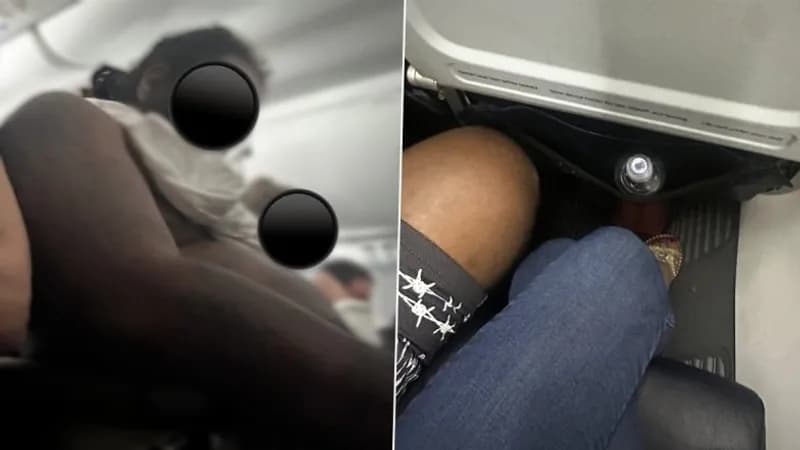
A US journalist’s account of an uncomfortable flight experience has sparked a debate online over airline seating, passenger comfort and how cabin crew should respond when one traveller’s size allegedly affects another passenger’s personal space.
Journalist Breanna Morello claimed on X that a fellow passenger occupied part of her seat during an American Airlines flight, despite her having paid extra to upgrade her seat.
Morello alleged that the man, whom she described as weighing more than 300 pounds, repeatedly came into her personal space and touched her. She also claimed that he removed his shirt during the flight.
The allegations have attracted millions of views on social media. However, the incident and the specific claims made in the post have not been independently verified.
According to Morello’s post, she had paid extra for a seat upgrade but found herself unable to sit comfortably because of the passenger next to her.
She claimed that part of the passenger’s body was occupying her seat and that he repeatedly touched her during the flight.
Morello wrote that she weighed approximately 120 pounds and contrasted her size with the passenger’s alleged weight of more than 300 pounds.
She also alleged that the passenger took off his shirt during the flight and that she detected what she described as the smell of marijuana.
These claims come solely from Morello’s account shared on X and have not been independently established.
Morello also criticised the response she said she received from the airline crew.
She claimed that she attempted to seek assistance discreetly but felt there was no practical way to contact flight attendants without drawing attention to the situation.
According to her account, she believed the crew was unwilling to confront the passenger.
The allegations have prompted some social-media users to question what procedures airlines should follow when a passenger’s size or behaviour affects an adjacent traveller.
There has been no independently verified account from American Airlines confirming the circumstances described by Morello.
Morello’s post circulated rapidly on X and reportedly accumulated more than 16 million views.
The discussion quickly expanded beyond the alleged incident itself. Many users focused on the passenger’s alleged behaviour, while others questioned whether airline staff should have intervened.
Some commenters specifically questioned why the passenger was allegedly shirtless inside the cabin.
Others tagged American Airlines and called for the airline to address the complaint.
Because the original account has not been independently verified, reactions online should not be treated as confirmation that every detail described in the post occurred as alleged.
The controversy has also revived a broader discussion about airline seating.
Modern commercial aircraft cabins can leave passengers with limited personal space, particularly when seats are occupied by passengers with significantly different body sizes.
Some users argued that passengers seated beside a larger traveller can have few practical options for moving elsewhere, especially on a full flight.
Others said the incident illustrates why airlines need clear policies for commercial aviation: passengers have to share confined spaces for hours, sometimes with little ability to change incident also demonstrates how quickly personal accounts posted on social media can become major online stories before airlines situations where a passenger cannot comfortably remain within their assigned seating area.
The debate also touches on questions around seat dimensions, personal boundaries and the responsibilities of airlines and passengers when problems arise during a flight.
No independent confirmation of Morello’s allegations was provided in the information available for this report.
The claims originated with Morello’s social-media post. There is no independently verified evidence establishing the passenger’s exact weight, whether he occupied part of her assigned seat, whether he touched her as alleged, or how American Airlines crew members responded.
Likewise, the reported presence of marijuana odor is an allegation and should not be treated as an established fact.
The viral nature of a social-media post does not by itself establish the accuracy of the claims it contains.
Regardless of the unverified details, the controversy highlights a recurring issue in commercial aviation: passengers have to share confined spaces for hours, sometimes with little ability to change seats.
When a traveller believes another passenger is encroaching on their assigned space or personal boundaries, approaching cabin crew is generally the most appropriate way to seek assistance.
The incident also demonstrates how quickly personal accounts posted on social media can become major online stories before airlines or other parties have publicly confirmed what happened.
For now, Morello’s account remains an unverified allegation, while the broader discussion over passenger space and airline policies continues.
Breanna Morello is a US journalist and commentator who shared an account of an alleged uncomfortable experience on an American Airlines flight on X.
Morello alleged that a fellow passenger occupied part of her seat, repeatedly touched her and removed his shirt during the flight. She also claimed that the passenger smelled of marijuana.
There is no independent confirmation in the information available for this report establishing the allegations made in Morello’s viral post.
The post reportedly received more than 16 million views on X.
The post triggered debate about passenger behaviour, personal space, airline seating arrangements and whether cabin crew should intervene when one passenger is allegedly unable to use their assigned seat comfortably.
No. The passenger’s reported weight of more than 300 pounds comes from Morello’s account and has not been independently verified.