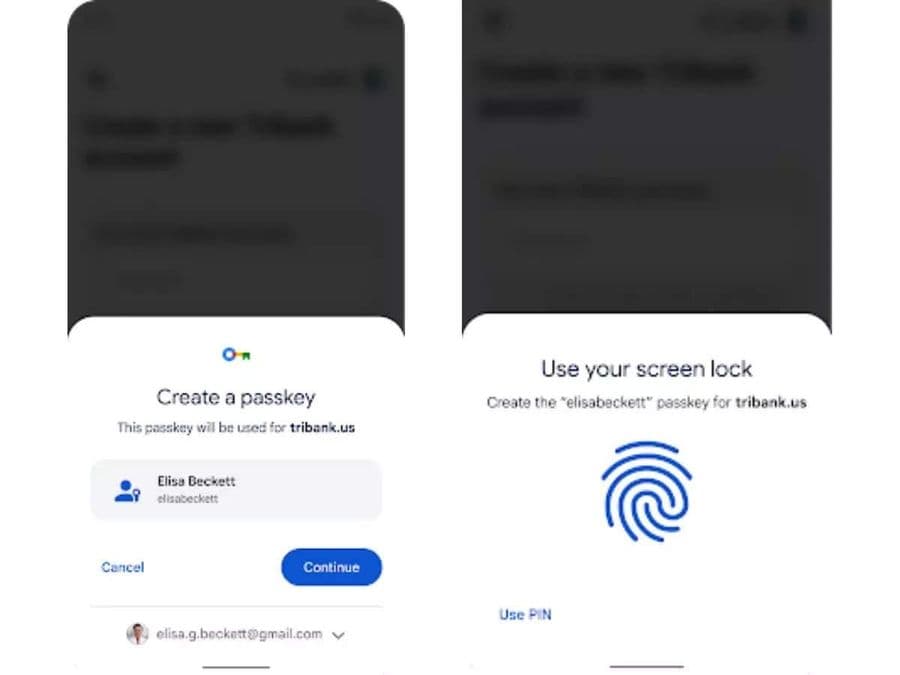
Could passwords eventually become obsolete? Yes, if Google gets its way. Google stated in May 2023 that passkeys could now be used to access your Google account.
It offers a degree of security that even two-factor authentication (2FA) cannot equal. Will other apps and services use the technique if Google does? So let's hope.
How to Configure a Passkey for Your Google Account and Use It?
Credit:google
Setting up your Google account to use passkeys is simple. All you have to do is sign in first.
On your Android device, launch your favorite web browser.
In order to validate that you are attempting to log into your Google account, press Yes when prompted.
Missing a Specific Android Device
Pay close attention to how passkeys have previously been set up on the Android devices that are connected to your Google account. Missing a device? Here's a method for finding out what's happening.
Under Automatically generated passkeys, select Manage devices.
Look for the header for X sessions on Android device(s).
For a list of all the Android devices, you've used to log in with your Google account, scroll down.
Locate your device in the list; a "yellow alert" icon may be there.
As you can see, some of my devices were missing. Most likely because they haven't done anything for over a hundred days. Find the device, then log in one more.
Create and Utilise Passkeys
Let's now configure and utilise our Google passkey. then go back to the Passkeys page:
Select Use passkeys.
Choose Continue (or Use another device to set up a passkey on another device) from the Create a passkey for your Google account screen.
Read the message that says You can now sign in with your passkeys by tapping Done.
Now log into a different device using your Google account. I used my Windows computer to log into my Google account for this test. When you first log into your Google account using a passkey, keep in mind that you only need to go through this process once.
Choose Continue after selecting
Use your passkey to ensure it's truly you.
Choose Display a QR code on a phone or tablet.
Your Android device's Camera app should be opened.
The QR code on the screen of the device you want to connect to should be pointed at with the camera.
Select Use Passkey.
Then tap Allow once more.
To sign in to your Google account on a different device, use the biometric information from your device, such as your fingerprint.
OPPO’s November ColorOS 17 rollout brings new photo, camera and productivity tools to nine phones, while more Reno, Find, K and F models await the OS upgrade.
Jio Happy New Year 2.0 brings unlimited 4G and 5G data on ₹399 and ₹3,999 plans, plus Canva, OTT perks and new ₹15, ₹25 and ₹50 data add-ons for users.
People who use WhatsApp, Telegram and other messaging apps without keeping their registered SIM card in their phone may need to reconsider how they access these services.
Oppo K14 Plus Price Hike: Oppo has increased the prices of all three RAM and storage variants of the Oppo K14 Plus in India. The mid-range smartphone, which was launched at the end of September, is now more expensive by ₹3,000 to ₹5,000, depending on the configuration.
Tesla has finally unveiled its long-delayed second-generation Roadster, and the launch came with one of the most theatrical product demos in recent car history. At an event at SpaceX’s test facility in McGregor, Texas, on Thursday night, October 15, the car drove up a curved ramp until it was upside down, used thrusters to flip and hover, and landed safely.
WhatsApp is rolling out a guest calling feature that allows people to join voice and video calls without creating a WhatsApp account or installing the messaging app on their devices.